
The military history of Nova Scotia and of Kings County in particular, is of special interest to a British Columbia collector and there’s a reason why. Vincent Merritt was born in Kings County and has family connections in Port Williams. The bluenose connection probably explains why he collects Nova Scotia and especially Kings County military artifacts; a hobby, by the way, that includes the collecting of this area’s little known, often forgotten military history.
Merritt and I correspond occasionally via e-mail and he often shares his historical discoveries with me. It was Merritt, for example, who told me about the Wolfville connection with a truly unique World War 2 military award, the Gibraltar Key.*
Recently Merritt wrote to ask if I had ever written about the Fenian Raids and how they affected Kings County. There were five Fenian raids of note beginning in 1866, which basically were attacks on British targets in Canada by Americans who sympathized with Irish rebels. While Nova Scotia was never directly attacked, the military was put on full alert across the province and militia units in various counties were called out to stand ready.
In his Kings County history, Arthur W. H. Eaton refers to the militia alert, noting that the size of this force had been increased (circa 1867) “due largely to the Trent affair, and probably the Fenian troubles.” It is these militia members and particularly the medals they were awarded during the “Fenian troubles” that are of interest to Merritt.
In recent correspondence Merritt said that citizens called out during the Fenian scare received a “bounty” for service, usually a land grant. Besides the bounty, anyone who saw military service was awarded a special medal by the government, the Canada General Services Medal. The medal carries Queen Victoria’s profile and the words, “Fenian Raid 1866.”
One such medal, which Merritt recently added to his collection, was awarded to one Richmond Wood for service in the Kings County militia. On the rim of the medal are the words, Richmond Wood, Kings N.S. Regt.” Wood is likely a local boy and if he happens to be a relative of anyone reading this, I’d like to hear from you.
The records are out there of other Kings County men who were called up during the Fenian scare. Vincent Merritt sent me a partial list of some of the Kings County militiamen who received the bounty and the medal and there are many more waiting to be discovered. Here’s the list:
Nathan Best, Foster Parrish, Waterville; John Caldwell, Benjamin W. Johnson, Cambridge; Charles E. Dodge, George W. Eaton, W. Wentworth Ellis, Stanley A. Fisher, John Hall, Solomon Lawrence, Charles E. Sanford, Albert Skinner, Berwick; Daniel B. Parker, Harbourville; James W. Lawrence, Hantsport; Albert Ogilvie, Victoria Harbour.
If you recognize any of these militiamen as your ancestor please let me know what became of them and how they were awarded for service.
*Two columns on the history of the Gibraltar Key were published in this paper in 1999 (column 1 and column 2).
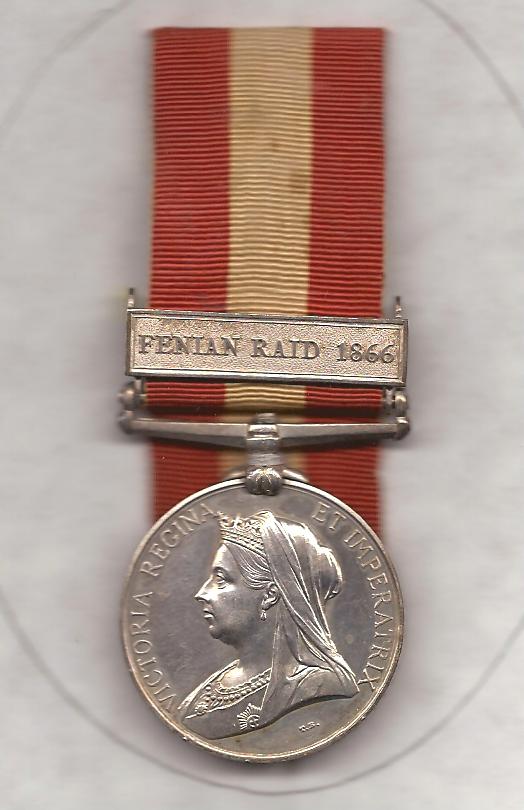
This Fenian raid medal of 1866, presented to Kings County militia callout Richmond Wood, is in Vincent Merritt’s collection.
 Ed Coleman