
WIDE AWAKE MERCHANTS – KENTVILLE STORES IN 1898 (September 19/11)

“The commodious dry goods establishment known as Whitehall is one of the oldest in Kentville, Mr. Ryan having been in business sine 1868 …. Mr. Ryan is an ex-mayor of the town and still finds time for public as well as business duties.”

It’s a few years after Kentville incorporated and the town is thriving. Kentville is doing so well by 1898 that The Herald, a Halifax daily, devoted an entire page in its June 8 edition to the town’s merchants. The above, one of over 30 businesses profiled on the page, refers to J. W. Ryan, one of Kentville’s prominent citizens through the latter part of the 19th century. Ryan served as the town’s mayor in 1894-1895 and in 1913-1914.

I came across a copy of The Herald page in the archives of the Kings County Museum recently and what caught my eye was a bold five column heading – “Kentville’s Wide Awake Merchants” – followed by a sub heading, “the “enterprising firms who make a reputation for Kings County.”

Reading on, I found a series of profiles, much of it historical, on various Kentville retail and manufacturing businesses. Except for one or two business that survived until recent times, most of the firms profiled in The Herald page are long gone and forgotten. One of the exceptions is the firm of T. P Calkin, which was established in 1847 and in 1898 had been in business for over a half century.

The historical information in the profiles should be of interest locally since Kentville has an incorporation anniversary this year. Some of the retail firms profiled were established in Kentville many years before incorporation and as the Herald indicated, contributed to the town becoming the business and shopping center of Kings County. One of the firms, the N.S. Carriage Co., became a pioneer in the automotive field when it built the McKay car in Kentville. T. P. Calkin, became a province wide leader in the hardware business. One of its original partners, W. Wylie Rockwell, later left the firm and established Rockwell Limited which still bears his name.

Another of the firms that remained in business until recent times and is mentioned by the Herald is Ross’ Bookstore. I’m not sure when this store closed but it was in business on Webster Street late in the 1950s. When it was profiled in The Herald the store had been operating for 20 years.

Also profiled by The Herald, and like T. P. Calkin, Rockwell Limited and Ross’ Bookstore, in business late in the 20th century, was the grocery firm of DeWolfe and Demont. This store, in business for decades when the Herald profiled it, will be remembered by senior citizens today as the Red Store.

Some of the “long gone and forgotten” stores in business in 1895 were a few I never heard of before discovering the Herald page. Among them were Leo Grindon & Co., The Boston Millinery Store, A. C. Moore, W. I. Grono, Dodge & Sealy and Dodge & Dennison Co. Ltd.
EARLY FARM DAYS IN WHITE ROCK (September 12/11)

“I have always been thankful my life span came when it did,” writes Gordon Young, a White Rock farmer who just celebrated his 90th birthday. “Half of my life was with horsepower, the other half with tractor power. We did not realize the dramatic change taking place as it happened over a period of time.”

Young made these observations in a series of stories he’s been writing about his early days in a farm community. As you’ll see from reading this extract from his tales, the changes in farming and farm life in the past half century have indeed been dramatic.

“Before mechanization everything moved at a slower pace. Farmers and neighbors helped each other and socialized; communities had their own schools, and the children were all well acquainted with other children in the community. I guess over the years I have slept in bout one third of the houses in White Rock while visiting my schoolmates. The hall was also a busy spot with Christmas concerts, bean suppers, entertainment shows and the Sons of Temperance, which met weekly.

In those days the young people used to have coasting parties on the mountain at night in the moonlight. We had two ponds that had cabins where we used to skate at night with a bonfire in the middle. Late in my teens (in the 1930s) White Rock had its own skating rink, complete with electric lights and a big cabin. The rink was enclosed, with a board fence and accommodations for spectators to watch the skating parties and hockey games. The rink was where Longs mill now stands.

“Older people used to spend a lot of time visiting. Nobody waited for an invitation (and) everyone was glad to have you come. The women of the community had their community club that met at a different home for each meeting. Often, on a Sunday evening, we would enjoy a hymn sing with music at someone’s home. If we went to help a neighbor, we could plan on a roast beef or corned beef and cabbage dinner.

“All that changed when mechanization came along. The older farmers had no choice but to give up. The younger farmers had to really love their job to stay with it. To stay on the farm you had to mechanize to compete. It did not mean just buying a new tractor. You had to have the equipment to match the tractor. To pay for it all you had to increase production. This meant you had to have more land to keep your equipment busy, more and larger buildings to keep your livestock and equipment.

“Finally, when you had everything where you wanted it, the new tractors came out. They were twice as big with new machinery to match. If you were going to stay in farming, you had to trade and get bigger in order to compete.

“In the end, those who stuck with it found they were the only ones in their community that were farming. These farmers were producing more than all the farmers (in the community) once produced. In the past, if a farmer went to a neighbor to work, he would not think twice about stopping for a hot dinner. Now there is no way you could let two hundred thousand dollars worth of equipments sit idle.

“Mechanization was intended to help farmers; instead it put 70 percent out of business. The rest had a 50 percent chance of succeeding or going bankrupt.”

Young concluded his story on farm life with observations on changes in the environment:

“Fifty years ago, on our way to the woods, we would usually see a fox or two, rabbits running across the road or a partridge flying from the wild apple trees. In the woods there were tracks everywhere. Deer would come late in the day and at night to browse off the tops of the hardwood trees that had been cut. It was a noisy spot with the chatter of squirrels and songbirds everywhere. Today the silence in the woods is deafening. You could walk a mile and not see a track.”

THE ABERDEEN – A GRAND OLD KENTVILLE HOTEL (September 5/11)

When Judge of Probate Edmund J. Cogswell wrote about Kentville in 1895, he mentioned the town’s seven hotels. Foremost among them, he said, was the Royal Oak and the Kentville Hotel, the former according to Cogswell being the better of the two.

Much later, in 1932, Leslie Eugene Dennison reminisced in The Advertiser about Kentville, covering the same period Cogswell wrote about. Dennison recalled the town having only five hotels or inns and he doesn’t mention the Royal Oak.

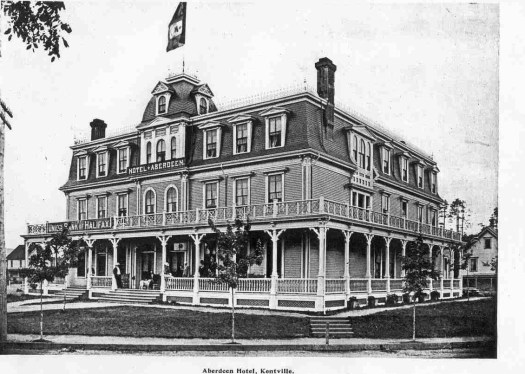
Surprisingly, Cogswell and Dennison fail to mention what for a time was the grandest hotel in Kentville and certainly in the Annapolis Valley. This was the Hotel Aberdeen which for about 40 years beginning in 1892 was the leading hostelry and social center. Before being torn down and replaced by an even more magnificent hotel in 1930, the Aberdeen stood in a prominent place near the railroad station. Kentville’s dominant position as the railway’s headquarters likely influenced the decision to place the Aberdeen there.

Among the numerous A. L. Hardy photographs of the Aberdeen that have survived is one reproduced many times in The Advertiser and in various historical publications. You’ll find it in Louis Comeau’s pictorial history of Kentville, for example.

Oddly, photographs and brief write-ups are the only record you’ll find on the Aberdeen despite its once prominent position in Kentville. How many rooms did the Aberdeen have in its three stories? What about its ambience, its dining room, its bar room? What conveniences did it offer besides the Union Bank and the fact that it was conveniently located close to the railway station? What did it cost to stay there overnight?

Search as I have, I’ve been unable to find answers to these questions. I can tell you the year the Aberdeen was built (1892) who built it (Daniel McLeod) when the railway purchased it and changed the name to the Cornwallis Inn (1920) and when the railway tore it down and built a larger, grander Cornwallis Inn across the other side of town (1930).

Other than these facts (that anyone can discover with a few minutes of research) I have no other information on the Aberdeen. Mabel Nichols Kentville history, The Devil’s Half Acre, contains a short history of the Aberdeen and from the researching I’ve done, this is the only written record currently available.

Aberdeen Hotel, Kentville, NS

This photograph of Hotel Aberdeen likely was taken during or after 1894 since the Union Bank of Halifax opened there in that year.