On the screen is a slide with photographs of a padlock that has seen much better days.
“This padlock was found at the railway roundhouse in Kentville,” Kelly Bourassa said. “As you can see, the photograph on the left shows a heavy layer of rust, sand and soil. The photograph on the right shows the same face with all this material removed.”
At the monthly meeting of the Kentville Historical Society, Bourassa was using slides to illustrate how conservators work to restore and preserve artifacts that otherwise might have been lost. The lock was one of some 40 items dug up at the roundhouse site in Kentville when it was torn down in 2007.
“Once the lock was cleaned, we could see CPR initials,” Bourassa said. “This helped to date the lock since we know that the Dominion Atlantic Railway was taken over by the Canadian Pacific in 1917.”
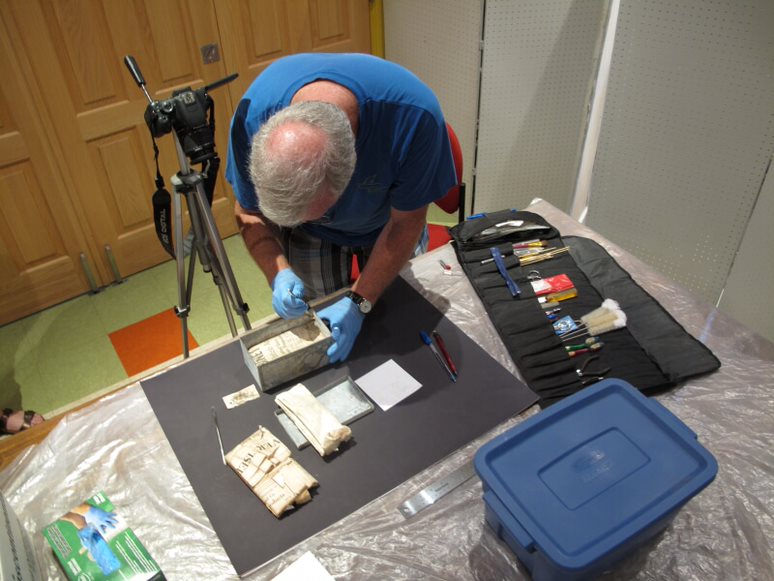
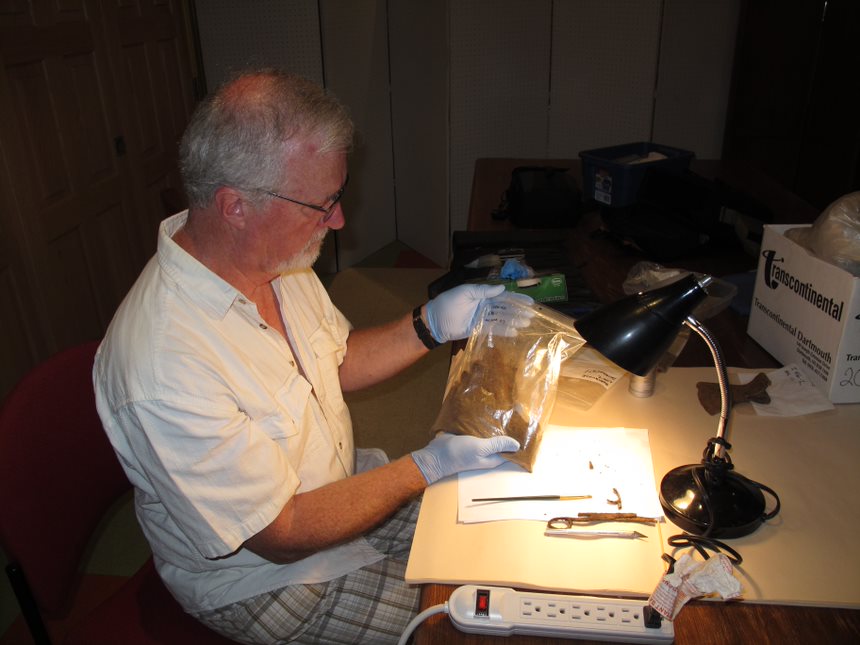
Using before and after photographs of the padlock and various other slides, Bourassa described his role as a conservator in the preservation of historical objects. Conservators, he said, act in partnership with collectors and custodians of historical objects “to ensure they are cared for and available for… future research.” Typically, conservators focus on artifacts that have been buried in the ground or come from shipwrecks, he said.
A graduate of the University of Saskatchewan with a Bachelor of Science degree in computer science, Bourassa has a diploma in the Conservation of Historical Objects from the University of Lincoln, UK, a degree he has put to good use as a volunteer at the Kings County Museum since retiring in Kentville in 2009.
Bourassa noted that in his role as a conservator in Kentville, he has worked on several collections of archaeological artifacts, not only at the Kings County Museum but at other museums and organizations as well, and he has participated in several archaeological digs. A blog he writes on these activities can be found on the Kings County Museum website. His specialty, Bourassa said, “is archaeological objects, particularly those that have been buried in the ground.”
One of the artifacts Bourassa discussed during his talk was a glass bottle, found at Prescott House in Port Williams. This was an excellent example of the work conservators can do with artifacts that have been damaged – while the slide showed an intact bottle it was actually in 18 pieces when Bourassa received it. Other artifacts Bourassa has worked on – an early 18th-century clay pipe from an Acadian site in New Brunswick, a section of chain from Oak Island, a halfpenny coin from the reign of King George 11, who ruled from 1727 to 1760, and a fragment of pottery with designs known to have been used between 1575 and 1775. These and other artifacts he worked on, along with some historical background, were discussed during his presentation.
At the conclusion of his presentation, Bourassa outlined various steps conservators take before attempting to restore and preserve artifacts. The examination and assessment of artifacts are the first and most vital steps, he said. These steps include preparing a detailed description of artifacts and determining if and how they should be treated.
There are also ethical issues, Bourassa said, noting that “there are plenty of examples where artifacts should not be cleaned.”
 Ed Coleman