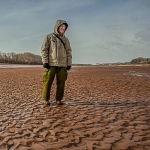
References to the Mi’kmaq fishing and hunting in earlier times on our rivers can be found in various historical documents. In this area, two of our largest rivers, the Avon and the Cornwallis, were recorded as major sources of fish, fowl, and game for the Mi’kmaq.
Both rivers also were tremendous sources of wild foods for the Acadians. Later settlers, the Planters and Loyalists, harvested fish and fowl on these rivers as well.
A major resource for fish, fowl, and game is only one characteristic the Avon River and the Cornwallis River have in common. Both are tidal, of course, and flow into the Minas Basin. As the crow flies, to use an old cliche, their estuaries are relatively close.
One difference between the rivers is their origin: the Cornwallis comes from brooks and boggy areas near Berwick and Aylesford (close to what is prime farmland) and is about 48 kilometres long. The Avon has its beginning in heavily wooded lake country. Of the two, the Avon River is the largest and the mightiest by far and has a watershed of 1,306 square kilometres.
At a time when at best there were trails and footpaths and no roads, the Avon and Cornwallis were major travel routes for the Mi’kmaq and Acadians, the equivalent perhaps of the old number one highway. Both rivers provided easy access to the clam beds and fishing waters in the Minas Basin.
Of the two rivers, the Avon has had more impact on development along the Minas Basin shoreline. The Cornwallis River has a few towns and villages near its banks, while the Avon has Falmouth and Windsor, the latter a major commercial and industrial centre long before anyone thought of opening a store in the quiet corner of Horton Township that became Kentville.
In fact, during the 19th century when Horton Corner/Kentville was an obscure village, Windsor was a bustling and prosperous mini-city with a major shipbuilding industry on the lower Avon. This industry was once the most productive shipyard in the Maritimes. One or two ships at most might have been built on the Cornwallis River, but even this is doubtful.
There was a gold strike on the west bank of the Avon River early in the 19th century, one of the first recorded in Nova Scotia. The strike was reported by Henry How, a Kings College professor. In 1868 How wrote that “sixty years ago gold was washed from the Avon River at Windsor.” Nothing even close to any kind of strike, gold or whatever, has occurred on the Cornwallis River.
Looking at the Mi’kmaq presence on the rivers, we find that the Avon, at its mouth, once held a large village, which was likely a seasonal place, a summer fishing grounds mostly deserted in the winter. The Cornwallis River’s upper meadows, immediately above Kentville, had spring and summer fishing by the Mi’kmaq for salmon, smelt and shad but there’s no evidence of seasonal camps.
On the Acadians, it appears the Cornwallis River wasn’t of much importance to them, except perhaps as a way to reach the Minas Basin. Historians say that near the river, in New Minas, there were a few Acadian homesteads and perhaps one or two in Kentville. There’s no evidence of much dyking on the Cornwallis River, in Kentville or New Minas, the Acadians concentrating instead on the Canard River.
On the Avon River, however, the Mi’kmaq camp at its mouth became a major Acadian settlement. The Acadians called the settlement Pipiquit and Pegiquit which evolved into today’s Pisiquid.
Both rivers have been abused over time and they’re similar in that aspect. Both were noted for their salmon and brook trout fishing at one time. The Cornwallis River was also hailed for its brown trout fishing but pollution killed the entire fishery. Today the river is one of the most polluted streams in Atlantic Canada. A report on the Cornwallis River, dated 1991, noted that at one time the river “received waste from seven municipal sewage treatment plants, five fruit and vegetable canneries, one potato processing plant, a meat packing plant and two poultry processing plants.”
While the Avon River hasn’t been hit as hard as the Cornwallis by pollution, the Avon River Heritage Society notes that the causeway, built at its mouth in 1971, is “one of Canada’s biggest man-made disasters.” The river is the home of two endangered species, the Atlantic Salmon and the American Eel and the Friends of the Avon River (FAR) intimate that the causeway undoubtedly is a major factor in the decline of these fish.
There are conflicting dates for the construction of bridges on the Avon and Cornwallis. There may have been a bridge on the Cornwallis River, at Port Williams, as early as 1780, but this is questionable. The historian John V. Duncanson places the first bridge on the Avon River between 1768 and 1771, so the Avon was first in this aspect.
Both rivers had ferries plying their waters, possibly as early as the Acadian period. On the Avon River at Falmouth, a Planter grantee, James Wilson, operated a ferry around 1760. Folklore has it that before the Planters arrived in Kings County, the Acadians operated a ferry on the Cornwallis River between what is now Port Williams and Wolfville.
Since we have no firm date on when or if the Acadians used a ferry on the Cornwallis, we have to concede that honour to the Avon River. Throughout the Mi’kmaq, Acadian, and Planter periods the Avon River was the dominant stream. The Cornwallis River is number one only when it comes to its various names – by the Mi’kmaq as the Chijekwtook (with one variation in the spelling) under the French the Riviere St. Antoine and Riviere des Habitant, under the Planters as the Horton and the Cornwallis.
Historians give us three known names for the Avon (with various spellings) – Toouneook (Tooetunook) by the Mi’kmaq, Pipiquit and Pegiquit by the French, and Pesiquid and at least two other variations in the spelling by the Planters before they settled on the present name.
There have been half-hearted suggestions to rename the Cornwallis and the Avon, using either the old Mi’kmaq or the Acadian names for the rivers. A major problem here would be deciding which spelling to use.
 Ed Coleman