
Lloyd Smith’s role as a town crier began in Windsor in 1978 when he was with the CFAB radio station – a role he says began “accidentally” and not by his choice.
Smith was the manager and the on-air voice of CFAB when Windsor’s Sam Slick days were being organized. As a radio celebrity, he was a natural choice to play the role of Sam Slick. Then, in 1978, the provincial government attempted to re-introduce town crying by organizing an international competition.
“They’d hired a British crier to set it up,” Smith recalls. “At the last minute, town officials advised me that I was enrolled in the competition representing Windsor.”
Despite his total lack of experience – he had to ask what a town crier does – Smith went to the competition and figured he didn’t do badly at all. “Out of 13 criers I placed 12th,” he says, “so I wasn’t on the bottom.”
That was 45 years ago. Today, Smith has the honour of being the longest-serving crier in North America and is a long-time member of the Guild of Town Criers of the United Kingdom. Along the way, as well as acting as Windsor’s official crier, he’s volunteered with several Annapolis Valley communities. On top of this, Smith has been the voice of the Annapolis Valley Apple Blossom Festival for decades and is its honorary crier.
“It’s something I’ve never regretted taking on,” Smith says. “My role as a crier is largely ceremonial and you need an awareness of crier history and traditions to appreciate and carry it on.”
As a crier, Smith strives to add pomp, dignity and color to any ceremony he participates in. By doing so, he follows traditions that are centuries old and as authentic as he can make them. The tradition of ringing a bell before a proclamation is one example. This symbolizes the period when a crier was required to rap three times to introduce guests into the presence of Royalty.
The introductory O yea, O yea, O yea, uttered by a crier before an announcement. is also traditional. Smith says it likely goes back to the period when Great Britain was under Norman domination. Originally the cry was oyez, oyez, oyez, a Norman term meaning listen.
The role of town criers harks back thousands of years, possibly to Greek and Roman times. It’s believed that the Greeks or Romans were first to use criers. It’s known that after the Norman conquest of England in 1066, the mention of criers began to appear in official records. In Great Britain criers became the voice of Royalty, announcing laws and making the wishes of Kings and Queens known. So vital was their role that criers were protected under English laws.
Smith observes that we tend to think British when the topic of town criers comes up. But there have been criers in many European countries for centuries, Smith notes, and likely it’s the second oldest profession in the world. For sure, it’s the oldest form of mass communication, the original media prior to posting notices publicly and publishing newspapers.
In his role as a crier, Smith carries on traditions that started from the first. Criers are the official greeters and welcomers, he says, using a bell to draw attention to upcoming proclamations. Done correctly, a crier rings the bell three times and only three times, or the tradition is broken.
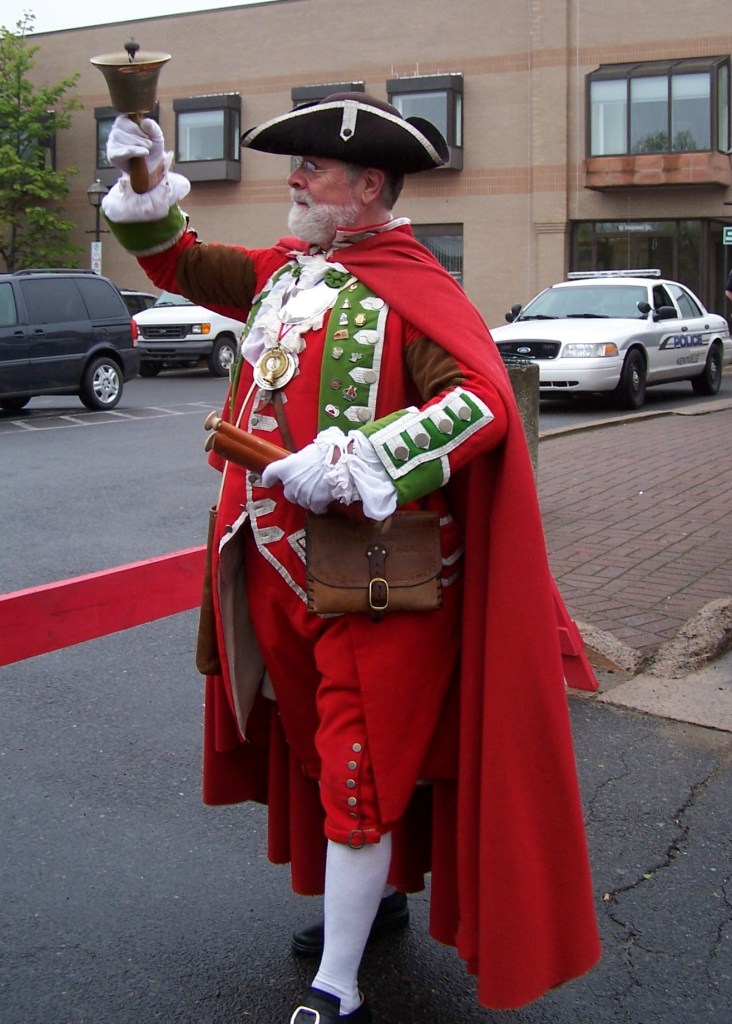
Often the uniform and headwear of the crier is traditional as well. Smith wears a tricorn, headwear popular with civilians and the military throughout the 17th and 18th centuries. While the military discarded the tricorn, it became part of the traditional dress of criers, representing what is British about crying.
One of Smith’s outfits is styled after a uniform worn by the commanding officer of the 45th Regiment of Foot stationed in Windsor at Fort Edward during the 1750s. His first uniform is historic as well, representing a gentleman’s dress worn here by New England planters.
As Smith has noted, the crier’s role today is ceremonial and promotion. It has been forgotten that the crier’s role originally was to lay down the law and deliver the news, good and bad.
As a town crier in the past 45 years, Smith has won many honours, and has provided greetings and welcomes in the traditional style on behalf of many communities, towns, villages and organizations. A partial list of his activities since 1978 as a crier include:
- In 1979 represented the community in several International Tours and hosted visiting International Criers on a Valley Bus Tour and was inducted into the Guild of Town Criers of the United Kingdom.
- In 1980 took an Ambassadorial Tour of the United Kingdom, as well as the Bahamas, exchanging greetings with local natives, notables and prominent authorities and competed in the first Invitational Town Crier’s Competition in Lyme Regis, Dorset, earning the title of Best Dressed Crier and Top Overseas Crier.
- Ambassador Tour and Competition in Gent, Belgium in 1979
- Ambassadorial visit to Bermuda, 1983
- Ambassador Tour and Competition in Jever, West Germany in 1986
- In 1989, opened that year’s annual convention of Quality International Hotels in Nashville, TN.
- Visited Buckingham Palace in 1984 during a promotional UK Tour and competition in the UK
- 2012, Recipient of the Queen Elizabeth II Diamond Jubilee Medal for community service
- Selected on two occasions as the Windsor and Community provincial volunteer from 2015.
- Multi Winner or Best Cry and Best Dress Nova Scotia provincial competitions
- Charter and Founding Member of the Nova Scotia Guild of Town Criers.
- In 2000, with the Amalgamation of Windsor and West Hants, was sworn in by new Mayor Abraham Zebian and Council to continue role as the municipal crier.
 Ed Coleman