
Before the First World War “there was much coming and going to Cape Split by an odd little Physics professor at Acadia,” Esther Clark Wright wrote in her book, Blomidon Rose. “Some materials were transported across and around the mountain (to Cape Split) but nothing came of the affair.”
Wright doesn’t tell us which Acadia professor she was referring to as odd and little – three were involved in the so-called “affair” – but she was referring to an attempt in 1916 to harness the tides at Cape Split and generate awesome amounts of electricity.
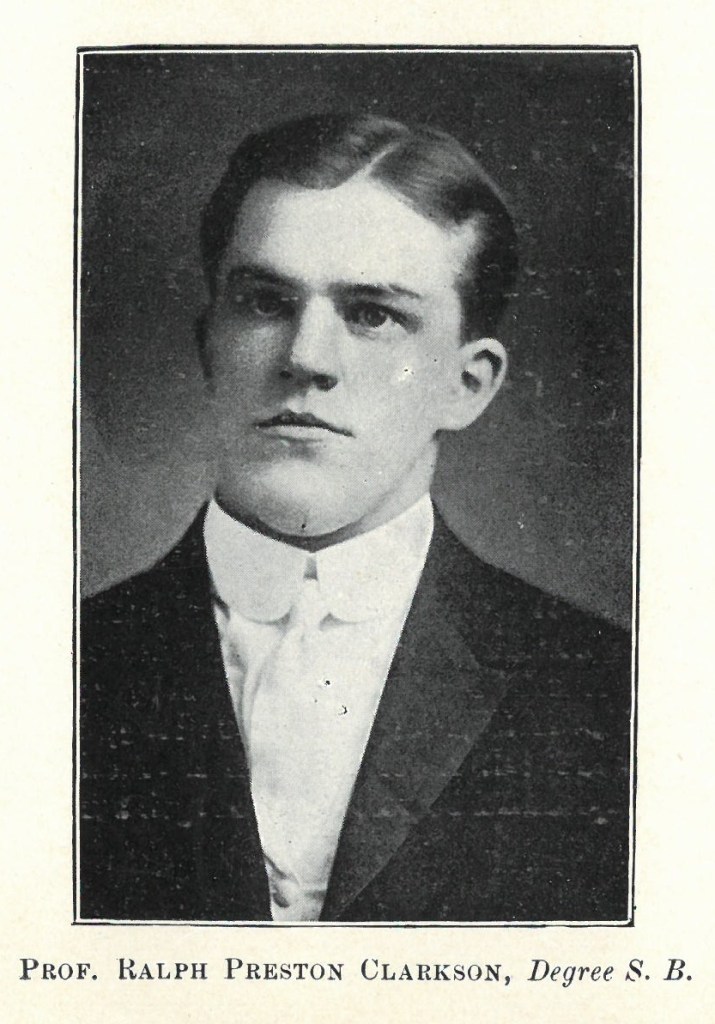
The odd little man Wright refers to may have been Acadia’s engineering professor, Ralph C. Clarkson, an American who had joined the University’s faculty in 1912. He had patented a unique tide-generated turbine, the Clarkson Hydraulic Current Motor. The motor was the key ingredient in a scheme, originating apparently with Clarkson, to generate electricity at Cape Split and potentially light up the entire Maritimes.
In 1916, perhaps even earlier as Wright suggests, Clarkson had partnered with Acadia president Dr. George B. Cutten, along with Acadia professors William L. Archibald and Alexander Sutherland, and former Wolfville mayor, T. L. Harvey to form the Cape Split Development Company (CSDC). The company’s grand plan was to generate enough electricity at Cape Split to service Nova Scotia and possibly most of the Maritimes. This was to be accomplished by placing a series of the Clarkson motors on the seabed that would power generators, which pumped seawater into 200 million litre power-generating holding tanks at the top of Cape Split.
I’ve simplified this a bit. This was a major undertaking, requiring extensive investigation into the feasibility of harnessing the tides. Clarkson played a major role in the undertaking, giving up his academic role at Acadia to some extent. This is explained in the University’s archival papers on Clarkson and the tidal power project: “While at Acadia, Clarkson did not pursue a life of pure academia. Instead, he became involved in the scheme to create a power plant that would utilize the tides of the Bay of Fundy to generate electricity. In 1916 he became the vice-president and managing director of the Cape Split Development Company.”
As said, Clarkson et al had a grand vision – to light up Nova Scotia, then the Maritimes and eventually all of eastern Canada. This was the grand plan but there was a roadblock – funding.
In a prospectus by the CSDC, the company estimated that 2.2 million dollars (nearly 50 million dollars in today’s money) would be required to finance the project. The public had to be convinced that the project was viable, so Clarkson and his cohorts organized a series of seminars in Nova Scotia and New Brunswick. Clarkson went on the road, spearheading the campaign to raise funds.
In one of those ventures abroad, Clarkson addressed a group of businessmen in New Brunswick (as reported in the March 25, 1916, issue of the Saint John Standard) claiming that the Bay of Fundy was “a veritable Niagara where millions of tons of water are moving daily, providing energy sufficient to provide power for the whole of eastern Canada.”
Clarkson made a pitch for financial support but with hindsight, we know it wasn’t forthcoming. In the meanwhile, the campaign in Nova Scotia was faltering as well. Despite the huge potential of the project, no more than $31,000 was raised – the Company going as far as contacting Henry Ford it is said, who balked at spending money on an unproven tidal project in the wilds of Nova Scotia.
So, the bottom line is that the Company admitted failure and closed its books. As Wright put it in Blomidon Rose, “nothing came of the affair and there was much grief among those who had been persuaded to back the venture.”
How much “grief” was Wright referring to? In winding up its affairs, the Company paid shareholders $4.41 for each $50 they had invested! This sounds bad but look at the list of shareholders and the amounts they invested, which is on file in the archives at Acadia. According to this list, most stakeholders invested no more than one or two dollars in the CSDC!
In 1916 the Cape Split project was ahead of its time but earlier than this, there was another futile attempt to harness the Fundy tides. In 1908 a plan was proposed to build a five-kilometre bridge or causeway from Cape Split to Spencers Island. Dynamos placed along the structure supposedly would generate electricity. Besides a highway, train tracks would be laid as well.
This was the plan in 1908, but it never went further than a sketch that was in files at Acadia. According to records, Clarkson had been working on a tidal motor before joining the faculty at Acadia. With the motor in hand, perhaps a coincidental discovery of the 1908 sketch inspired his attempt to harness the Fundy tides.
 Ed Coleman