
OLD KENTVILLE LEDGERS DATE FROM 1868 (February 3/15)

Recently three business ledgers used in Kentville drugstores in the 19th century were donated to the Kings Historical Society by the Gerrard family.  The ledgers were found some 20 year ago in the basement of a house on Main Street that was once used as a pharmacy.  Archivists currently are cataloguing the contents of the ledgers and a conservator is tidying them up as much as possible. The archivists working on the ledgers hail them as an “amazing look at the state of pharmacology in the mid-19th to early 20th century in Kentville.”   Here’s more about them:

In his blog on the Kings Historical Society web page, conservator Kelly Bourassa describes the old ledgers as mouldy, musty, water stained, riddled with insect holes and “representing a considerable challenge” when it comes to conserving them.

Archivists Merrily Aubrey and Ken Kaiser, who are cataloguing the ledgers for the Kings Historical Society collection, note that that they indeed are “incredibly fragile.”

The condition of the ledgers is understandable since they date back to the 19th century, to a time when Kentville only had a few stores and was a struggling county village known widely as Horton Corner.

Actually the ledgers are in reasonably good condition given their age.  The dates when the ledgers were used have been determined as 1868 to 1874, 1884 to 1896 and 1887 to 1906.  The oldest ledger was originally used in Kentville’s first drugstore which was opened by Leander J. Cogswell in 1868.  According to Kings County Museum curator Bria Stokesbury, the 1884-1896 ledger belonged to the Kentville Drugstore, operated by R. S. Masters.

Basically, the three books are pharmacy ledgers.  However, one of them originally was used as a register from 1897 until 1898 by a Kentville hotel, the Porter House, and then turned into a “scrapbook for prescriptions” (Stokesbury) by Dr. W. S. Woodworth.  Actual prescriptions were pasted onto the pages of the register over lists of guests who stayed at the hotel between January 1, 1897, and February 26, 1898, but there are pages where guests’ names, addresses and dates of stay can clearly be seen.

Kelly Bourassa, who is president of the Kings Historical Society, says that the ledgers contain hundreds of prescriptions filled by the earliest drug stores in Kentville. As such, “they represent an import record of medical practise at the time, which was much different from modern times,” Bourassa said.  “They’re a fascinating read of (19th century) drugstore dispensing practises.”

Once cleaned and catalogued, the ledgers will be stored in the vaults of the Kings County Museum until funding can be found to properly restore and preserve them.  “They represent a considerable challenge in conservation,” Bourassa says, “since they require rebinding, which essentially is restructuring each ledger.”

Once the ledgers have been restored the long range plan is to digitize them.  Bria Stokesbury said that digital copies of some of the more interesting contents of the ledgers will eventually be viewable on the Museum website.
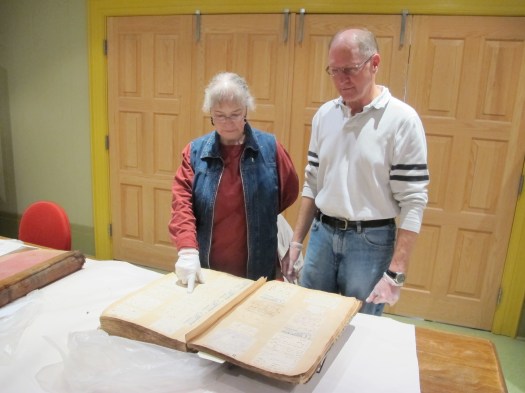
Merrily Aubrey and Ken Kaiser with ledger

Archivists Merrily Aubrey and Ken Kaiser at work on the 19th century ledgers that were donated to the Kings County Museum.

One of three old ledgers donated to the Kings County Museum

One of three old ledgers donated to the Kings County Museum. Originally a hotel register, the ledger also was used by a Kentville pharmacy to scrapbook prescriptions.

FOLK SUPERSTITIONS FROM THE OLD COUNTRY (January 19/15)

Ordinary table salt once was so precious and so scarce a commodity at one time that battles were fought to protect its sources.

An old folk belief that says it’s bad luck to spill salt and to avoid it – the bad luck that is – you must immediately, without any hesitation whatsoever, throw some over your left shoulder.  I assume my mother brought this superstition over from Great Britain since I heard it many a time at the kitchen table whenever I knocked the salt shaker over.

Now I ask you, if salt was once as precious as diamonds – it was  restricted solely to the ruling classes at one time –  how and why did this superstition arise about throwing it away to avoid bad luck?

Anyway, this is one of many beliefs that came to North America with immigrants and you still hear it and other weird superstitions like it today.  Recently, for example, a friend said he thought he could “make it safely to Halifax in a storm, knock on wood.”  He actually looked around for some wood to knock on and then caught himself.  “That’s what my Dad used to say,” he said.

I grew up hearing all those old superstitions and quaint beliefs.  My mother must have brought a cartload of them with her from England and I heard them all, many times over.  There’s the one about tea leaves, to give another example.   Finish your cup of tea, turn the cup upside down on your saucer and rotate it several times.  The tea leaves would form a pattern inside the cup that foretold your future, if you knew how to read them. (Tea was once steeped with loose leaves which explain how a pattern was formed.)

There were other beliefs, courtesy of a mother who was one of the most superstitious persons I ever knew.  Trouble with warts, rub them with raw onion; or if they were large, tie string tightly around them and they’ll disappear or fall off overnight.   Never put a coin in your mouth – this will give you canker sores.  Pick up a penny when you find one and put it in your pocket; you’ll have good luck all day.  Don’t pick up toads; they’ll give you warts. Break a mirror and you’ll have seven years of bad luck (which is an oldie but I heard it for the first time from my mother.)

Save the wishbone from a turkey or goose and make a wish on it.  My mother always dried the wishbone on the woodstove.  The wishbone is “y” shaped and after it was dry, two people could make a wish by grasping each prong of the Y and pulling until it broke.  The person getting the longest piece got their wish.  No umbrellas were ever opened in our house; it was bad luck if you did.  Don’t step on a spider since doing so brings on a heavy rain, I was told.  If your left palm itched you were sure to get money and so on.  An itchy right palm meant the opposite – you were going to lose money.

You probably laughed when your read these old superstitions and beliefs, but keep in mind that at one time they were all that people had to guide everyday living.  People of my mother’s generation and in earlier times took these superstitions and beliefs to heart.  There were many old beliefs, for example, that forecasted the weather. You couldn’t go to the weather channel in the old days so you depended on mackerel skies, red sunsets, rings around the moon and the way smoke issued from chimneys to forecast the weather.

WHICH IS CORRECT – SCOTS BAY OR SCOTT’S BAY? (January 12/15)

“From these temporary residents the place got its name,” writes Arthur W. H. Eaton in the History of Kings County.  Eaton is referring to Scots Bay, mentioning the oft repeated folklore that Scotch emigrants were forced to land there in 1764 and “began the present settlement.”

Like Eaton, a former provincial archivist also mentions the storm-forced landing of Scottish emigrants on the Bay of Fundy shoreline – hence the name “Scots Bay” for the area writes the archivist.  In his book Place-Names and Places of Nova Scotia, the archivist Charles Bruce Fergusson notes that an early name for Scots Bay also was Scotch Bay.

We now turn to the Atlas of the Maritime Provinces, published in 1878.  Here you will find a separate, detailed map of Kings County in the Nova Scotia section.  I’d say this was an authoritative source on the origin of place names and it probably was referenced by Eaton and Fergusson in preparing their books.  And, I have to add, the publishers of the Atlas must also had trustworthy sources as references when preparing their Maritime Provinces maps.  This being said, the Atlas map of Kings County has the community of Scots Bay spelled just that way – Scots Bay.

Another older map of Nova Scotia, dated 1829, also indicates that the community was known as Scots Bay away back then.  I found this map by Googleing Historical Maps of Nova Scotia and checked out provincial maps from the 1800s.

Now, on to the Ambrose F. Church series of county maps produced for the province between 1865 and 1888; there were 18 maps in total and to produce them, Church and his cronies travelled through every county to sell advertising and to map out every road, listing whoever lived along them.  The Kings County map is dated 1864 but according to the Department of Natural Resources, it wasn’t published until 1872.

Ambrose F. Church took it as gospel that the community first settled inadvertently by Scottish immigrants was called Scots Bay and nothing else.  Perhaps confirmation that this was the correct spelling of the community at the time he made his Kings County map was the aforementioned Atlas of the Maritimes Provinces.  We will never know this for sure but it’s guaranteed that Church had a source he trusted when he included place names on his maps.

Now, closer to our time, the road maps produced currently by the Department of  Highways spell Scots Bay as Eaton and Fergusson did, the same way it was spelled in the 1878 Atlas.  Look in the latest telephone directories and you’ll also find the community listed as Scots Bay.

Why then, given historical precedents do we find Scots Bay spelled as Scott’s Bay? – in various publications such as this newspaper, for example. Using Scott’s Bay for the community, instead of Scots Bay, implies that the place name originated from the surname Scott.  Yet this isn’t the case.  As Eaton and other historians tells us, the place name originated with Scottish settlers.   As I’ve also shown, the community was known as Scots Bay on a map dated 1829 and in an atlas dated 1878.

Historically, Scots Bay must be correct as the name for the community.  But to be fair and offer a bit of evidence to the contrary, the official highway map produced by the Department of Highways in 1935 has Scotsman Bay in bold type as the community name.  The Department’s map for 1944 has Scotsmans Bay displayed boldly as well, and near that in small type is the name “Scott Bay.”  Another source, Thomas J. Brown’s book, Nova Scotia Place Names, published in 1922, has the name of the community spelled as Scott’s Bay.

Perhaps Brown’s spelling and the addition of “Scott Bay” to the 1944 road map somehow led to the current spelling of the community’s name in local publications as Scott’s Bay.  But that’s speculation on my part.

AN ACADIAN HISTORICAL SITE OVERLOOKED (December 15/14)

Where did the Acadians first start dykeing in Kings County?

Former Advertiser editor Brent Fox, who in my opinion wrote the definitive history on building the Wellington Dyke, found that some of the earliest dykes and aboiteaux in this region were built by the Acadians on the upper Canard River.  One of the sites mentioned by Fox is an area at the head of the Canard River, in Steam Mill Village near the northeast edge of Camp Aldershot. If I recall correctly a conversation I had with Mr. Fox, I believe he told me an aboiteau was constructed approximately where the railway bridge of the old Cornwallis Valley Railway would eventually span the Canard River.

Fox writes that “this first Canard aboiteau” was later abandoned and another was built farther down river.  Fox says that this aboiteau was constructed “where the bridge stands on the road (Highway 341) between present day Kentville and Upper Dyke Village.”

In fact, as Fox points out, most of the area around the head of the Canard River and near Upper Dyke Village was dyked early on by the Acadians.  In one area you can even see remnants of the early dykeing.  A few years ago John Newcombe pointed out a site just above where a Canard River tributary crosses under Highway 341 and Newcombe Branch Road.  The outline of an early aboiteau is visible there and Mr. Newcombe believes it was one of the very first constructed here by the Acadians.

All of this is most interesting.  Here we have some historic sites that practically are ignored or not treated with any importance when it comes to county history.  In Steam Mill Village and in Upper Dyke, Highway 341 (or Canard Street as it is better known) runs through a historic area.  Beginning around Steam Mill and then downstream all along the Canard River, and up many of the Canard River tributaries, the Acadians built a series of aboiteaux and running dykes.  The dykeland acreage the Acadians reclaimed along the Canard River nearly equals the dykeland acreage in Grand Pre.  Brent Fox writes that the Acadians began building aboiteaux on the Canard River in the early 1680s, at about the same time they began reclaiming marshland in Grand Pre.

Emphasizing what I wrote above, Brent Fox says in his Wellington Dyke book that “strangely, these Acadians and their work (on the Canard River) have been ignored (while) the running dyke systems of Grand Pre have become well-known.  Little has been written about the cross-dyke or  aboiteau systems on the Canard River.”

Not only has little been written but little has been celebrated about the achievements of the Acadians along the Canard River.  These achievements resulted in the area along the Canard River becoming one of the largest Acadian settlements in western Nova Scotia.  I’ll let Brent Fox have some final words on this:  “Of the 2,700 or so inhabitants of Minas (as this area was generally known) at the time of the deportation, perhaps half of them lived in Canard.”

This fact alone emphasizes that those long ago efforts of the Acadians who successfully conquered the Canard River were significant, to say the least.  The Planters inherited these dykes and expanded on them, another historical fact that’s rarely acknowledged.

HARNESSING THE CORNWALLIS RIVER TIDES (December 2/14)

With ocean levels rising, many communities along the Cornwallis River are definitely at risk, Kings North MLA John Lohr said in a recent column in this paper.

Lohr singled out Kentville, Port Williams and Meadowview as areas of concern, but he could have added that communities along the Habitant River, the Pereau River and the general area from Grand Pre and inland to the westward are at risk as well.

In fact, any communities, villages and towns along the edge of Minas Basin and along tributaries that run into the Basin will be affected one way or another by rising ocean levels.  Look at Wolfville, for example.  While high running dykes now protect the town, how long will they be effective when sea levels rise and we have sure-to-come storm surges?

John Lohr suggests that way one to tackle the problem of future flooding in his riding is to look at building a great aboiteau across the mouth of the Cornwallis River at Port Williams.  This is a good idea and it has been seriously considered before.  The concept of building an aboiteau near the mouth of the Cornwallis River was examined at least twice in years back; while sparsely documented, government records indicate some serious thinking went into building this aboiteau.

In 1912, for example, government records show that an “Act to Incorporate the Cornwallis Aboiteau Company” was passed on May 3.  The Act stated that the “general object and purpose’ of the Cornwallis Aboiteau Company was to construct an aboiteau across the Cornwallis River at Port Williams.  The aboiteau would replace the current bridge and control the river’s twice daily tides, at the same time creating many acres of upriver dykeland.

If I read government records correctly, public funding would have been available to build the aboiteau.  The Company incorporated by the Act had as its officer at least 10 of the more prominent citizens of Kings County as shareholders, all of whom were investing in the aboiteau.

Looking back over a century later, we know the aboiteau was never constructed.  The reason why is unknown.

A similar scheme was proposed even earlier.  Government records indicate that in 1865 an Act was passed to “provide for building an aboiteau across the Cornwallis River” at Port Williams.  The Act read that the Commissioner of Sewers for Kings County was authorised to “build and erect an aboiteau,” but it’s obvious from our viewpoint today that nothing was done.

Getting back to John Lohr’s proposal, he mentions as well the possibility of constructing an aboiteau from Starr’s Point to Wolfville.  It may surprise everyone that this idea was also considered more than a century ago, around 1865.  The Statutes of Nova Scotia for that year indicate an aboiteau was proposed across the mouth of the Cornwallis River. In his Kings County history, Arthur W. H. Eaton, quoting an earlier historian, says that the aboiteau would run from the “old French fort at Starr’s Point.”

AN OLD KINGS COUNTY MILITIA BADGE (November 17/14)

“I wanted to share with you a picture of a military badge I just collected,” wrote Vincent Merritt recently via e-mail.  “I consider it a real nice piece of Nova Scotia’s early military history, dating before Confederation,” It is the oldest Canadian military related item in my collection.”

Merritt, who was born in Port Williams, shipped out of here at an early age to spend over 30 years in the Canadian Army.  He began collecting military badges over 50 years ago while travelling around the world with the Engineers Corps.  Early on he specialized in Nova Scotia military artefacts, such as hat and lapel badges, medals and books. And after five decades of collecting he figured his collection was about as complete as it could get.

Then came the find of a rare Nova Scotia badge in a coin and stamp store.  This was a badge he had never seen before, the badge of a military unit he had never heard of either and it was a total surprise.  “The official title of the unit is the Nova Scotia Volunteer Artillery and this is stamped on the badge,” Merritt said.  “This was new to me so I tried researching it and found a one line reference saying it was a militia unit and that was it.  My next move was to contact the curator at the Citadel in Halifax about the militia and I’m  waiting to hear back.”

Merritt eventually found that “the circa of the badge is the 1840s,” which dated its origin as pre-Confederation.  The size of the badge (about three inches by about two inches) makes it too large to be worn on headwear.  “I don’t think it was worn on a hat but possibly on a cross belt or a leather pouch,” Merritt said, but he wasn’t sure.

Merritt asked why there was a milita artillery unit in Nova Scotia in the 1800s and this is a good question.  The badge harkens back to a time in Nova Scotia history when most of the province depended almost entirely on local militia units to defend it.

Here in Kings County several militia units were formed immediately on arrival of the Planters.   As early as 1758 the provincial government established an act requiring all males between 16 and 60 to bear arms and to muster regularly for training.  By the early 1860s Cornwallis Township had three companies of militia and Horton Township two; all of them were farmers, the sons of farmers and their servants.  At first, all militia units had to equip themselves with firearms and other military paraphernalia at their own expense but this would change later.

Some of the militia units organised around the province were required to form artillery outfits to assist in defending the coastline.  One of the units was the Nova Scotia Volunteer Artillery and they wore the badge Merritt found.  This outfit can trace its lineage back to about 1776 and one of its units is believed to have concentrated in Kings County on the shoreline of the Minas Basin.  It isn’t likely but perhaps one of the militiamen guarding the Minas shore wore the very same badge Vincent Merritt discovered in a pawn shop.

Merritt also added another rare militia badge of Nova Scotia origin that he suspects can be traced back to the 1850s.   Merritt refers to his latest find as a “silver wire Nova Scotia Militia badge” and he’s currently attempting to learn something about its history.

Cutline: A rare Nova Scotia volunteer militia badge that may have been worn by farmer soldiers in Kings County over 150 years ago.

A SCHOOL ARITHMETIC BOOK FROM 1840 (November 4/14)

“If 6 horses eat up 21 bushels of oats in a week’s time, how many bushels will serve 20 horses the same time?”

With its reference to bushels and horses – and requiring familiarity with arithmetic’s rule of three – this problem is something you probably won’t find in school exercises today.  This was one of many similar problems students in Kings County schools were required to solve in the early 19th century.

The problem about the horses and oats comes from an exercise book, dated 1840; this belonged to Matthew Wood when he was attending the district school in Woodside near Canning.  Young Mr. Wood – he was 15 at the time – was required to study simple arithmetic and beyond that, some advanced math that might faze today’s high school students.

But I’m getting ahead of myself.  I’m looking at a 1945 Journal of Education report that along with two school exercise books dated 1840 and 1841 was donated recently to the Kings County Museum.  In the report is a review of Wood’s exercise books with some revelations that are surprising.

The exercise books are interesting in many ways.  They tells us that in Wood’s day the arithmetic taught then was far advanced compared to what is in today’s school curriculum.  The report was written by Alex S. Mowat, a Dalhousie University Professor of Education.  Mowat marvels that Wood’s exercise books have “a great deal that might scare the Grade VIII or IX pupils of today.”  Could any of us do this? asks the Professor, noting the exercise books contains work on “vulgar fractions, followed by decimal fractions, double rule of three, conjoined proportions,” and so on.

Another interesting aspect of the exercise book – used when oxen and horses were common and there were no paved roads or railways – is that it permits comparisons with commodity prices then and now.  Well actually not “now.”  From the exercise books we can compare prices in 1945 with prices in the 1840s, which then gives us a comparison with prices today.

Commodity prices in the exercise books are given in shillings and pence and Prof. Mowat provides the 1945 value for each.  “If you call a shilling 25 cents and a penny two cents,” Mowat writes, “you will have some idea of the price of commodities 100 years ago in Nova Scotia.”  Eggs in 1840, for example, went for 1 shilling and 6 pence for two dozen.  A teapot sold for 1 shilling and 2 pence, a handkerchief for 8 pence, a jackknife for 6 pence.  You can do the multiplication yourself to roughly determine the price of eggs, etc., allowing for inflation of course.

“Some prices mentioned (in the exercise book) are of interest,” and reflect the times, Prof. Mowat writes.  “For example, one exercise gives the postage of three letters at 4 shillings and pence, another two waggons of coals costing one guinea (about $5.25) another three oxen for 24 (pounds) and 10 shillings (about $122.50) others bushels of oats at $2.00 per bushel and bushels of beans at $2.00 per bushel.”

All in all, the exercise books offer much more than just an inkling of what school work was all about 175 years ago.  We have a glimpse of every day living away back then since the exercises were meant to be of practical use.  Prof. Mowat hits it right on when he writes that “here is a piece right out of the very web of Nova Scotia’s past.”

As mentioned, the old exercise books were donated to the Kings County Museum.  The donor was Robert Borden of Dartmouth.  Matthew Wood was Mr. Borden’s great grandfather.

MEDALS OF WORLD WAR ONE (October 13/14)

During the First World War countless thousands of men and women saw active service in the allied armed forces.  As a way of recognising this service the allied governments awarded victory medals.  Those who served on the battlefields, in the air, on the sea and behind the lines received a medal common to all, a “Victory Medal,” as it was called. The medal was awarded to officers and other ranks alike; a medal emphasizing the unity of the allies and commemorating victory.

Since the allied forces were comprised of many countries with no common language, it was decided that each nation produce its own Victory Medal.  One of them is in my possession.  Suspended from a double rainbow ribbon, the medal reads:  “The Great War for Civilization 1914-1919.  On the obverse side is a figure described as “Winged Victory.”

This medal was awarded to my father for his service in the war.  For years it was kept in a metal box in my rec room and would probably still be stored away but for a nephew who collected military badges and medals. He inquired abut my father’s war medals and this led to a search for the box and discovery of four medals on faded ribbons.

Later my nephew sent me new ribbons – duplicates of the originals – so the medals could be properly mounted and displayed.  He sent along as well an article on medals of the Crown.  This told me my father’s allied victory medal was produced by the Royal Mint and was engraved by a Canadian, W. McMillan.  The medal was struck in bronze and gilded.  As was pointed out in the article, the medal was hastily produced and of poor quality.

I was surprised by the cheapness of the medal.  Given the importance of the occasion, it would seem no cost would be spared to produce the medals.  Apparently the allied governments squabbled over the cost of issuing a joint medal and the Canadian government came up with its own design.

One of the medals I found in the box was issued by the British government and it had my father’s name on it.  This puzzled me at first; then I recalled my father telling me he enlisted in a British unit at the start of the war and later transferred to a Canadian division.  This medal either supports what he told me, or as a member of the Canadian Army he was entitled to it.

The two other medals in the box marked my father’s participation in World War Two when he served at Camp Aldershot.  One was the Canadian Volunteer Service Medal, also tarnished by time and cheaply produced; the other appears to be the Word War Two version of the British war medal.

All those medals are treasured today.   I look upon them as reminders of a time when ordinary people like my father answered the call to serve his country.

98 YEARS AGO HANTSPORT WAS FLOURISHING (October 6/14)

When a New Brunswick based magazine published a feature on the  Annapolis Valley in 1916, Hantsport was one of the towns profiled.

Hantsport’s inclusion in The Busy East feature was recognition of the town’s relative prominence at the time.  Only the leading towns in this region were included in the magazine’s review, Berwick, Wolfville and Kentville among them.

At the time of the review Hantsport had recovered from decline of the shipbuilding era in which it played a leading role throughout the 19th century.  Rev. A. R. Dickie, who wrote the Hantsport review, referred to the shipbuilding period as the town’s “palmy days” when it “enjoyed great prosperity (and) shipyards boomed under the ring of the broad axe.”  During the shipbuilding time Hantsport produced hundreds of vessels, one of them the largest three-masted barque built in Canada.  Prominent among the shipbuilders was the Churchill & Sons Shipyards, in its prime renowned along the Atlantic seaboard.

However, while shipbuilding had declined, Hantsport was far from finished.  In his review Rev. Dickie writes that “though on a decline for a time,” the town had rallied and was again flourishing.  In 1916 Hantsport could boast about having at least two major hotels. Some sources say there were several hotels located in the town from about 1900 on, but Dickie only mentions the Evangeline Hotel and the Hantsport Hotel; he describes the latter as being “one of the best hostelries of any town in Nova Scotia.”

Although no mention is made of it in The Busy East, a newspaper (the Review) was printed in Hantsport in 1916 and 1917. (Source: Fergusson, Place Names and Places of Nova Scotia).  This was Hantport’s second newspaper, the Advance being published there for eight years until about 1912.

Among the town’s industries in 1916 was the Chesley Artificial Limb Co. which was flourishing, says Dickie, because of the ravages of World War One.  That the firm enjoyed the “patronage of the Imperial Government of England” (Dickie) and was supplying artificial limbs to British hospitals undoubtedly explained its success.

Other major industries located in the town at the time were the Hantsport Fruit and Basket Company with markets throughout the Maritimes, the W. C. Balcom Greenhouses, and the Candy Manufactory of G. H. Yeaton & Sons with markets all across Canada and as far away as the West Indies.  Dickie also mentions that a number of small businesses were in operation at the time, among them a garage and retail stores.  Hantsport would become even more prosperous with the arrival of the Jodrey family and Minas Basin Pulp and Power, but that was a decade away from becoming operational.

HANSFORD STORIES – WW1 HUMOUR (September 22/14)

Born in 1899, the former Wolfville barber Cecil Hansford was 16 when he joined the Canadian Army to fight in World War One.  As a boy soldier with the 25th Nova Scotia Battalion, he soon found himself in the front line trenches in France.  While in service, Hansford participated in 12 major engagements and was wounded twice.  He would enlist again in 1940 when the Second World War broke out, serving through the war years at Camp Aldershot.

As his son Gordon often says, his father saw firsthand what trench warfare was all about.  Like most World War One veterans he came back    with horror tales of being in the trenches.  However, there was a lighter side to the war, a side you rarely hear about.  Cecil Hansford often talked about those lighter moments, about incidents that took place behind the lines in rest areas far from battle, and Gordon Hansford wrote them down and saved them.

Here are two of the incidents that Cecil recalled, courtesy of Gordon Hansford.  In the first, some Canadian boys outwit their officers while in a rest area in France.

“One day the battalion was out of the line and billeted along a sunken road, which were common in that part of France. Two lads were exploring and came across and army service corps driver who asked them to help get a wheel back on his wagon.  They agreed to help and the three tried in vain.  The wagon was heavily loaded so the driver asked if they would watch it while he went for help.  They said they would so he unharnessed the horse and rode off.  As soon as he was out of sight the pair lifted the wagon cover.  To their delight, the first thing that met their eyes was a big jar marked S.R.D. (Service Rum Diluted).  Grabbing it, they started off down the road.

“Unfortunately they had to pass two officers at the crossing of a side road.  They were sure they would be caught with their loot but one of them caught sight of a pile of stretchers at a clearing station.  They threw the jug on a stretcher, threw a blanket on top and bunched it up so it would look like someone was under the blanket.  The two bore their burden past the officers, giving them a smart ‘eyes left’ as they did.  One of the officers asked if it was one of their boys and they said it was.  Both officers saluted the dead hero as he was borne away to his last resting place.”

Spuds for Trade

“Every village in France has at least one ‘estaminet,’ a sort of restaurant or pub where the soldiers loved to hang out when they were out of the line.  They could buy, for a few francs, some ‘Vin Rouge’ and eggs and chips.  A couple of chaps from the 25th Battalion had spent their few francs and were heading back to their billet when they spied a wagon loaded with bags of potatoes rolling along, hauled by a large horse led by a grizzled old farmer.  They offered him a few cigarettes and he offered them a drink of  Vin Blanc and one Canadian went behind the wagon to relieve himself.

“The farmer waved to them and started away.  One of the boys told his pals he had taken a bag of spuds off the wagon and hid them in the ditch.  They decided to trade them at the estaminet for a few bottles of Vin Rouge.  They retrieved the bag and headed for the estaminet.  There the busy proprietor nodded towards the store room where the two deposited their load.  Noting that the back door was unlocked, they took the same bag of spuds out and traded them three more times.”