STRIPERS: BEST BAITS, THE HOTSPOTS (July 22/13)

Back when there were no regulations on striped bass fishing, a friend and I often trolled the Gaspereau River in a canoe, using squid and big spinners.  On some tides, when the run was good, we’d hook into a lot of fish. Since there was no size limit we’d keep any striper that yielded good filets.

We trolled with fresh water tackle, fly rods and Hardy St. Johns with lots of backing, and the undersize bass you have to release today provided great sport.  Occasionally we hooked into large bass but most of the fish we filleted ran five to eight pounds.

We experimented with various baits – herring, gaspereaux, mackerel and even shad strips. For trolling the most effective bait was squid. Probably because it could be cut up into strips roughly one inch by six inches and would take a lot of pounding, it was the best to use with on our trolling rigs.  At the time only a few local anglers used squid; most anglers fishing the shoreline and the Gaspereau River with heavy tackle preferred herring.  Bloodworms, another popular bait today, was unheard of locally decades ago.  Back then (in the 1950s, 60s and 70s) a few anglers fished for stripers with large clams but I never hear of this bait being used today.

Nowadays, squid is often the preferred bait with anglers fishing along the Minas Basin.  However, from what I’ve been told, striper baits apparently are like the fashion trends you see with clothing.  In Baxter’s Harbour, Bay of Fundy fisherman John McCulley packages squid, herring and mackerel for striper anglers. He says anglers sometimes get a run on a particular bait; one year it’s herring, the next season squid and so on; and there seems to be no particular reason for the changing preferences.

What’s the most popular striper bait this summer?  John McCulley says squid is again numero uno, or has been recently.  At the current local hotspot, Porters Point, anglers fishing with squid have been taking a lot of keeper size bass.

There are many striper hotspots long the Minas Basin shoreline in Kings County.  The Guzzle near Evangeline Beach attracts a lot of anglers, as does the lower tidal section of the Gaspereau River.  Striper anglers are like salmon anglers, by the way – mum about their favourite fishing spots in other words.  Often you only find out about a hotspot – through the angler grapevine – after the stripers have followed the baitfish to some other area of the coastline.

To see how popular the Guzzle is, by the way, take a look at the web sites devoted to Nova Scotia fishing.  Lots of mention of the Guzzle there; anglers either looking for directions to the Guzzle or mentioning it as a great spot to fish for striped bass.

LLOYD SMITH – CARRYING ON A TRADITION (July 15/13)

The red mid-18th century replica of an officer’s uniform of the 45th   Regiment worn by Lloyd Smith for decades has been retired.  The long-time Valley Crier – some 35 years and counting – is resplendent today in dress representing the clothing of 18th century aristocrats.

But Smith’s role as a Crier remains hasn’t changed. The centuries old tradition of Criers announcing news and proclamations in the village square continues, with Smith still playing a prominent role at functions and celebrations throughout the Valley

However, the breeches, jacket and trim are now in subdued shades of green and gold (the colours of the town of Windsor), the hints of blue in the waistcoat representing our Acadian heritage.  And while his new uniform might not be traditional town Crier apparel (if there is such) the bell, staff and tricorn, part of the Crier costume for centuries, are still there.

In other words, a proclamation made today by Smith is, in effect, a historically correct re-enactment of the ancient art of crying.   Bells and staffs have been carried by town Criers for hundreds of years.  The tricorn  many Criers wear today was a fixture on Criers centuries ago.

It’s believed the ancient Greeks and Romans were the first to employ Criers but little documentation exists. What we do know is that after the Norman invasion of England in 1066, Criers are mentioned in official records.  In Great Britain Criers eventually became the voice of ruling Kings and Queens and officers of the Crown; most of the time they were used to inform people of orders and decrees from higher up.  So entrenched in British history and so vital was this role that Criers became protected under English laws; laws, by the way, still in effect today.

This is Lloyd Smith’s third Crier uniform.  The first, a gentleman’s dress of New England/Planter style was designed locally and was prominently green and gold.  The outfit worn by a military officer stationed in Windsor was the model for the red uniform Smith wore until recently.  This uniform was officially retired May 18 and is now on display at the Hants Historical Society.

Now, let’s take the significance of the paraphernalia Smith carries in his town Crier role.  In every sense it is historical.  The bell, for example, has traditionally been used as an “attention getter” for centuries.  Ringing the bell three times before an announcement symbolizes the time when a Crown appointed Crier was required to rap three times with a mace to introduce guests into a Royal Chamber or Royal presence; hence both the mace and the bell are carried by Criers today as an acknowledgements of this ancient tradition.

As for the introductory O Yea, O Yea, O Yea preceding Crier announcements, this custom likely goes back to the period when Great Britain was under Norman dominance.  Originally the cry was Oyez, Oyez, Oyez, an old Norman French term meaning “to harken,” or “hear ye.”

As for the tricorn Smith wears, this hat was popular in civilian fashion and with the military throughout the 17th and 18th century.  While the military discarded the tricorn in favour of other headwear, the hat became the traditional dress of Criers, a symbol of what is so British about crying.

Lloyd Smith in his new uniform

Lloyd Smith in his new uniform, the dress of an 18th century aristocrat. (Submitted)

GASPAROT/GASPEREAU /GASPER– HISTORY OF A NAME (July 9/13)

The Acadians called it the river of the gasparot; as we know, those bustling Planter people, once they saw the tremendous runs of herring-like fish up the river every spring, thought the name was appropriate.

The Planters called it Salmon River at first.  But eventually, by anglicizing the Acadian name slightly, the stream became the Gaspereau River.  Eventually, Gaspereau was applied to the river, to the village on its banks, to the valley the river flowed through and the lake at its headwaters.

If Esther Clarke Wright is correct, Gaspereau applies to more than a fish, a river, a village and a lake.  It also indicates a state of mind, says Wright respectfully in her book Blomidon Rose, noting that the early settlers along the river were “God-fearing, tight-fisted, house-proud, farm-proud people.”  It all had something to do with the Gaspereau Valley being relatively isolated from other communities in the area, Wright implies, that isolation perhaps creating a Gaspereau mindset.

The oddest thing about the word Gaspereau is that a few people believe it’s has nothing to do with the Acadians and their prized fish.  Years ago I heard that the Gaspereau River, and the village, valley and lake weren’t named after a fish.  In all seriousness, a friend told me Gaspereau came from the surname of a man named Gasper.  I scoffed of course, but the friend insisted it was true; it’s documented in history books and it is common knowledge, he said.

The Acadian origin of Gaspereau, for the fish, the river and so on, is so well known I couldn’t believe the friend was serious.  Then I discovered the booklet I wrote about in a recent column – the Souvenir of Wolfville and Grand Pre published in 1897 and written by D. O. Parker.  There it was in the book.  Just what my friend told me, that the word Gaspereau came from a man named Gasper.  Here, word for word, is what the author of the book says about the origin of Gaspereau:

“Legend says (Gaspereau) is a compound of Gasper and eau.  Gasper was a gentleman who died on his way to Acadia and was buried near the mouth of the river.  Eau is the French word for water; hence the water near his grave was called Gasper-eau, i.e. Gasper water – Gaspereau.  Others say it takes its name from a river in France and is sometimes spelt with an x, eaux, the plural for water.”

This is remotely possible, I suppose, but I suspect Parker wasn’t serious and simply was passing along a whimsical, curious piece of county folklore.  I hope so.  I see that Parker signs off his book as Rev.  D. O. Parker; a man of the church, in other word, and well educated enough to know fact from fiction.

RAIN, GAME AND GRAIN (July 8/13)

In June there was around 40 percent more rainfall than the same period last year, with an above average number of cold and windy days.  May wasn’t much better; earlier in May there were a few days when the precipitation came down as short-lived snowfalls.

In past years when we had similar spring weather, grouse and pheasant numbers often were down in the fall.  My hunting records indicate some sort of relationship between the spring weather and my hunting success.   In other words, a good spring weather-wise, a good fall upland hunting season; a bad spring weather-wise, poor hunting in the fall.

Now, not being a biologist, I’m only guessing that inclement weather during the peak nesting period for grouse and pheasants resulted in fewer birds in the game coverts.  I’m speaking solely of my own hunting efforts; perhaps overall the poor nesting weather in May and June had no effect on how much game I found while out with my bird dog.   It may simply have been bad luck and a lack of effort on my part.

However, since 1960 I’ve been keeping notes on every hunting day I’ve been afield; and notes as well on every day I fished in the same period.  In my notes I recorded the weather through winter and in the fishing and hunting season.  With these records, it was a simple matter to determine what kind of hunting success I had following a cold, wet spring and summer.

Now, as I said, I’m a layman.  My record keeping, in other words, is by itself probably totally useless to trained biologists.  Nice to have, yeah.  But wildlife biologists rely on a lot more data than mean temperatures and amounts of rainfall when assessing wild game populations or explaining why a hunting season has been good or bad.

Anyway, I’d guess – note that I said “guess” – that the weather to date hasn’t been favourable for nesting grouse and pheasants; and likely not all that favourable for nesting waterfowl either.  I saw some early broods of mallards that were decimated by the cold, rainy weather in early May.

On pheasants and grouse, most information sources will tell you that cold, wet weather through the nesting season is tough on nesting birds and on hatchlings.  But how cold and wet does it have to be before game bird nesting is affected?

This question is difficult, if not impossible to answer. However, there’s an indicator of how extensive the cold and wet the weather has been through spring and it is corn planting.  Generally this is a reliable barometer of the extent of cold, wet weather and by extension, an indicator as well perhaps of how much game bird nesting might be affected.

The international conservation club, Pheasants Forever, sometimes refers to the planting of corn in pheasant belts as an indication of how weather might be a factor in nesting success.  Late planting due to bad weather, for example and possibly nesting will be affected.  Normal planting and perhaps weather won’t be a factor in nesting production.

“Really,” you’re saying to yourself.  “Sounds far-fetched to me.  It can’t be that simple.”

Okay, you’re probably right.  But just to see what effect the spring weather had on corn crops here, I contacted the local farming guru and  newspaper columnist, Glen Ells.  I ask Glen if the weather through May and June affected planting.

Most of the corn was planted on time, Glen said.  “I’d say the weather so far hasn’t hurt the corn crop.”

From this we can take it the cold, wet weather earlier may not affect game bird nesting at all, even though I speculated it might.  Let’s hope the corn barometer is right.

PRIMORDIAL BEASTS – A BOOK ABOUT OXEN (June 24/13)

Did you know it’s considered an insult to call an ox shoer a farrier, or that the word “ox” is a term of endearment, that oxen predict the weather? Or that oxen have been used as draught animals for over 6000 years, and the Acadians farmed and built their dykes here in Kings County with the aid of oxen?

These are a few on the interesting, little known facts about oxen Carmen Legge divulges in his book on the care, training and use of these hardy animals.  Legge’s book is just off the press – it will officially be launched July 14 at Ross Farm in New Ross – and I’ve been given the privilege of reading and reviewing it.

What an eye opener this has been!  I’ve seen oxen around, mostly at pulling competitions and farm fairs, for as long as I can remember; but I was never fully conscious of the role they played in settling our land.  From the Acadian period right up until relatively recent times, Oxen have played a vital role in field, dyke and forest, helping settlements establish and helping them flourish.

“We can say that societies would not be were they are today (without oxen)” Legge observes in his book.  They were fixtures in the farms of old, performing tasks no other draught animals were capable of handling.  As Legge amply illustrates, there simply would not have been any farms, no clearing of the wilderness or of fields without these animals.

Basically written as a how-to-do book on the care, training and use of oxen, Legge’s book has enough historical background and is so well researched that I recommend it as a good historical read. I’ve often looked with disinterest at oxen plodding along at community fairs but not anymore.  Anachronisms they may be today, but they weren’t always, as you will discover in Legge’s book.

In the book you will be introduced to various words and expressions that in our great grandparent’s days were commonplace.   You will see what farm life was like with oxen and how difficult life would have been without them.  You will discover how important, actually how vital oxen were when Nova Scotia was a wilderness that was waiting for the axe and the plow.

Most of all, you will discover why oxen were cherished for the work they did and why they are still cherished today.  Carmen Legge grew up farming with oxen and his love and understanding of this magnificent animal shines through.  You may wish to skip the sections of his book dealing with the care of oxen but the remainder is educational and enlightening.

Book cover, "Oxen: Their care, training, and use" by Carmen Legge

MERCURY IN GAME FISH – BEWARE! (June 17/13)

Brook trout fried in an iron skillet, the butter spattering in the pan as the fish brown up.

Is there any better spring dish?  Is there any better reason to go fishing than a golden brown, well fried, crispy pan of brook trout?

Anglers who’ve been fishing for brook trout more seasons than they can recall, pan frying them every spring, will tell you these are unnecessary questions.  Brook trout on the table, along with suitable condiments and vegetables, is one of the reasons most of us go fishing; in many cases probably the only reason.

Personally, I like a few dollops of catsup or salsa, along with a few onion slices with my trout.  I prefer eating small trout – and not because they’re safer to eat than larger fish when considering mercury content.  To me, the small trout taste better; they fry up crispier for sure, and the brown water, swampy taste of the larger brookies is absent.

As for the mercury content of trout, if you enjoy frying up the fish you catch, it’s something you should check into.  It’s enough of a concern that the angler’s handbook passed out with the fishing license every season contains a fish consumption advisory.  The advice, in a nutshell, is limit your consumption of freshwater sportfish, especially the larger fish.

The advisory doesn’t go far enough, however.  In effect, the advisory says that the mercury content is not all that high in rainbow trout, brook trout and white perch – below Health Canada Guidelines in fact – but just to be safe, limit your consumption of these fish.  Brown trout and smallmouth bass aren’t mentioned specifically but we should be cautious with these fish as well.

Where they don’t go far enough is limiting the advisory to freshwater fish.  From the studies I’ve read and what I’ve been told, striped bass and flounder also contain unsafe levels of mercury.  I’ve shopped several times at tackle shops in Maine where striped bass fishing was big.  At every store I was told that no one eats the larger stripers because of mercury content.  They simply aren’t safe to eat, is the word I got.

Yet here in Nova Scotia we’ve been legislated to release small striped bass, the fish that are safe to eat, and to keep large ones, the fish with high mercury content.  Don’t you find this bizarre?  The fisheries people advise us that due to mercury content in fresh water large fish we should limit our consumption to small fish.  Yet it’s a different mind set when it comes to stripers!

By the way: If you want to see how widespread mercury is in fresh and salt water fish, including the canned stuff you buy at the grocery store, go to your computer’s search engine.  Search for mercury content in fish.  You’ll be surprised and shocked by how prevalent mercury is in everything that swims in the water and has fins.  You may find that those pans of fried brook trout I raved about above don’t look so succulent any more.

AN 1897 SOUVENIR BOOK OF WOLFVILLE (June 10/13)

In 1897, D. O. Parker, M. A., compiled and published a book that is an unusual combination, a historical document, tourist guide and local directory.  Parker called it a Souvenir of Wolfville and Grand Pre.  The book was published in Wolfville (likely by Davison Bros., publishers of the Acadian newspaper) and sold for 25 cents.

Only 24 pages, there are historical notes, tourist information, and a business directory that’s brief and incomplete.  Yet it is interesting.   Written over a century ago, the book contains some historical nuggets.  Doug Crowell, who sent me the text of the book, notes for example that it has information on the location of the friar’s house that “Parks Canada has been searching to find for years.”

Parker places the friar’s house a “few steps west of the chapel.”  Here are the “remains of a cellar,” Parker writes, that “without doubt belonged to the house of the friar,” – I assume he meant the house of an Acadian priest.  The chapel, in turn, is said to have been west of “Evangeline’s well,” which was “discovered a few years ago by treasure seekers digging for hidden gold.”  Many valuable Acadian relics were found at the bottom of the well, Parker says.  An Acadian graveyard was also close by, “a little east,” according to Parker.

Also historically interesting is Parker’s contention that the grounds of Acadia University once held Acadian homesteads.  In the rear of Acadia University are Acadian cellars, Parker writes.  Many Acadian relics, found on University grounds, were stored at one time in the college museum but were destroyed in a fire.  “A valuable cabinet of (Acadian) relics was lost when the college was burnt,” writes Parker, no doubt referring to the 1877 fire that destroyed most of the University.

Readers familiar with an earlier Wolfville will be intrigued by Parker’s reference to Acadian homesteads where “about one mile and a half east of the P. O. (Post Office?) a private road leads in by C. C. Harris’s to one of the most picturesque nooks imaginable.”  There, says Parker, one can find old willows, old apple trees, the remains of old cellars and a “remarkable road down to the dyke… where the Acadians passed up and down a century and a half ago.”

The reference to the C. C. Harris property may be enough of a clue for amateur archaeologists to find this “picturesque nook,” and its Acadian cellars.  Parker mentions that a brook ran through the site and there were old willows, which also may be helpful clues.

As for being a local directory, Parker only mentions a few businesses, most of them catering to tourists.  “Only” is the correct word here since in 1897 Wolfville was a prosperous town, the largest in the county at the time.  In the early 1890s Wolfville had 16 stores and hotels, several boarding houses, a busy port and a patent medicine factory.

Parker writes about six Wolfville and three Grand Pre hotels in his  book and briefly describes points of interest that might attract tourists.  There are “pleasant walks” and “pleasant drives,” and mention that in 1897, land now occupied by Acadia University held “3,000 young apple, pear, plum and peach trees.”

Readers interested in early Wolfville and the various references to the Acadians will find Parker’s book more than interesting.  While the book is out of print, it is posted on the Internet and can easily be accessed.

ANGLING NEWS AND VIEWS (June 10/13)

How many anglers around the province fish for striped bass?  No one knows for sure but a marine license, which may be coming as early as next year, will at least tell us how many salt water anglers there are.

In the Federation of Anglers and Hunters fish committee annual report, Scott Cook estimates there are “well over 5,000 striped bass anglers” in the Bay of Fundy area alone.  Cook singles out Minas Basin as being one of the top striper fishing area in the province and he’s probably right.  Add the striped bass fishery along the Annapolis Basin, which was once one of the best areas in the province for striper angling, and you can see that the 5,000 angler estimate is likely a low number.

They came, they set up a special management area on the Cornwallis River, and they left.

I suppose this is an unfair comment on the upstream assessment of the Cornwallis River that started last year.  However, the word is that the assessment was kind of a flop, apparently because the study was set up in one of the most barren reaches of the Cornwallis River.   All that electrofishing, live trapping and angling to assess migrations of brown and speckled trout apparently didn’t turn up enough fish to make the study worthwhile.  Or so I heard at one of the wildlife association meetings.

Ever hear of the “lilac run?”

This is what an angling friend dubbed the spring migration of sea run brown trout up the Cornwallis River – at the time the lilacs are in full bloom, hence the name.

After fishing the Cornwallis River for over half a century, I never found any particular time when sea run browns ran up the Cornwallis.  Yes, there is a sea run, a good one.  On any tide, in fact, you’ll find a fresh run of, brown trout, all silvery and full of spunk from being in the salt water.  This is especially noticeable in the tidal areas of the Cornwallis River where, when we fished with bait, we often caught trout all running 11 and 12 inches.  The schools were like that, all trout of similar size and all moving upriver with the tidal flow.

How has your trout fishing been this spring?

Most of the anglers I’ve talked with tell me they’re having the poorest spring of trout fishing ever, and with no explanation of why it’s a below average.  Sure we’ve had some rain, but I’ve seen rainier springs when the trout fishing was great.

The anglers I’ve talked to have mostly been fishing streams and lakes in the eastern end of the Valley.  Wondering what fishing was like at the western end, I contacted Clementsvale angler Reg Baird.  Reg told me in a stream monitored every year the catch of brook trout is down a whopping 40 percent!

I assume from Reg’s report and my one man survey of anglers here there’s some kind of angling glitch happening this year.  Blame a changing climate, maybe?

AN ACADIAN/PLANTER ABOITEAU IN KENTVILLE (May 28/13)

Two events, one of major importance taking place in 1995, the other a recent discovery that seemed insignificant at first, may be related.

In 1995, the Terry-Young house at 229 Main Street in Kentville was designated a heritage property.  About 200 years old, the house may have been built on an Acadian cellar.  Eaton’s history of Kings County mentions the Acadian cellar on which the house stands; this to me suggests the possibility Kentville was the site of other Acadian homesteads.

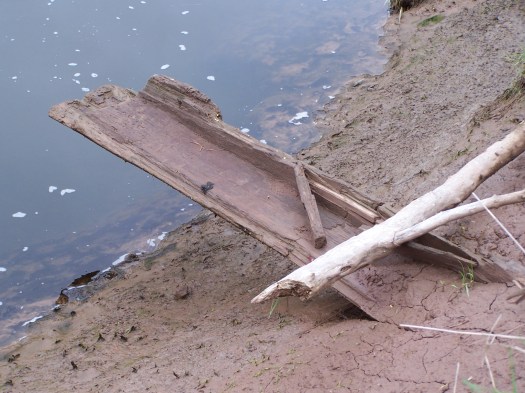
The other event was discovery this spring of an object protruding from the claylike banks of the Cornwallis River in Kentville.  Kings County Museum curator Bria Stokesbury noticed the object while walking in Miner Marsh and decided to investigate.  “Something caught my eye sticking out of the bank on the opposite side of the river from the marsh,” Stokesbury wrote in an email.  “I finally took my camera and got some pictures.  It looks like an aboiteau to me.”

When I looked at the photographs Stokesbury emailed me, my first impression was the same as hers – that I was looking at an aboiteau sluice.  An aboiteau is a sluice with a one-way valve the Acadians used to prevent flooding of land they dyked.  The aboiteau allows water to drain from dyked fields but prevents tidewater from flooding them.

Intrigued by photographs of what appeared to be the remains of an aboiteau sluice, I decided to take a closer look at it.  I walked down the side of the river the sluice was on and when I got close I was surprised by what I found. First of all, the object is an old sluice of the type once commonly used by the Acadians to make an aboiteau functional.  The sluice appears to have been handmade, hewed out apparently from a log.  This alone would indicate it is old, but how old it is difficult to say.

Secondly, the sluice protrudes from the bank of the river about a meter below ground level, meaning it has to have been buried for a long time, perhaps since the Acadian or Planter period.  The ground nearby is really marshy, the type of tide-flooded marsh the Acadians would have tried to reclaim by putting in dykes and aboiteaus.

Now, as for the connection between the Terry-Young property and the old sluice, let’s speculate that the house confirms an Acadian presence in what is now the town of Kentville.  The marshy area where the sluice was discovered isn’t far from the Terry-Young house.  If Acadians had settled in this area and had decided to reclaim land from the tides, the nearby marshy area was a logical place to start.  Evidence of this dykeing should show up from time to time and it has with discovery of the old sluice.

There’s more to the story.

The marshy land where the sluice protrudes from the banks of the Cornwallis River is owned by Jim and Sally Haverstock; part of this marshy land is also the property of the town of Kentville.   The Haverstock land, which is behind their Chestnut Place house, is bordered on the east side by Mill Brook and on the north by the Cornwallis River.  Jim Haverstock discovered an old aboiteau on Mill Brook decades ago and you can still see the ancient trough jutting from the bank.  There’s also the remains of an old dyke on this property, which is separate from the running dyke constructed and maintained by the Department of Agriculture.

The Haverstock meadow was cattle pasture at least a century ago.  The late Garth Calkin recalled when he was boy herding cattle on the meadow, then known as the Calkin Meadow, about a hundred years ago.  This land was once part of a Planter grant.  On February 19, 1766, Jonathan Darrow received a grant of 500 acres, land Arthur W. H. Eaton mentions in his county history as including some of downtown Kentville.   About six months later, Darrow sold the land to James Fillis and Joseph Pierce. Fillis farmed his land, part of which today is the town’s business section. According to Eaton, Fillis built a house smack in the town’s business district, about where Centre Square is today.

To sum up, from what Eaton has to say, the area in and around downtown Kentville was farmable land we can speculate would have interested the Acadians.  Furthermore, the aboiteau on Mill Brook discovered by Jim Haverstock, and the aboiteau sluice found recently by Bria Stokesbury indicate the area close by the town’s business section was dyked and at least two aboiteaus were constructed.  We also know, from the Terry-Young house, that Acadians once lived close to this land.

Early attempts definitely were made on the Haverstock/town property to reclaim tidal marsh from the Cornwallis River; but was it Acadians or Planters who were responsible?   Unless further investigations are made in that triangle of land formed by the Cornwallis River and Mill Brook we may never know.

aboiteau sluice

This old aboiteau sluice, recently discovered jutting from the banks of the Cornwallis River, suggests either Acadians or Planters dyked land in the town of Kentville. (E. Coleman)

GASPEREAUX (OR KIACKS) OFFER GOOD EATING (May 20/13)

Most anglers rate the brook trout as “the best eatin’ fish ever,” as a friend puts it.  Anyone who has had the pleasure of eating pan fried or barbecued brookies will agree that it’s one of the best when it comes to eating fish.  We’re talking fresh water and not salt water fish here, of course.  There are many who will argue that brook trout can’t compare to striped bass or flounder for table fare but, like I said, we’re talking fresh water fish here.

When it comes to frying up brook trout, the smaller fish are better.  To me, large brook trout, 10 inches or more, tend to taste a bit muddy or earthy – I can’t think of more appropriate words to describe the damp, river bottom flavour of large brookies.

Brown trout, even the smaller fish, aren’t as tasty as brook trout.  The same goes for rainbow trout.  Browns and rainbows have a bit too much river bottom flavour for me, but I suppose with a bit of experiment with various condiments they can be perked up and made tasty.

Fish for fish, I believe white perch and smallmouth bass stand out as superb table food, even when compared to brook trout.  To me, pan fried filets of smallmouth bass taste a lot like striped bass; pan friend filets of white perch are a close second.

Now, when it comes to eating fish not classified as a sporting species, the lowly gaspereau rates near the top.  For hundreds of years the run of gaspereaux has been a traditional spring fare in the Maritimes.  Never mind that nonsense about the gaspereau being to bony to enjoy.  Dining on the pale, slightly oily flesh of the gaspereau (which is high in healthy omega-3 fatty acids) is worth the effort of picking out a few thousand bones from each fish.

You could employ a method of preparing gaspereaux a friend told me about a few years ago.  After it has been cleaned and the scales and head removed, lay the fish on its side, cut along its length and remove the lower half of the body. This eliminates most of the rib cage and three quarters of the bones; what’s left is might good eating.

Here on the Gaspereau River and down the Valley on the Annapolis and Nictaux River I’ve never heard of this fish being called anything but a  gaspereau.  They’re referred to as kiack in other areas of the province, which might come from the Mi’kmaq word ki’ak.

Gaspereaux will take a fly, by the way.  I’ve caught gaspereaux in the Gaspereau River using size 12 yellow wet flies.  I’ve had to argue with federal fisheries officers on more than one occasion when doing so, however.  They told me I couldn’t legally angle for gaspereau, yet below me on the river fishermen were catching thousands of them in their nets on every tide.

Difficult to find nowadays is the finest fish treat of them all, smoked gaspereau.  At one time there were at least half a dozen smokehouses operating in the Gaspereau Valley when the spring run was on, all turning out smoked gaspereau.  I’m only aware of one smokehouse operating today in this area and good luck if you can get on the waiting list for a few of these golden, smoked goodies.