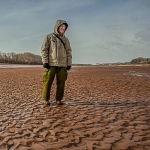
DYKEING THE CORNWALLIS – EARLY ATTEMPTS (April 2/99)

“It is necessary, in order to raise grains, to drain the marshes which the sea at high tide overflows,” the Sieur de Diereville wrote of his travels in Acadia in 1699. “It is not easy to stay the course of the sea,” de Diereville continued, “(but) the Acadians nevertheless accomplish the task by means of strong dykes which they call aboteaux.”

As we know from history books, the Acadians did accomplish this task well; the evidence is all around us in Kings, Hants and Annapolis County. Much of the prime farm land in these areas was first dyked off by the Acadians. A number of dykes and aboiteaux stand today where they were originally conceived and laid out by the Acadians.

Locally the Acadians placed dykes and aboiteaux on the Pereau, Canard and Habitant (Canning) River. There are running dykes on the Cornwallis River, some of which are of Acadian origin. However, there is no evidence that the Acadians attempted to place a cross dyke and aboiteau on any part of the Cornwallis.

This seems puzzling at first since the Acadians dyked other major waterways in this area – in some cases feeder streams were dyked as well. When we take a second look, however, we can see that the Acadians would have been gained little by placing an aboiteau on the Cornwallis. Dykes and aboiteaux were built with one purpose in mind: to hold back the sea and create farm land.

What agricultural land would have been reclaimed by dykeing the Cornwallis and placing an aboiteau on it? Running dykes along the lower Cornwallis salvage meadows that were being flooded daily, but there were no great upland meadows to be claimed from the sea such as are found on the Canard and Habitant.

Beside lack of reclaimable uplands, the Acadians may have ignored the Cornwallis because of its nature. Compared to the Pereau, Canard and Habitant River, the Cornwallis is swift, treacherous and deep; its tidal force is concentrated in a narrow, muddy channel that may have been too powerful to contain. In other words, the dykeing techniques used by the Acadians may have been inadequate for the Cornwallis.

But if not the Acadians, what about the Planters? Did they consider dykeing the mighty tidal waters of the Cornwallis?

The answer is a tentative “maybe.” In his History of Kings County, Arthur W. H. Eaton quotes an earlier historian, Dr. Benjamin Rand, who says that an aboiteau is “now proposed at the old French ford at Starr’s Point.” Eaton gives no year for the proposed aboiteau but the date may have been 1865. The Statutes of Nova Scotia for that year record an “Act to provide for building an Aboiteau across the Cornwallis River.” The site of the aboiteau was to be at Port Williams.

The historical records don’t tell us why this plan to build an aboiteau on the Cornwallis was never carried out. Like the Acadians perhaps, 19th century engineers found that blocking the Cornwallis and putting is a sea gate was not only difficult but impractical. If the aboiteau was placed at Port Williams, for example, wouldn’t the farmlands on the seaward side in this area be flooded on every tide?

While the loss of farmlands already reclaimed from the sea may have resulted from a Cornwallis River aboiteau, this didn’t stop people from considering it again. In 1912 an act was passed to incorporate the Cornwallis River Aboiteau Company. The plan was to build an aboiteau on the river “west of the present bridge at Port Williams.” Once again the plan was dropped, perhaps because of the downstream flooding that would have resulted.

SAXBY GALE – STORM SURGE DEVASTATING (March 26/99)

One of my friends claims that the greatest natural disasters to hit Nova Scotia were the mice plague of 1815, the Saxby Gale in 1869 and his wife’s pot roast dinner.

Geologist Alan Ruffman may not agree with the lumping of someone’s cooking with mice plagues and destructive hurricanes; however, when he spoke about the Saxby Gale at the Wolfville Historical Society on March 17, Mr. Ruffman said that the “hurricane and storm surge associated with it was quite devastating.”

When the Gale struck Nova Scotia and New Brunswick, Mr. Ruffman said, hundreds of buildings were destroyed, there was great flooding, and thousands of mature trees were destroyed. While there were only a few deaths locally as result of the storm, over the course of the Gale through the Atlantic Provinces and the United States over a thousand lives may have been lost. “It was quite a serious, serious storm,” Ruffman said.

A short time before the Saxby Gale came ashore in Nova Scotia, the Dominion Atlantic Railway had celebrated arrival of its line in the Annapolis Valley. In her railway history Marguerite Woodworth describes the devastating effect of the Gale on the D.A.R. line and on Valley residents:

“On the night of October 4 …. the wind rose until it became a veritable hurricane and with it came a great tide from the Basin of Minas, rolling in over the dykes and carrying everything before it. The morning of October 5th revealed a scene of destruction: Throughout the Valley orchards were laid low, the apples torn from the branches; uprooted trees lay across the highway; crops were flattened; brooks became swirling torrents.”

Mr. Ruffman’s name for the great tide that came with the hurricane is “storm surge,” a rapid rising of tidal waters above normal levels due to a combination of high winds, high tide and other factors. The Saxby Gale arrived during a period when tides were at unusually high levels and it was too much for the dyked areas and the newly laid railway line in Kings and Hants County. “Bridges, tracks and fencing had been swept away over an area of nearly 20 miles,” Woodworth said. “The dykes along the right of way were nothing but a turbulent sea and the roadbed had crumpled before the tidal wave like sugar.”

During his talk before the Historical Society, Mr. Ruffman mentioned the Saxby Gale briefly, dwelling mainly on hurricanes in general. Hurricanes are nothing new to North America – there have been at least a thousand in the past 100 years, Ruffman said – and Nova Scotia has had its share. A hurricane and storm surge disrupted the early Acadian settlement, for example. In the last four or five decades some hurricanes have been as destructive as the Saxby Gale.

Mr. Ruffman concluded his talk on hurricanes by screening a map of the Minas Basin indicating dyked areas that could be hardest hit by future storm surges. The conditions that prevailed during the Saxby Gale can occur again, Mr. Ruffman said.

While there isn’t a lot of information out there, Mr. Ruffman said, he has been attempting to document the havoc wreaked by the Saxby Gale in the Atlantic Provinces. Hopefully, he said in effect, people out there have old letters, diary entries and other references to the Gale. If so, Mr. Ruffman would appreciate having access to them.

RANDSVILLE – A COMMUNITY THAT DISAPPEARED (March 19/99)

“Come and gone with the wind is the rural community of ‘Atlanta,’ near Sheffield Mills, which has recently been obliterated by the caprice of the Nova Scotia Department of Highways,” Watson Kirkconnell writes in his book on Kings County place-names.

“Easy come, easy go,” Kirkconnell adds, noting in the meanwhile that the majority of place-names in Kings County are of Planter and Loyalist origin and that most are still in use today. However, some Planter and Loyalist place-names have been changed, have been dropped from usage for various reasons or have simply disappeared. Among the former that come to mind are Port Williams, Kentville and Wolfville which at one time had Planter-inspired names. I’m aware of only a few Planter place-names that have disappeared and one of these is the topic of this week’s column.

Borden Street, which is named after one of our most famous Planter surnames, runs west from Canning and connects to Sheffield Mills. Along the Borden Street stretch between Canning and the Mills is a sort of no man’s land that has no name; it is neither Canning nor Sheffield Mills (though it has been called both). The trend today is to refer to this area simply as Borden Street as if it were a community. However, if you had traveled over this piece of highway in the 19th century, you would have passed through the now vanished community of Randsville.

Jonathan Rand was one of three brothers who were among the original Planter grantees in Cornwallis (Eaton’s Kings County history, page 793). According to Howie Rand, Randsville was part of Jonathan Rand’s original grant, which was north of the Habitant River and took in most of the area along Borden Street that lies between Canning and Sheffield Mills.

I first heard about Randsville when Leon Barron told me recently about a reference in 19th century government papers to a public school in the old community. Apparently Randsville was first a community and then a school district. The school in Randsville was constructed in 1878 (Marie Bickerton in her book on Canning and area history) and was located near Lyndhurst Farms where the old dyke road crosses from Saxon Street.

I have been unable to determine when Randsville ceased to be known as a community or when the school district closed and was amalgamated with Canning. The closing of the school and the disappearance of Randsville as a place-name are probably connected.

Since hearing about Randsville I’ve scoured various historical sources for reference to the community and found little. Eaton’s Kings County history has high praise – and rightly so – for the Planter Rands but there is no mention of Randsville. Watson Kirkconnell failed to come up with Randsville in his book on Kings County place-names even though there is a section on the Planter contribution. Charles Bruce Fergusson’s massive compilation of Nova Scotia place-names has no reference to Randsville; and I was unable to find Randsville in a similar work published in 1922 by Thomas J. Brown. Marie Bickerton’s Canning history refers to Randsville, or actually the Randsville school, three times.

Mention in government papers and Bickerton’s history are the only printed references to Randsville that I could find. So except for the memories people have of the old school, this is the only evidence that the community of Randsville once existed. Like the early Irish settlements on the North Mountain and along Saxon Street, Randsville has vanished and the reason why may never be known.

THE D.A.R. – “WHAT A PITY IT IS GONE” (March 12/99)

I occasionally refer to Marguerite Woodworth’s Dominion Atlantic Railway history in this column. Published in 1936 and never reissued as far as I know, the book is difficult to find and commands a higher than average price for used, out-of-print books. If you own a copy and will part with it, don’t let it go for less than $50; the going price at used book stores is slightly higher than $50. depending on condition.

If you are interested in reading Woodworth’s D.A.R. history there is a copy in the Wolfville public library; Woodworth’s book should also be available at the Acadia University library.

I mention the Woodworth book because of a letter received earlier this winter from Hugh Kinsman of Bobcaygeon, Ontario. Mr. Kinsman was looking for Woodworth’s history and I directed him to the Odd Book in Wolfville where I had seen a copy that was in excellent condition.

When I replied to Mr. Kinman’s letter I asked if he was a former employee of the D.A.R. and wondered if he had any memories he would like to share with readers of this column. In a second letter Mr. Kinsman said that while he was not a former employee he would have been proud to have been associated with the railway.

“I’m afraid that my experiences would hardly merit the interest of your readers,” Mr. Kinsman wrote. “For instance, few would care that we virtually set our clocks by the train whistle at the Sheffield Mills station and that the engineer waved to us kids as he passed within a few feet of Canning school.

“Two of my cousins married D.A.R. men – one of them to Ben Patten and the other to Joe Dickie. I’ve heard Ben and Joe referred to as ‘Spic and Span’ relating to their housekeeping in the D.A.R. caboose! Besides Ben and Joe, there are several D.A.R. men I knew through their sons – Howe Harris, Biscuit Corning, Herbert, Ritchie, Crosby, Banks, Boyle.”

Mr. Kinsman concluded by saying he was sorry because he didn’t know more about the D.A.R. “I’m afraid we took it for granted we’d have this dependable and convenient service forever. What a pity it is gone!”

The touch of nostalgia in Mr. Kinsman’s letter is, I’m sure, experienced by many people when the topic of the D.A.R. comes up. Like many people in this area I grew up when the railroad was in its heyday and I certainly took it for granted. My old newspaper route began in the morning when the train arrived from Halifax. After the bundles of daily papers were tossed on the station landing and distributed to the waiting paperboys I paid a dime to ride the train to Aldershot Camp.

I took my morning train ride to sell newspapers at Aldershot Camp for several summers. Later, after the run was discontinued, I regretted not riding the train north to the end of the line at the Kingsport wharf. A number of boys in the neighborhood camped, fished and dug clams at Kingsport and Medford every summer, using the train to tote the tons of gear necessary for youthful excursions.

If I remember correctly the train carrying the newspapers from Halifax arrived in Kentville after 10 o’clock. It must have been at least 10 o’clock or later because when I went through high school at KCA, students came from the Canning area on an early morning train. I never heard that the Halifax train running north to Aldershot and the morning train carrying the KCA students to Kentville ever met head on.

Like many Valley residents I have many pleasant memories of the train; and like most I never thought that one day the runs would stop and the rails would be torn up. As Hugh Kinsman said, what a pity.

DR. GIBSON ON “ACADIAN NATURAL HISTORY” (March 5/99)

If one knows the approximate areas to look, it may be possible to locate the sites of Acadian homesteads. As recently as the 1950s Acadian cellars were visible in Upper Dyke, Canard, New Minas, Grand Pre and in areas running eastward to Gaspereau and the Hants County border.

However, while Acadian cellars are not easily discernible today, there are various clues indicating where they may be found. Speaking at the Kings Historical Society on February 23, retired Acadia University professor Dr. Merritt Gibson said some plants are indicators of possible Acadian homesteads.

One of these plants is the wild daphne. One of some 87 plants, shrubs and trees the Acadians are known to have introduced to Nova Scotia, the daphne was used as an ornamental shrub. Slow to spread, the daphne often grows close to sites of Acadian homes, Dr. Gibson said. “If you find daphne growing in profusion, you can be certain that the Acadians once lived nearby.”

Another plant that may indicate Acadian homesteads is the red fly-honeysuckle. While it is planted today for ornamental purposes, Dr. Gibson said that in the wild the red fly-honeysuckle has “remained largely in areas of Acadian homesteads and is a good marker in finding such sites.”

A number of plants introduced by the Acadians were used for medicinal purposes and many of them grow wild today and are classified as weeds. Dr. Gibson asked members of the Historical Society if any of them remembered the tansy tea their grandmothers used to make them drink at the least hint of a sniffle. “It was bitter stuff,” Dr. Gibson said, adding that we have the Acadians to thank for introducing tansy. The Acadians made a tea from tansy for use as a tonic and to treat colds and fevers. Also among the plants introduced by the Acadians for medicinal and culinary use were red yarrow, chicory, wormwood, caraway, hops and slender vetch.

When the Acadians arrived in Nova Scotia the climate was going through what Dr. Gibson called the “little ice age.” It was much colder here in the Acadian period, Dr. Gibson said, and this affected the types of plants and animals that were here. One of the birds harvested by Acadian hunters was called by them the “white partridge.” This was the ptarmigan, Dr. Gibson said, a northern bird that once thrived here but disappeared as the climate warmed up.

The colder climate during the Acadian period also brought beluga whales into our waters, Dr. Gibson said. Beluga are now found mainly in the St. Lawrence River but in the Acadian period they were regular visitors to the Minas Basin. The Acadians hunted beluga, which they called “white porpoises,” for blubber which they processed for oil – “one for home use and two to be sold,” Dr. Gibson said, apparently quoting from Acadian records.

Another indication that the Acadians lived in much colder times, Dr. Gibson said, was the presence of wolves in Nova Scotia. Evidence that wolves were considered a threat by the Acadians is found in a 1750 petition they drew up after their firearms were confiscated. In the petition the Acadians asked that their firearms be returned, mentioning they needed them to protect domestic animals from wolves.

When the Acadians arrived in this area there were no fields and the forest grew down to the marsh. “It was a mature forest, a forest that had never been cut,” Dr. Gibson said. The native tress, red and white pines, hemlock, beech, sugar maple, red and white birch, were here and the Acadians introduced others, such as the Lombardy poplar and French willow and at least seven types of apple trees.

ALL THE OLD APPLES – AND MORE (February 26/99)

During a break in our Friday night card game I brought out some apples and challenged the guys to name the varieties before they dipped into them. There were Cortlands and Macs, which I knew would be named immediately, but I figured that a couple of the varieties might not be recognized by the younger members of our card club.

As I suspected, only the seniors in our card group were able to identify the old-fashioned Gravensteins. No one identified the Cox’s Orange, an old variety that was a favorite in our grandparent’s day. Which was a surprise, by the way, since a couple of the club members have lived in the Valley’s apple belt over half a century.

On the other hand, maybe it shouldn’t have been surprising. Many of the old apples have disappeared and have been forgotten. In the marketplace today are apple varieties that were never heard of a decade ago.

My favorite apple is the Bishop Pippin; you can still find this apple if you know where to look out in the country, but most of trees have been cut down. The Bishop Pippin has a sweet, wine-like flavor and would certainly be a hit with the younger generations if it was readily available. But perhaps like many of the old apple varieties that have disappeared, they weren’t hardy enough, or storageable, or disease-resistant enough, or shippable or something.

The work of the Acadians has had a social and economic impact on this area that is often ignored or overlooked. While an obvious example is the dykes, the Acadians may have laid the foundation for the Valley’s apple growing industry. Eaton says in his Kings County history that the “first fruit gardens of Kings (County) were planted by the Acadians.” Eaton refers to the Acadians as “fruit-raising pioneers.”

In his discussion on Acadians and apples, Eaton the historian is quoting from an essay by Eaton the fruit-grower. Ralph Samuel Eaton, the originator of the famed Hillcrest Orchards northeast of Kentville, wrote that the “patches of fruit trees” planted by the Acadians “encouraged the New England settlers …. and they soon began to enlarge the orchards and introduce new varieties of fruit.”

When Eaton the fruit-grower wrote his essay, which may have been for the annual report of the Nova Scotia Fruit Growers’ Association in 1892, or 1893, he said that a few of the apple trees planted by the Acadians still existed. “A few individual trees at Gaspereau, Grand Pre and Canard still stand, which are supposed to have been planted by (the Acadians)” Eaton wrote.

In the essay Eaton named many of the early pioneers of apple-growing in the Annapolis Valley. Among these pioneers are names familiar to Valley history buffs: Col. John Burbidge, who started the Nonpareil and Golden Russet; Bishop Charles Inglis, who introduced the Bishop Pippin (or Yellow Belle fleur); Ahira Calkin, who introduced the Calkin Pippin and Calkin’s Early.

Last summer a new apple variety was dedicated to another fruit-growing pioneer, Charles Ramage Prescott, who died in 1859. A news release in this paper said Mr. Prescott helped to introduce various varieties of apples, grapes and peaches. Eaton’s history is more specific, mentioning a number of apples that Prescott cultivated – and incidentally giving us the origin of many of the old varieties, some of which are still on the market today.

“Here, in his beautifully kept garden,” Eaton said, “Mr. Prescott planted the Ribston, Blenheim, King of Pippins, Gravenstein, Alexandra and Golden Pippin, which he imported from England, the Baldwin, Rhode Island Greening, Esopus Spitz, Sweet Bough, Early Harvest and Spy, which he obtained from the United States, and the Fameusse, Pomme Gris and Canada Reinette, which he got from Montreal.”

HABITANT – AN EARLY ACADIAN SITE (February 19/99)

“Of the dozens of Acadian hamlets that speckled Kings County countryside in early 1755 …. only four survive by name in 1971, namely Grand Pre, Gaspereau, Melanson and Pereau,” Watson Kirkconnell wrote in his study on local place names.

Dr. Kirkconnell either overlooked or ignored the old community of Habitant, which lies immediately east of Canning and was one of the first areas settled in this region by the Acadians. Outside Canning, by the way, there is evidence that in some quarters the existence of Habitant is still being ignored. Just as you leave Canning driving east a road sign announces that you have entered Habitant. A hundred meters or so past this sign another sign indicates that the “Canning Aboiteau” lies to your right.

Putting this triviality aside, let’s look at the history of Habitant, which may rightfully claim to be one of the oldest settlements in this area. Over half a century ago Ira Cox compiled a collection of historical facts about Habitant, which was published in this newspaper in 1950. Cox identified Habitant as a unique community of Acadian origin.

Like many rural communities in the Annapolis Valley, Habitant has nebulous borders. Road signs may mark where Habitant starts and ends, but most people refer to its western area as Canning and the east end as Kingsport. Habitant, or Habitant Village as it was once called, may have been situated west of Canning at one time In his newspaper article Ira Cox wrote that according to an early map, “the west end of Canning, at the corner of the highway near the residence of the late Dr. John Miller, was known as Habitant Village.” However, this reference to a westerly location for Habitant was most likely an error.

Mr. Cox notes that “Habitant, as we consider it today (1950) is the school section 54, about two miles of street between Canning and Kingsport.” This areas was settled by the Acadians between 1670 and 1680. After the expulsion of the Acadians, the whole of Habitant may have been granted to four individuals. Cox names two of the grantees as Loomer and Rand. One of Cox’s ancestors also received a large grant in Habitant. Capt. John Cox, “who landed the greater part of the New England settlers in this part of the province,” was rewarded with a large land grant, part of which may have been in Habitant. Ira Cox wrote that it wasn’t clear who the other early Habitant grantees were but he notes that “MacKenzie and Wickwire are also mentioned among the names.”

For the most part, Ira Cox’s history is a record of the “individual residences or homes” of Habitant. After a brief preamble on the Acadians and Planters, Cox writes that he “will begin at the east end of the street” and tell his readers who has occupied the various Habitant homes that existed in 1950. In this recounting we learn that beginning with Capt. John Cox, seven generations of the family have lived on part of the original grant since 1775.

Several sons of Capt. Cox built homes in Habitant and the property of one of them, Harry, was eventually owned by a couple of famous Valley personages. In 1897 Sir Frederick Borden purchased the property that Harry Cox originally built on. Cox tells us that this property was inherited by Borden’s daughter after his death. In 1949 the property was purchased by a company headed by R. A. Joudrey.

Many of the names Cox mentions belong in a who’s who of Annapolis Valley and Nova Scotia history. Besides Borden and Joudrey, Cox mentions Rand, Wickwire, DeWolfe, Eaton, Newcombe, Blenkhorn and Chase, the surnames of families that were among the movers and shakers of this area.

NEW MINAS WAS ACADIAN SETTLEMENT (February 12/99)

In a fax to this newspaper, Geoffrey Muttart referred to a three acre area the Village of New Minas plans to turn into a park and suggested we look at its history. “It would be a shame to have a park with no mention of the historical significance of the immediate area,” Muttart wrote.

Mr. Muttart noted that since the park will soon be a reality, the Acadian/Native connection the park area should be researched. “I seem to recall mention of a burial ground (in Eaton’s History of Kings County)” Muttart said.

Eaton’s History does indeed mention a burial ground in New Minas, In fact, there are several pages on New Minas that will be fodder for anyone doing historical research in relation to the park. New Minas was the site of an Acadian settlement. Eaton suggests New Minas was settled because the first Acadians had taken the best land along the Minas Basin and latecomers had to look elsewhere. In one sense history repeated itself centuries later. New Minas became a major commercial center when retail firms in Kentville looked for space to expand.

According to Eaton, New Minas apparently was a “somewhat important hamlet” in Acadian days. He bases this assumption on the works of contemporary researchers which he quotes freely. The sources Eaton quotes reveal that New Minas had a priest, a chapel and the Acadians may have built a small stone fort nearby.

The Acadian farms mentioned in Eaton’s History may not be easily located today since his work was published almost 90 years ago. However, Eaton has important references to Acadian sites and the efforts of the Acadians to settle the New Minas area. These references, two of which are quoted below, refer to the Acadian chapel and burial ground; these quotes should help determine if historical sites of any importance are located in the proposed park.

“On what was formerly known as the Best Farm, now owned by Amos Griffin, in New Minas, was a French village, where there was a chapel and a resident priest. Most of the cellars have been filled, but the foundations of the chapel, say 28×36 feet, are still partly visible, as are also the supposed site of the priest’s house …. By the side of the brook, about 50 rods from the chapel, some of the first English settlers found a set of blacksmith tools buried. They found also, a mile or two south, in the woods, remains of a stone building, which has always been known since as the French fort.”

“Minas, with its dykes, consisted of the village along the banks of the upland with the Grand Pre lying in front, and with Long Island and Boot Island bounding it on the north. As new lands for settlement were wanted, some of the (Acadians) went up the Cornwallis River and found a place that seemed curiously familiar.

“There was a piece of marsh somewhat resembling the Grand Pre, with Oak Island lying outside it. On the edge was a similar chance for settlement to that furnished by the upland that bordered the Grand Pre. They, therefore, put in short dykes at each end of Oak Island, reclaimed a considerable piece of marsh, built themselves some houses, and called their settlement New Minas.

“In later times French cellars have been numerous here …. The center of the (settlement) was what afterwards became known as the Foster farm. The French burying ground is said to have been on a little knoll near the railroad track. To the south and east of the Griffin house a chapel was built …. It would seem as if there was a burying ground here, too, and tradition says that not far off there was a mill.”

HISTORICAL NUGGETS IN SESSIONAL PAPERS (February 5/99)

These dry, dusty pages from our past are as exciting to read as a recipe for a mustard poultice.

Yet the journal and proceedings of the Nova Scotia House of Assembly, which mainly are column after column of expenditures on roads, bridges, wharves and so on, offer valuable clues about our past. I have before me, for example, copies of the House of Assembly lists for the years 1844, 1845, 1846 and 1847. Leon Barron found these records at Acadia University library and they have helped him with his research on the old Kingsport wharf.

As mentioned in last week’s column, Barron is building a miniature replica of the wharf which was first laid down over 130 years old. Before he could proceed Barron required answers to several questions. In what year did the Oakpoint Pier Co. lay the foundation for the wharf and open it for shipping? When was the wharf turned over to the province and/or the federal government? When were the various stages of the wharf – seven in all – constructed.

If one has the patience to pour over those tedious lists, the answers to these questions are in the journal and proceedings of the House of Assembly. There are other historical nuggets as well; which I suppose could be called mini-nuggets since they mostly fill in missing pieces of local history.

Where and when was the first bridge placed on the Cornwallis River? Port Williams, Kentville or another location? Tantalizing clues can be found in those old lists. In 1845 the provincial government granted the sum of 1,375 pounds “for the service of Roads and Bridges in Kings County” and there is the following entry: “To complete the Bridge over the Cornwallis River near Kentville and on the Road from thence northerly to Mrs. Silver’s, and to pay Wm. McKittrick two pounds, an over-expenditure on said Bridge, 1844 – 50 pounds.”

From this we known there was a public bridge over the Cornwallis, near Kentville, as early as 1844. An entry in the 1846 proceedings indicates there may also have been another bridge spanning the Cornwallis at that time. An entry reads that the sum of 12 pounds was allotted for work on the road from “John Parson’s to Annapolis Road, and to build a bridge over Cornwallis River (in addition to 11 pounds undrawn last year).”

Other interesting tidbits from the House of Assembly proceedings:

That mysterious, aloof Isle Haute in the Bay of Fundy once had a lighthouse. In 1847 the sum of 1,250 pounds was granted to build a lighthouse on the Isle.

Just over 150 years ago some enterprising Horton businessmen decided that a steamship service from the Minas Basin to New Brunswick would be feasible. The House of Assembly records show that a petition was presented for “John Fisher and others, of Horton, by Mr. DeWolf and read, praying aid in the erection of a Wharf or Pier at Blue Beach, on the Windsor (Avon) River for the accommodation of a Steam Boat plying between St. John, N.B. and Windsor.”

While that wharf was never built and the steam boat never ran from Blue Beach, we can see from the Assembly records that dyke and road repairs were an ongoing expense. In 1845: The dyke Gate on the new Road crossing the Grand Prairie (Grand Pre) – 15 pounds. “Little Island to Boot Island and to secure the embankment – 8 pounds.” And again in 1846: “Little Island to Boot Island and to secure the embankment – 10 pounds.” Most of the Sessional entries for 1844 to 1847 refer to the building of new roads or extension of existing ones. It’s speculation but perhaps many of our current roads came into existence in this period.

WHARFS, READERS AND ROYAL OAKS (January 29/99)

In the 100 plus years that it has existed the wharf at Kingsport has gone through numerous changes. Constructed sometime before 1865 by the Oakpoint Pier Co., the once busy wharf has been remodeled seven times, the last upgrading taking place in 1911.

Once an important terminus in the glory days of sailing ships and railroads, the Kingsport wharf is now a ragged shell. However, a project by Kentville amateur historian. Leon Barron, will give us a glimpse of what the wharf looked like in the various stages of its existence. Barron is currently building a wooden replica of the old wharf on a scale of one inch to 10 feet. His model should be complete sometime this summer, and will be on display locally. Mr. Barron has also unearthed a lot of historical data on the wharf and a capsule version of his findings should accompany the display.

Recently I received a call from a Wolfville reader who had some observations on the column about the non-existent Port Williams lighthouse. The reader said that in effect there actually was a lighthouse that served Port Williams.

When the reader attended Acadia University she said there was a lighthouse at the mouth of Wolfville harbor. The reader contends that since Wolfville harbor is at the mouth of the Cornwallis River, said lighthouse would be useful to ships navigating upriver and hence could be considered as serving Port Williams.

This sounds logical and to argue otherwise is pointless. However, the lighthouse in the harbor mouth, which I’ve been told was demolished or destroyed by fire in the 1960s, was known unofficially as the Wolfville light and was placed to serve Wolfville harbor. Large freighters navigating the Cornwallis River to Port Williams usually did so with the assistance of a pilot who resided locally. Apparently it was never considered necessary to have a lighthouse at Port Williams, perhaps because of the river pilot system or because there was a lighthouse marking the possibly treacherous sandbars off Wolfville harbor.

In December I ran Gordon Hansford’s story about the old Wolfville High School band’s Christmas concerts in the belfry of the Baptist Church. Here’s another Hansford tale about a “Royal Oak” that grows in Wolfville.

“There is an old gnarled oak tree to the west of the driveway of the Wolfville Post Office. Alfred Lake, who had been born in England was a veteran of WW1. He served with the 85th Nova Scotia Battalion and was badly wounded. Around 1947 he pointed this oak tree out and related this story to me.

“He said that after leaving the hospital in England on convalescent leave in 1918 he went to Windsor to see the castle. On the grounds of the castle there was a large, very old oak tree, which was a descendant of the tree in which King Charles took refuge at the time of the English Civil War.

“It was called the Royal Oak and Alf picked up a few acorns from it. Upon returning home to Wolfville he planted these acorns. He became caretaker of the old sandstone Post Office and always kept the grounds in immaculate condition. He planted the oak tree and it still stands today.”

Some historical trivia from the Internet: The most numerous surnames in this area in 1881 were Newcomb, Eaton, Bishop, Borden, Harris, Caldwell. Ells, Ward and Davidson. In 1864 the most numerous surnames were Bishop, Porter, Parker, Newcomb, West, Harris, Eaton, Smith, Graves, Taylor and Tupper. Between 1864 and 1877 the most numerous surnames in Kings, Hants and Annapolis County were Smith, Parker, Sanford, Brown, Harvey Miller, Harris, Bishop, McDonald, Mosher, Burgess, Marshall, Foster, Morse, Porter, Chute, Newcomb, Caldwell, Patterson, Wallace, Taylor, Wilson, Whitman, Young and Johnston.