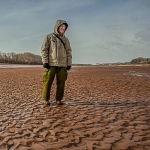
EATON ON ACADIANS AND THEIR DYKES (July 17/98)

I’ve mentioned local historian Ernest Eaton on numerous occasions, most recently in a February column on a 900-year-old pine log found on the Canard dykes. Mr. Eaton was involved in research on the pine and the result was a plaque at the Old Kings Courthouse Museum.

After that column appeared, and perhaps spurred by it, a telephone call came from Veronica Connelly, Windsor. Ms. Connelly told me about a talk Eaton gave in 1984 on the Acadians and their dykes at the West Hants Historical Society. The talk had been taped Ms. Connelly said, offering to forward a copy.

Hearing Mr. Eaton’s gravely voice on that tape brought back memories of times I visited his home and listened to stories about his favorite topic, the Canard dykes. “One of these times I’ll put together a book based on my research” Eaton used to say when we talked about the dykes. As far as I know he never did. His work lies in scattered papers and on recordings such as the tape I received from Veronica Connelly.

“The older I get, the more I appreciate the diligence, the energy and the high degree of esoteric skill that the (Acadians) exercised in building these dykes.” Eaton began his talk with this observation, noting that around the headwaters of the Bay of Fundy the Acadians had reclaimed approximately 100,000 acres of land from the sea, in the process creating hundreds of miles of running dyke. “It was a very great achievement,” he said.

Most of the dykework of the Acadians in this area was completed in a relatively short period of 90 years, Eaton noted. He described the dyke building expertise of the Acadians, an accomplishment he called amazing given the lack of machinery and modern materials, contrasting this with the feeble attempts at dyke building by English settlers in the 19th century. Then there were the engineers sent here by Ottawa when the government first got involved with dyke repairs some years ago. Eaton said they looked at the remains of the old dykes that were still in use and exclaimed, “You can’t build dykes like that; it can’t be done.”

The accomplishments of the Acadians were put in perspective when Eaton dwelt on the land they reclaimed: “It’s the only (area of) fertile soil in Nova Scotia of any size,” Eaton said. “I think there’s no place on the North American continent where such a poor piece of natural soil has been so productive as the Annapolis Valley. People talk about the fertile Valley but they don’t look at the soil as it was in its original state (before they Acadians began to dyke it).” Eaton added that as far as he was aware, “there are only two large marsh bodies in use that were not built by the Acadians.”

The Acadians began their dyke work in this area in 1673, Eaton said. “In other words, 35 to 40 years after the first settlers (arrived) at Annapolis, three families moved up the Minas Basin, families by the name of Landry, Theriault and LeBlanc. From that date on to the expulsion practically all the dykeland we see around here was reclaimed.”

That the Acadians could transform so much of the seabed into productive land in so short a time was a miracle, Eaton said. “Try to imagine what an accomplishment it was, what the Acadians did in approximately 90 years, in bringing many thousands of acres of dykeland into use.”

It’s an accomplishment we tend to take for granted today.


DR. CHASE’S RECIPES – A “CURIOUS” BOOK (July 10/98)

Found at the Kentville library in a box of used books selling for 25 cents each – a hardcover copy of Dr. Chase’s Recipes, 1862 edition. In excellent condition and no doubt a reproduction of the original.

An unusual book containing among other things, medicines once used to treat ailments common in grandpappy’s day. People of the older generations will recall the multitude of patent medicines once offered by Dr. Chase. Some of the older local newspapers I’ve looked at recently, the 1890 to 1910 editions of the Western Chronicle and Advertiser, for example, carried a host of the venerable Doctor’s advertisements, often two or three a page.

It really wasn’t that long ago that Dr. Chase’s Nerve Pills and Dr. Chase’s Ointment could be found on pharmacy shelves. Perhaps a few of his products are still being sold but I couldn’t find any when I called several drug stores recently. One pharmacist told me the nerve pills and ointment were the last products to carry the Dr. Chase name.

As mentioned, old Dr. Chase offered a great many treatments, usually for afflictions that had strange names and were curious in the sense of being uncommon or having exotic characteristics. In some cases, the “medical” concoctions were as curious as the maladies they treated.

Dr. Chase’s suggestion for treating “felons” (an old-fashioned term for inflammation around finger or toenails) is a perfect example: “Take a sweet oil, 1/2 pt., and stew a 3 cent plug of tobacco in it until the tobacco is crisped; then squeeze out and add red lead 1 oz. and boil until black; when cool add pulverized camphor gum 1 oz.”

Consumption (tuberculosis) was a common and deadly disease in Dr. Chase’s day and he offered a syrup as treatment. “Take tamarack bark, 1 peck, spikenard root, 1/2 pound, dandelion root, 1/4 pound, hops 2 oz. …” These ingredients were boiled in several gallons of water to which brandy and honey were added and the consumptive drank three or four glasses a day.

Following this recipe – and despite all the patent medicines bordering on quackery -there is a discussion about tuberculosis which reveals that Dr. Chase was ahead of his time. After admitting that the above syrup contained no ingredients “usually put into syrups for this disease,” Dr. Chase offers this sagacious advice for tubercular patients:

“First then, do not go south to smother and die; but go north for cool, fresh air; hunt, fish and eat freely of the roasted game; cast away care. Take a healthy, faithful friend with you to lean upon when needed in your rambles.”

On the subject of fat in the diet, however, Dr. Chase contended that a healthy lifestyle was impossible without it. Avoiding fat meat, butter, and oily gravies and substituting milk and eggs for them is a mistake, he said. “They (milk and eggs) constitute an imperfect substitute for fat meat, without which sooner or later the body is almost sure to show the effects of deficient calorification.”

If you found this amusing, Dr. Chase’s argument that chicken is worse than pork will leave you laughing: “Set a piece of pork before a lady; ‘Oh, horrible! The dirty, nasty, filthy stuff. Give us chicken, clean, nice chicken.’ Now this lady was no farmer’s wife or she would have observed that the habits of chicken are ten times more filthy than the hog, for even the hog’s leavings and droppings are overhauled by them, and much of it appropriated by ‘ladies meat’.”

WHITE ROCK’S GRIST AND LUMBER MILL (July 3/98)

(Built on the banks of the Gaspereau River above the White Rock bridge, the S.P. Benjamin grist and lumber mill began operations in 1885. The late Raleigh Eagles reminisced about the mill when I interviewed him years ago. Part two also includes reflections by Bert young, New Minas, who has written a book about his early days in White Rock.)

Part Two

The areas along the Gaspereau River and around Gaspereau Lake were the main sources of lumber for the Benjamin mill. S. P. Benjamin may have controlled thousands of acres of woodland when the mill was operating but it appears he wasn’t sure how much he actually owned. Raleigh Eagles remembers a story making the rounds when Benjamin sold his holdings to the Nova Scotia Light and Power Company. “Everyone was saying that when Benjamin sold out, the best he could do was estimate the number of acres he owned,” Eagle said.

Eagles also remembered the log drives down the Gaspereau River in the spring when the mill operated night and day. He told me about the teams of horses and oxen that hauled freshly milled logs through the Deep Hollow Road to Port Mills, “where they were loaded on schooners and shipped around the world.”

The haul through Deep Hollow, the most direct route to Port Williams, was made over a difficult and occasionally treacherous road. Before it was paved the road through the hollow was swampy and often had to be corduroyed – reinforced by laying poles crosswise – before horse and ox teams could traverse it. “At times even this didn’t help,” Eagles recalled, “and teams had to double up just to get through.”

Eagles said that ten teams of horses and “seven or eight yoke of oxen” were used by the mill at the peak of operations. Each team and yoke were expected to make two trips daily to Port Williams, a task that often took from dawn to dusk. These hauls, no more than one trip a day according to some, may have been made to Canning or Wolfville rather than Port Williams. There is some question whether lumber was being shipped out of Port Williams when Benjamin’s mill was in operation.

Lumber was hauled in what Eagles said the lumberjacks called “Dutch wagons,” so called perhaps because they were made on the South Shore. Eagles’ brother, Leslie, was a teamster with the mill and he often talked about the rigors of the daily hauls. The teamsters occasionally competed to see who could haul the largest loads. In one run, Leslie hauled 4,000 feet of finished lumber, a record that stood for years.

Dictated perhaps by a dwindling timber supply, S. P. Benjamin closed his mill after less than two decades of operation. In 1900 the mill machinery was dismantled and moved to Falmouth, a move Raleigh Eagles remembered as being unpopular at the time. “Those weren’t easy times,” he said, “and more than one family depended on the mill for their livelihood.”

Eagles told me there were other mills operating around White Rock besides Benjamins. This was confirmed recently by Bert Young who remembers that there were at least three small mills located along the Deep Hollow Road. In the 1920s Emery Schofield dammed the Deep Hollow brook and operated a steam mill on two sites. While he couldn’t recall details, Young said his grandfather Eagles operated a mill in the late 1800s at the northern end of Deep Hollow.


WHITE ROCK’S OLD GRIST AND LUMBER MILL (June 26/98)

If you look upstream from the bridge spanning the Gaspereau River in White Rock, you can see the area once occupied by Benjamin’s grist and feed mill. The late Raleigh Eagles recalled many details about the mill when I interviewed him for this newspaper in the early 70s. I kept the notes of the interview and they are incorporated in the following two-part story on the mill.

Part One

During the latter part of the 19th century, White Rock was the site of a bustling enterprise known as the S. P. Benjamin Grist and Feed Mill. The mill was built along the banks of the Gaspereau River in 1885 and operated for 15 years.

Little trace remains of the mill today. The site where the mill sprawled along the Gaspereau River just above the highway bridge has filled in over the years and there are few signs to indicate that a major industry once operated there. Mr. Eagles recalls that for a decade or so after the mill closed one or two small buildings remained to mark the site but these were swept away during a spring flood.

While time has erased most traces of the Benjamin mill, many long-time residents of the area remember it well. Eagles, who was 80 when I interviewed him, recalls walking past the mill when he was a schoolboy in White Rock. His father and brother worked in the mill.

Bert Young, New Minas, recalls that when he started school at White Rock in 1917, parts of the dam and the mill’s cribwork were still visible. Young said that two bridges spanned the Gaspereau at the mill site when he was a schoolboy. Mr. Young recently completed a book about his early days in White Rock – as yet unpublished – and while he says it’s “mostly reminiscing,” the Benjamin mill is mentioned.

When I interviewed Raleigh Eagles he showed me two photographs which had been in his possession for over 50 years. One was of the mill, an imposing array of buildings along the south bank of the Gaspereau. The second photograph, a group shot, indicates from a head count that at least 50 men were employed at the mill when the picture was taken. While there’s no way today of determining how accurate this figure is, there’s no doubt that the mill was an important industry at the time. Eagles told me that as well as offering year around employment, the mill drew heavily on the countryside for supplies. Men and draft animals had to be fed and the lumberjacks supplied with the tools of their trade. “As a result, there was a flourishing trade in the area around the mill,” Eagles said.

According to Eagles, the mill was “nearly a self-contained community.” At the top of the hill was a boardinghouse with a full-time cook – where the cook used a barrel of flour a day making bread for the lumberjacks, Eagles recalls. Tucked into the bank at the bottom of the hill was the company store which supplied tobacco, clothing, and other basics. Bert Young tells me the store was located in the parking area just over the bridge looking south while the boardinghouse was on the old Messom property.

Also on the site was a blacksmith shop. In Eagles’ photo, this is shown snuggled up against the bridge with adjacent stables for horses and oxen. Above the stables stood the grist and lumber mills, the latter standing on the right bank of the river looking upstream. (Continued next week.)

MARITIME BOOKS – SOME ARE “COLLECTIBLES” (June 19/98)

At a yard sale recently a tattered paperback copy of Ernest Buckler’s book, The Mountain And The Valley, was selling for .25 cents; at a sale in the town library the same book, a well-used hardcover book club edition, was half a buck.

These prices aren’t unusual since the books of the renowned Annapolis Valley author have been re-issued over and over in various inexpensive editions. However, if you happen to own the hardcover first edition of Buckler’s, The Mountain And The Valley, you could ask much more for it than the yard sale price. A 10-year-old price list of first issue books showed that the Buckler book was selling for $75. And in the 10 years since this price list was published, this book had undoubtedly increased in value.

Another valuable Nova Scotia book is Marguerite Woodworth’s history of the Dominion Atlantic Railway. This book was published with a soft cover in 1936 and copies are scarce. The Odd Book on Front Street, Wolfville, recently had a copy on its shelves priced at $60.

While I have no idea of the going prices, some of the books of Thomas Raddall are sought after. The limited edition of Raddall’s history of the West Nova Scotia Regiment has increased in value since its release and copies are hard to find. Well, perhaps not hard to find, but try to buy one and see how much luck you have. A local book dealer has a waiting list for this history and a few other books by Raddall.

Other books by Maritime authors may be in the same category as books by Buckler, Raddall, and Woodworth. While they may not be “collector’s items” yet, the early editions of books by Esther Clark Wright may one day be valuable. Bliss Carman’s Low Tide On Grand Pre, especially the edition with his name misspelled, will bring upwards of $250. The edition with Carman’s name shown as “Carmen” was estimated to be worth $3,000 in 1989, which apparently was the going price at the time if a collector was interested.

The first issues of the works of Thomas Chandler Haliburton are unlikely to turn up at a yard sale. If you had an early issue of The Clockmaker you could ask for at least $700 for it and possibly more. In Book Collecting, a book about book collecting by Allen Ahearn, The Clockmaker was listed at $750 in the 1989 edition. The market price is undoubtedly higher now.

While this is speculation on my part, the early editions of books by Sir Charles G. D. Roberts, Will R. Bird and perhaps even Theodore Goodrich Roberts and Clara Dennis will one day be valuable. You won’t find collectible books by these authors at flea markets or yard sales, however.

Postscripts

In a recent letter, Douglas Eagles of Sarnia mentioned an earlier Kings County commercial enterprise called the Boot Island Fishery. He didn’t have much information about the business but Mr. Eagles said that it operated on or near Boot Island.

I’d appreciate hearing from readers who have information about this enterprise or who may have heard about it. Any tidbit you have, confirmed or otherwise, would be welcome.

An E-mail letter from Bev Keddy, Halifax, notes that it would be “nice if all (my) columns on local history could be online for all to enjoy.” Your comments are appreciated, Bev. Hopefully all my history columns will be available on my website in the near future.

Richard Pierik also writes via E-mail. Mr. Pierik is interested in Kings County postcards and Nova Scotia bottles and currency. He has an interesting display on his website at http://www3.ns.sympatico.ca/pierik-connors/page.htm.

125 YEARS OF SERVICE – THE CALKIN STORY (June 12/98)

The story of T. P. Calkin Ltd. begins with a New England Planter who was granted one share of land in Cornwallis, Garth Calkin said when he addressed the Kings Historical Society recently.

The Planter was Ezekial Calkin and it was his grandson, Benjamin, who founded T. P. Calkin, a firm that operated in the Annapolis Valley for 125 years. Garth Calkin was the firm’s last president before it was purchased by Sumners. A former Kentville Mayor and sixth generation Planter, Mr. Calkin spent his entire career with his family’s firm. In his address to the Historical Society he spoke about that career which began when he graduated from high school; but long before his graduation, as he pointed in his address, Calkins was already a household name and the firm had been catering to Valley people for several generations.

Benjamin Calkin opened the family’s first store on Main Street in 1847. “I wish I could tell you more about (this) business,” Mr. Calkin said, “but I was never told and apparently didn’t have enough interest to find out.” By 1867, however, the firm had moved to permanent quarters at the corner of Webster and Cornwallis Street and their inventory reflected the times. “For the blacksmith we stocked iron bars, horseshoe nails and shoes, even borax for the forge; for the wheelwright (we stocked) wooden rims, hubs, spokes, whiffletrees, shafts and all metal parts for carriages.”

Mr. Calkin joined the firm in 1924 and Calkin’s inventory and business methods at the time reflected the changes in society. Gone were deliveries by horse and wagon. The firm had several trucks on the road when Mr. Calkin took his place behind the counter of the family’s retail store as a 17-year-old clerk. By this time the blacksmith was on his way out and Calkin’s inventory was heavy on tools for farm and forest workers.

In 1926 Calkins set up separate retail and wholesale divisions and Kentville Hardware Store Limited was opened. Over the next two decades, Calkins opened hardware stores in Middleton and Bridgetown. In the meantime, the wholesale division had expanded across the province. When Calkins celebrated their 100th anniversary in 1947, the firm was operating a plumbing and heating supply outlet in Halifax and a year later in Dartmouth and Bridgewater. By this time the firm had close to 200 employees.

When Garth Calkin reached retirement age in 1972, the firm had, in his words, “become more of a distributor of plumbing and heating supplies and less of a hardware and building supplies business.” At this time Ontario manufacturers were opening factory outlets and selling directly to plumbing and heating tradesmen. To be competitive, Calkins were forced to either amalgamate with a larger firm or sell.

The sale of the firm to Sumners concluded the Calkin family’s association with a business that had endured since the day Benjamin decided he didn’t like clerking for someone else. The firm began in the days of the horse and ox, adapted to the advent of the automobile, flourished through two world wars, eventually succumbing when broad changes in business practice made some provincial firms obsolete.

Today Calkins – or “Corkins” as old-timers used to call it – is no longer the household name it once was but it is still remembered.

DR. MOORE REMEMBERED PLUS 19th CENTURY TRIVIA (June 5/98)

In the column saluting one of Kentville’s most prominent citizens, Dr. Willis B. Moore, I remarked that it was unusual so few people remembered him today.

While I meant that there was no “official” remembrance of one of the Annapolis Valley’s more eminent practitioners, several readers took me literally, calling to say they certainly remembered Dr. Moore.

One caller was Bev Eaton of Kentville who said Moore was his first physician. Eaton was four or five years old when he went to Dr. Moore’s Main Street office in the early 20s. He clearly recalls his office, Dr. Moore’s “great beard” and the large mounted head of a moose (which Dr. Moore probably bagged himself since he was a renowned hunter). “The best chair in the office was always occupied by Dr. Moore’s dog,” Eaton said. The dog likely was Dr. Moore’s favorite hunting companion, the animal that posed with Moore in the A. L. Hardy photograph.

Another caller -“please leave my name out” – who comes from an old Kentville railroad family and has lived in the town all her life, also remembers Dr. Moore. This caller, 84 years young, was treated by Dr. Moore when she was a girl. Like Mr. Eaton, she also remembers the mounted moose head in Dr. Moore’s office. Reminiscing about Kentville and a variety store called Wheatley’s, the caller said Dr. Moore’s office was situated on the south side of Main Street; her description would place Dr. Moore’s office next to the old Advertiser building (now a pub) on the site of what was once Joseph’s Restaurant.

From The 1890s

During the 70s The Advertiser ran a series pages from old Valley newspapers of the mid-to-late 19th century. Following are excerpts from these pages, the first an example of how fearless (or foolish) newspaper editors apparently were in the old days.

From the editorial page of the Western Chronicle, 1879, apparently regarding a long-running dispute about the legalities of a dam on the Gaspereau River: “Mr. W. H. … again comes to the fore to defend his abortion of a fish way at Gaspereau. His language is that of a blackguard, (and is) simply blatant, loud-mouthed boasting, a disgrace to the Department whose confidence he abuses.”

From the same issue, dated January 15, a report that in 1878 Kings County farmers exported a grand total of 224,518 bushels of potatoes valued at $138,744. Most of the crop was shipped out of the port of Canning.

We take electric power for granted most of the time but as you will see from the following, it was a novelty in 1893. From the Western Chronicle‘s December 6 issue: “Next Sunday evening, Dec. 10, St. James Church, Kentville, will be lighted for the first time with the electric light. Special offerings will be taken up both at the morning and evening services to defray the cost of the introduction. Suitable fixtures have been ordered from Toronto.”

Driven insane by an unprovoked beating, a young farm worker wandered around Kings County posing as the proprietor of a local business, reports the October 25, 1893, issue of the Western Chronicle and Valley Scribe. As well as describing the attack on the farm boy, the newspaper report reveals that the old name for Gallows Hill, the prominent rise of land on Kentville’s southern boundary, was Joe Bell Hill. Bell was either the man who owned a house at the bottom of the hill or the person hanged for murder on its peak.

DANDELION GREENS AND OTHER WILD TONICS (May 29/98)

Every spring an old friend collected dandelion greens for his grandmother. This was many years ago but I recall his grandmother calling the greens her spring tonic. “Grandmaw has to have her greens,” the friend used to say, “and they have to be picked when the plant is young.”

My friends dear old granny insisted on having dandelion greens in the spring and collecting of them was a ritual with near-religious overtones. While granny didn’t realize it, what she sought in the greens was probably a mega dose of vitamin A. In Stalking the Healthful Herbs, Euell Gibbons notes that the dandelion is the best-known source of vitamin A among the green vegetables. Another reference book on wild plants says dandelion greens are also high in vitamin C.

My friend’s grandmother knew little about vitamins but “folk instinct” told her that dandelions were a good cleanser and she ate them. Like other folks of her generation, granny occasionally looked to wild plants to “right the winter wrongs,” as they used to say. Relatively harmless greens such as those of the dandelion were often called upon to act as spring tonics and were probably more palatable than cod liver oil.

Nowadays we look with amusement on some of the beliefs and superstitions of past generations, especially those regarding medicinal plants. However, I know that at least one wild plant is good. Take the Teaberry, for example.  When we were kids we picked and ate these berries for their wintergreen flavor. The friend who collected dandelion greens also gathered Teaberry leaves for his grandmother. She dried the leaves and made a tea, which I once sampled.

When you hear about the wild plants natives and settlers used for food, teas, and medicine, it’s best to be skeptical and leave the sampling to more adventurous souls. There are various wild food guides that tell you this or that plant is safe, but I wouldn’t trust them. That being said, here are a few other wild tonics and teas my friend’s dandelion eating granny and people of my grandparent’s generation told me about. Keep in mind that the following is based on folklore, superstition, and hearsay, and are to be taken as such.

Now a common weed in this area, Yarrow (the pinkish, purple variety) was introduced by the Acadians. I’ve read that the Acadians used Yarrow to treat throat and respiratory ailments. White Yarrow is a native plant. A tea made of dried Yarrow is said to have been used by the settlers as a tonic and stimulant. Some sources say that in the Old World Yarrow was used to treat wounds, call up the devil, to cast spells and make love charms.

Burdock, another common weed, was used by our ancestors as a food and as medicine. The seed and root were used by folk doctors as a blood purifier and tonic. Poultices of crushed were once used to treat poison ivy and insect bites.

We have several varieties here but I believe it was red clover that was singled out as a cure for athlete’s foot. Folk doctors are said to have used red clover, brewed as a tea, as a sedative. I remember a tea with red clover as the basic ingredient being called “gossip tea,” supposedly because it loosened the tongue.

Wild strawberry tea: sounds interesting and I recall my old friend’s granny talking about it. The leaf of the wild strawberry is high in vitamin C and this may explain the folktale that dried leaves of this plant were a great winter tonic when steeped as a tea.


KINGS COUNTY ONCE A MAJOR SHIPBUILDING AREA (May 22/98)

When Cathy Margeson stops digging into old records and archive files – in the past year alone she’s made 14 trips to the [Maritime] Museum of the Atlantic in Halifax – she will have compiled a list of over 600 sailing ships that were built in Kings County, some dating back to the 1700s.

However, that research may never be completed. “There’s no deadline. It’s one of those projects that are ongoing and we’ll probably leave the file open,” Ms. Margeson said. “There will likely be other additions to the list in the future.”

As chairperson of the Kings Historical Society history committee, Ms. Margeson has been involved in many similar community projects. None have taken quite as much time as the sailing ship compilation, however. Ms. Margeson told me recently that she has been working on the project for at least a year. The file folder containing the results of her research is a good two inches thick and its size confirms what I’ve long heard about Kings County – that shipbuilding was once the area’s main industry.

Just over a century ago, in fact, Nova Scotia was the leading shipbuilding province in Canada and every seaside nook and cranny in Kings County literally hummed with the shipwright’s saw. “At Scots Bay, Hall’s Harbor, Baxter’s Harbor, Black Rock and French Cross (Morden) many vessels have been built, while at Canning and Kingsport there have been a great many more,” Eaton writes in the History of Kings County, giving 1790 as the date when the first sailing vessel was built.

Later historians would confirm Eaton’s estimate of Canning and Kingsport as important shipbuilding centers. At one time Kingsport was the site of one of the largest shipbuilding operations in Nova Scotia. In a 30-year-period Ebenezer Cox – touted as one of the “Maritime’s great master builder” – turned out at least 30 schooners and other sailing vessels averaging 1,000 tons each from his Kingsport yard.

In Canning, a monument marks the site of Ebenezer Bigelow’s shipyard. Eaton calls Ebenezer Bigelow the “first shipbuilder of importance… who began to build vessels in 1800.” The Bigelow yards were productive until the second decade of the 20th century, turning out many fine vessels that put Canning on the map.

To the Cox shipyard in Kingsport goes the honor of producing some of the largest sailing vessels in Canada, however. In 1890 a four-masted bark of 2,061 tons, the Kings County, was built in the Cox yard. The Kings County was one of only two four-masted schooners built in Canada. In 1891 Cox built the 2,137 ton Canada, one of the country’s largest square-rigged vessels.

During the era of sail, ships from Nova Scotia carried cargo around the world. Foremost among these merchant ships were vessels built in Kings County, not only in the Cox and Bigelow yards but in obscure byways such as Town Plot, Horton Landing and the upper reaches of the Cornwallis River. The names of those vessels, their builders, tonnage and other details are now known, thanks to the Old Kings Courthouse Museum assistant curator, Cathy Margeson.

Unfortunately, Margeson doesn’t believe there would be enough interest in the sailing ship compilation to make it viable as a book. However, her work will be on file in the Kentville museum for anyone interested in looking at it. The file may also be available later on computer disk.

OLD PHOTO IDENTIFIED AS DR. WILLIS B. MOORE (May 15/98)

The patrician-looking gentleman stared into the distance when A. L. Hardy took his photograph near the turn of the century. The occasion was an outstanding autumn day afield and the gentleman celebrated the event by donning his best corduroy suit, a stylish hat, and having his picture taken. A dozen or so years ago I wrote a column about the old time photograph, describing the scene and elaborating on what the picture revealed about the period the gentleman lived in.

The name of the gentleman wasn’t identified on the photograph and there seemed to be no way of discovering who he was. I showed the photo to several long-time area residents and hobby historians without luck. The editor of this paper published the photo asking readers for help but no one was able to make a positive identification. I wasn’t looking in the right places, however. A file existed on the gentleman and he turned out to be a distinguished Valley Doctor who was born in Kentville.

While flipping through scrapbooks at the Kentville museum recently I came across a sheet containing a photocopy of the old photograph; beside it someone had written, “It is, indeed, Dr. W. B. Moore!”

Most current residents of this area will not recall Dr. Willis B. Moore. In his day, however, Dr. Moore was hailed as a medical pioneer and eminent practitioner. At the time of his death at the age of 84 in 1939, Dr. Moore was lauded in an editorial as “another of that band of devoted pioneers in medicine who ministered to the people of this Province in the face of hardships which, to the modern practitioner, would seem almost impossible to bear.”

The editorial referred to Dr. Moore’s distinguished medical career which spanned a period over half a century long. After graduation from Dalhousie University, Dr. Moore flirted briefly with a career as a ship’s surgeon. In 1880 Moore was appointed house surgeon at Victoria General Hospital, a post he held for three years. Following this, Dr. Moore returned to the town of his birth where he was to live and practice until his death.

“Dr. Moore was born in Kentville, son of Mr. and Mrs. Daniel Moore,” his obituary of April 13 reads. “His father was for many years a member of Parliament. The youth received his education at Horton and Pictou academies before going to Dalhousie to take his M.D. degree.”

Other obituaries and salutes in Dr. Moore’s file spoke of a practice that extended well beyond Kentville even though his office and residence was located there for at least half a century. “For over 50 years Dr. Moore had practiced in Kings County,” reads one newspaper excerpt. “His untiring good nature and ability as a physician impressed all with whom he came in contact and it was said … his field of practice extended from Yarmouth to Halifax,” another reads.

“Typhoid, diphtheria, tetanus, pneumonia – not even a beginning had been made in their conquest when this man began his work of ministering to the sick and injured,” another tribute said. “And there are thousands who can testify to the ability and skill which were his in spite of the universal lack of scientific knowledge.”

Dr. Willis B. Moore… distinguished, a pioneer, a long-time medical practitioner of exceptional skill and devotion, “a good citizen, a faithful doctor with widespread interests.” All are attributes of a once unidentified gentleman who posed in his Sunday best for a Hardy portrait. Isn’t it unusual, to say the least, that few remember him today.