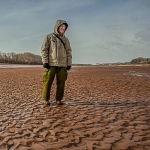
AN ANCIENT FOREST UNDER OUR FEET (August 6/04)

Out on the mudflats between Evangeline Beach and Boot Island, near that treacherous channel called “the guzzle,” are remnants of an ancient forest of pines and hemlocks.

Some three to four thousand years ago the ancient forest was destroyed by rising sea levels; today the remains of the forest, stumps and fallen logs, can only be seen at low tide.

Recently marine biologist Sherman Bleakney told me about the guzzle when I spent a morning with him examining the remains of an old forest. Unlike the trees in the guzzle, these are located about 8 miles from the sea at Upper Dyke. Like the guzzle stand, however, these trees also were destroyed by rising sea levels and were eventually covered by silt.

The old trees at Upper Dyke lie under some 12 feet of dykeland and their presence was suspected but never confirmed. They were discovered recently when major renovations were made to a sewage treatment plant situated on the south bank of the Canard River several miles from Kentville. Leon Barron happened to be driving by the excavation site when he noticed what appeared to be a large tree trunk sticking up out of a pile of debris. If he hadn’t stopped to check it out, we may never have known that the old forest had been uncovered.

As mentioned, the old trees at Upper Dyke are part of the forest that’s visible at the guzzle. Sherman Bleakney estimates that the trees in Upper Dyke were killed by rising sea levels at least 500 and perhaps as long ago as 700 years ago. The guzzle area trees were killed by rising sea levels much earlier due to the sea bottom being lower there. From Upper Dyke, which is 19 feet above sea level, the land gradually drops off into a deep hole that’s the Minas Basin

Several years ago a waterline was being laid between Kentville and Camp Aldershot. To run the waterline under the Cornwallis River a tunnel had to be bored some 10 to 12 feet under the riverbed. During the tunnelling, workmen dug up segments of tree trunks and brush. This was reported at the time but the news that trees, the remnants of an old forest, had once existed in Kentville didn’t cause much of a stir at the time.

We can assume that the trees discovered under the Cornwallis River were part of a ubiquitous ancient forest. In fact, Sherman Bleakney says that wherever there’s dykeland in Kings County, an ancient forest can be found under it.

If you think this is unusual, the picture painted by naturalist Merritt Gibson is even more interesting. Mr. Gibson tells me that under the dykeland are vast lakes and streams. Gibson says that much of the dykelands is literally floating on these lakes. He also told me about the discovery of ancient trees under the soil when a highway bridge just outside Canning was being replaced. When these trees were killed by rising sea levels they were 200 years old. Carbon dating of a long-buried tree uncovered out on the Canard dykes indicate it had been destroyed by the sea some 800 years ago.


MARINE LORE FROM STANLEY T. SPICER (July 30/04)

“It was good to see mention of my grandfather’s old vessel, the E. J. Spicer,” writes marine historian Stanley T. Spicer in a recent letter.

Mr. Spicer was referring to my June 11 column where I referred to “mystery entries” in an 1880s ledger. One entry was purchase by Canning shipbuilder Ebenezar Bigelow of water closet tanks for the ship he was working on. After consulting with a local marine buff, I speculated that the tanks likely weren’t for the ship, since sailing vessels weren’t known to have flush toilets.

Anyway, I speculated incorrectly as Stanley Spicer kindly points out in his letter. The author of several popular books on sailing ships, which are standard references today, Mr. Spicer is a recognised authority on sailing in Atlantic Canada. He writes that the E. J. Spicer did have a “bathroom of a kind,” as family records indicate. “My grandfather’s diaries comment on water closets (i.e. toilets) and copper bathtubs,” Mr. Spicer said.

Mr. Spicer explained why some sailing ships had water closets. “Like many master mariners of the time (my grandfather) frequently took his family to sea with him until the children reached school age and I’m afraid buckets just would not cut it with most wives of the time. As an example, my father had been to London and Shanghai before he ever set foot in school.”

On the vessel mentioned in the column, the E. J. Spicer, Mr. Spicer writes that it was built “in Spencers Island, not in Canning,” an inference I made in the column. “The Bigelows were 12/64 shareholders in the ship and I suspect Gideon Bigelow was the designer,” Mr. Spicer said.

Mr. Spicer wrote that much of the equipment for the E. J. Spicer came from Canning, Windsor and Saint John. This explains the entry for “two tanks for water closets” in the ledger of the Canning firm of Sheffield and Wickwire, which led me to assume the ship was being constructed in Canning by Ebenezar Bigelow.

Being an ignoramus when it comes to ships, I incorrectly called the E. J. Spicer a barque. Mr. Spicer writes that the E. J. Spicer “was a full-rigged ship, not a barque. A ship had four square sails on all masts while a barque carried fore and aft sails on her mizzen masts. A barque or a ship carried at least three masts.”

As I mentioned, Mr. Spicer is a noted expert on sailing ships and has written extensively on them as well as on Mi’kmaq legends and lore. For his contributions to local history and his documentation of our sailing heritage, Mr. Spicer was awarded a Doctor of Civil Laws by Acadia University. A Canning native, Mr. Spicer was educated at Kings County Academy, the University of New Brunswick, Springfield College and received a B.Ed. from Acadia University. Mr. Spicer also has a Kentville connection. His father was a dentist in Kentville from 1929 until 1956.

A BIT OF HISTORY ON ABOITEAUX (July 23/04)

Away back in 1996 I devoted this column to investigation of a word most Kings County natives are familiar with – aboiteau and its plural, aboiteaux. After pointing out that many people, myself included, often pronounce it with an “R” sound in the first syllable – ar-ba-toe – I went on to note that it was one of the few words of Acadian origin still in use here.

Although I didn’t know it at the time, this statement appears in one sense to be incorrect. Aboiteau isn’t of Acadian origin; that is, it wasn’t original coinage by the Acadians as I kind of implied. The word comes from a region in France where most of the Acadian settlers apparently originated.

If you live in the Valley and in particular in areas around here where there is dyked land, aboiteau is probably part of your vocabulary and is in common usage. However, while natives are familiar with the word, outsiders are puzzled by it. When giving directions to visitors, for example, you’ll get strange looks when you tell them to take the “road by the aboiteau to reach Aunt Maude and Uncle Jake.”

As well as putting an “R” in the word when pronouncing it, we often incorrectly use the word to refer to the dyke walls associated with aboiteaux. Correctly speaking, an aboiteau is the sluiceway containing clapper valves that lets fresh water flow out but closes from the pressure of tide waters. However, we have a tendency here to refer to the dyke walls around a sluiceway as the aboiteau. At Wellington Dyke, for example, waterfowlers hunt “on the aboiteau” when actually they’re shooting on the sea walls well away from it. People who hike on the Wellington Dyke often say that they went for a walk on the aboiteau when they really mean the dyke connected to it.

Confusing dykes with aboiteaux isn’t new, by the way. Take for example the Sieur de Diereville who visited the colony of Port Royal, lived there about a year, and wrote a book about his experiences when he returned to France. Diereville is quoted by numerous historians since he gave some first-hand descriptions of the Acadians and their lifestyle. In 1933 his book was translated into English and published by the Champlain Society; a 1968 reprint can be found at Acadia University.

One interesting aspect of the book is Diereville’s description of dyke building in which he confused aboiteaux with dykes. In his book on the early geography of Nova Scotia, Andrew Hill Clark quotes this description, noting that Diereville was “confused as to terminology” when describing dykes and aboiteaux. “The ebb & flow of the Sea cannot easily be stopped, but the Acadians succeeded in doing so by means of great Dykes, called Aboteaux,” Diereville wrote.

The editors of the 1968 reprint of Diereville’s book inserted a footnote regarding the origin of the word aboiteau. “There has been considerable difference of opinion as to the meaning of this word and its derivation. By some, it has been thought to be of Acadian origin, but Dr. Ganong has proved that it was in use in France long before the settlement of Acadia. The Aboiteau was especially associated with the province of Saintonge, from which so many early settlers came to Acadia.”

The footnote included various spellings of aboiteau, for example, “aboteau,” which is French, and “aboideau,” which is an English (Planter) spelling.

J.D. HARRIS – A LEADING KENTVILLE MERCHANT (July 16/04)

The history books inform us that few wagons and carriages were found in Kings County before 1800. Thus it caused a stir when in 1823 or thereabouts a “Yankee peddler” arrived in Horton Corner with a horse-drawn wagon filled with tinware.

According to Mabel Nichols in The Devil’s Half Acre, it was the first wagon in the area and was quite a curiosity. People came from miles around to see the peddler’s “red wagon drawn by a white horse.” After the peddler sold his wares, Nichols said, the wagon and horse were purchased by James Delap Harris.

The arrival of the first wagon in the area was such a momentous event that it was deemed worthy of recording in the Wolfville history, Mud Creek – but with a different twist. “In 1816 a Yankee peddler brought a waggon load of tinware to Horton Corner and sold the outfit to Mrs. James Delap Harris.”

I’m interested in these historical tidbits because they mention a prominent citizen in Kentville’s history, the Hon. James Delap Harris. My interest was aroused when Ivan Smith e-mailed an extract from eBay regarding the sale of an 1824 five pound merchant scrip or note, issued by Kentville merchant James D. Harris. There was a bit of interesting history included in the sales pitch, explaining that merchants issued what amounted to their own money in the 19th century due to a general shortage of coins. “Many private merchants, well respected in their communities, took it upon themselves to issue paper small change notes to help alleviate the shortages,” reads the sales pitch.

The stature of James D. Harris obviously was such that the community accepted his notes. The Harris genealogy, on file at Kings County Museum, contains the following on James: He was a “prominent merchant and leading citizen of Kentville. Later he became a member of the Legislative Council at Halifax. He and his wife were long considered among the more important people of Kings County and the Province.”

James, a Planter descendant, was born in Cornwallis in 1782; he died in Halifax in 1858 and is buried in Oak Grove cemetery in Kentville. I scoured a number of history books for mention of James and came up with bits and pieces but little biographical information. He is mentioned at least four times in Eaton’s Kings County history, once in Louis Comeau’s Kentville history, once in the Mud Creek history as already quoted, and four times in Mabel Nichols book.

From these books, I found that James operated the first drugstore in Kentville. Mabel Nichols writes that James established the store in 1868 in partnership with Caleb H. Rand and L. J. Cogswell.

In his Kings County history, Arthur W. H. Eaton traces James’ ancestry back to the Planter grantee, Lebbeus Harris from Connecticut. Lebbeus represented Horton in the Legislature from 1761 to 1765 and James was to follow in his footsteps. Eaton lists James as a member of the provincial government and confirms his importance in the Kings County community. James’s tombstone reads that he was a “member of her Majesty’s Legislature Council for Nova Scotia.

Eaton agrees with Nichols in that James was an early Kentville merchant, one of the first after Henry Magee. However, Eaton writes that James ran a general store, not a drugstore. But perhaps in the 19th-century general stores and drugstores were synonymous.

NOBLE MASSACRE PART OF ACADIAN HISTORY (July 9/04)

“Eileen Bishop of Greenwich contacted me recently to suggest I write something about the Noble massacre which took place at Grand Pre. A freelance writer and history buff, Bishop has researched the Noble massacre extensively and has had a couple of articles published about it. Bishop feels that the Noble incident is being overlooked and the event should be acknowledged during the upcoming Acadian celebrations.

“We’ll have busloads of people coming here (during the Acadian Congress) and they’ll be driving by the Noble monument without knowing it exists or why it’s there,” Bishop said. “It’s part of Grand Pre’s history and the story should be told.”

Another local history buff who has researched the Noble massacre agrees. “We’re all sorry about the deportation,” Gordon Hansford of Kentville says, “but the telling of history shouldn’t be lopsided. If we’re going to tell the Grand Pre story, we should tell the whole story and include the attack on Noble and his troops.”

Bishop and Hansford are referring to an incident about which took place at Grand Pre in the winter of 1747. Since the massacre is usually ignored when the Acadian story is told, you may not be familiar with it. Yet as Bishop and Hansford point out, it’s part of Acadian and Grand Pre history.

What occurred during the so-called Noble massacre and what are the details? Let’s turn to Arthur W. H. Eaton’s history of Kings County for his observations on the event. “In all the history of Minas,” Eaton writes, “no incident is as tragical as this night battle between the French and the English at the hamlet of Grand Pre.”

By “Minas” Eaton meant the Acadian settlement that stretched from Grand Pre south to the Gaspereau Valley and westerly up both sides of the Canard River and Cornwallis River. Other than the expulsion, this “night battle” was one of only a few violent events in the history of the Minas settlement. Eaton was referring to the sneak attack by the French and an “Indian force” on British troops from New England; the troops under the command of Lt. Colonel Arthur Noble were housed at Grand Pre in the winter of 1747 when they were ambushed.

I’ve read various accounts of the attack on Noble and his soldiers, and some called it a massacre, some a battle. Most accounts agree that it was a treacherous affair and that the French force was assisted by local Acadians. Giving no warning, the French attacked under the cover of darkness, firing upon Noble’s troops while they were in their beds. The attack took place during a snowstorm in the early morning hours of February 11.

Eaton writes that “the English loss was one hundred killed, fifteen wounded and fifty captured,” and the “French loss was seven killed and fifteen wounded.” The monument marking the incident, which was placed by the Federal Government, reads that Noble’s loss was about 70 killed, which is probably the correct figure. The monument confirms that the attack by a French and Indian force took place without warning under cover of a snowstorm.

If you’re interested in reading about the incident, you’ll find numerous accounts on the Internet. I went to Google and typed in Noble + Grand Pre and found a lengthy account that was prepared from original sources, French and British records of the affair.

UP ON THE OLD “DUG ROAD” (July 2/04)

When you turn up Prospect Road at the lights in New Minas and then turn left up Perrier Drive you are traversing the course of one of the oldest roads in Kings County. According to local folklore, the road is of Acadian origin, and some of the older New Minas residents call it the “French road.” However, while the Acadians may have travelled the road to reach the high country south of New Minas and the Gaspereau Valley, it probably was of Mi’kmaq origin.

To most senior residents of New Minas, the old road is known as the “Dug Road.” How it got this name is a mystery. Some people jokingly say the road got its name because it probably had to be dug by hand out of the rocky ridge south of New Minas.

Once you turn up Prospect and onto Perrier Drive you can pick up what remains of the old road at the top of the hill. Actually, it’s in good condition. At Perrier Drive, it looks like a well travelled walking trail, but further on after the road runs under the 101 via a culvert it widens out. From the top of Perrier Drive, the road runs southerly for a couple of kilometres until it reaches the Canaan Road. Much of it is in good condition and some people say if you don’t mind a few scratches on your vehicle, you can drive over the road from the south end up to the 101.

Gerry Milne’s family moved to New Minas early in the 1930s when he was six and the Dug Road passed their property on Prospect Road. Gerry remembers teams of horses and wagons using the road when he was a boy. “On the old maps it’s shown as a government road,” he says. “Even back then it was called the Dug Road, never the French Road.”

According to folklore, there was a small Acadian settlement beside the Dug Road immediately south of the 101. There’s at least one rock cellar possibly of Acadian origin near the old road. Along with Ken Belfontain and Maynard Stevens of the New Minas Heritage Sites committee I was recently shown this foundation by Peter Milne. The forest has grown up around the cellar but several decades ago the area was a large clearing and there’s a water source close by.

Gerry Milne tells me that the cellar is believed to be the foundation of an Acadian church and not a homestead. Village people referred to the site as “the old church,” he said. When he was a boy in the 1930s the remains of a building made of logs lay strewn around the cellar.

In 1960 the New Minas Boy Scout troop built a camp beside the Dug Road. Gerry Milne was Scoutmaster at the time and he tells me the boys used to dig around the old cellar hoping to find Acadian coins. As a project, the Scouts put together a history of New Minas in newspaper format, interviewing some of the senior residents of the village who gave them some Acadian folklore about the Dug Road.

The Dug Road was still being driven over at the time the camp was built, Milne said. Thus when a village resident complained that the camp blocked the road and he couldn’t get through with his vehicle, the Scouts had to be moved back. Several years later the camp was burned by vandals.

I checked several old maps – one of them the 1872 Ambrose Church map of Kings County – and none showed the Dug Road. I suspect, as I said, that the road was probably a Mi’kmaq trail from the ridge. The Canaan Road, which runs in an east and west direction along the ridge, was probably a Mi’kmaq trail as well. Following the high ground, the road runs east to a Mi’kmaq village in the Gaspereau Valley; running west it winds close to the Mi’kmaq wintering grounds on Gaspereau Lake.

A LOOK AT KINGS COUNTY IN 1903 (June 25/04)

“It is rather surprising that no one has written a history of this county,” Robert R. McLeod wrote in his 603 page history of Nova Scotia, published in 1903. McLeod called the history Markland or Nova Scotia and the county he referred to was Kings.

Of course, McLeod was unaware that Arthur W. H. Eaton was ready to publish his Kings County history, which was released in 1904. Thus he took it upon himself to describe Kings County as it was a century ago, the description including a bit of history and the natural resources of the county.

McLeod writes about the expulsion of the Acadians from Kings County with a sympathetic voice. He adds, however, that while it was all sad and terrible, “let us remember that it was a mere fly bite compared to some of the outrages within the range of Christian history.” The Acadians, McLeod claims, “were taken away because it was determined by Lawrence and Shirley that Nova Scotia should remain a British colony.”

Much more interesting than McLeod’s slanted views on historical events is his description of various towns and villages in the county. At the time McLeod published his history there were “three principal towns” in the county, Kentville, Wolfville and Canning. All are “charming localities,” McLeod says, and a stranger would like “each one best as he visits them one after the other.”

As the shire town, Kentville is given prominence. “The town has now a population of 1,781 and is a railway station of considerable importance, where there are repair shops and the head office of the Dominion and Atlantic Railway and also a terminus of the Cornwallis Railway.” McLeod adds that there are good hotels and the town is a “commercial center of a large district devoted to farming and fruit raising.” Adding to the charm of the town is the Cornwallis River and the streets shaded with fine trees.

Wolfville is second in prominence according to McLeod. With a population of 1,412, it is “not only a trading center to a considerable district but it has the distinction of being a college town” where “grave professors and retired clergymen are the commonplace of the locality.”

McLeod paints a rosy picture of Wolfville where the “climate is not severe, there are no malarial diseases to rack a poor body with chills and fevers, tornadoes are unknown,” and the vista includes “wide dykes and the brown basin to the hills of Parrsboro.”

Canning is a surprise to one who drives across the Cornwallis region for the first time, McLeod writes. He gives a beautiful and romantic description of the village: “One comes abruptly across pretty streets shaded with fine trees, stores and wharves and tall spars, and flapping sails almost in the shade of overhanging branches. The schooners with their hulls hidden in the narrow channel appear to be sailing on dry land through dykes and fields as they follow the great tides that follow the moon around the world.”

Port Williams is dismissed as no more than a “station on the D.A.R;” Harbourville and Hall’s Harbour are “precarious shelters” on the Bay of Fundy and Berwick is a “beautiful and enterprising village.” There is “no room for extended description” of other villages in the county, McLeod writes, adding simply that most are located along the railway line.

ACADIANS, SCOTS, PLANTERS – OUR EARLY DAYS (June 18/04)

With its estuaries, high tides, its diverse shoreline, its tidal marshes, and its bogs barrens and varied agricultural land, Kings County is one interesting and unique place. The county is even more unusual when we consider how its uniqueness shaped its history.

Take the French colonisation of Nova Scotia, for example. The French came for the fur trade, the timber and the fishery but it was the agricultural potential that brought the colonists to what became known as Acadia. We have to admit – if we’re frank about it – that the success of the Acadian settlers eventually led to them being driven from the province. Right or wrong, I’m convinced that if the Annapolis Valley and other areas weren’t rich in natural resources, there would have been no expulsion and no Planters in Kings County.

The year 1604 is given as the time Nova Scotia was settled by the French. However, for a brief period roughly between 1628 and 1632, the English and the Scots were the dominant power in the province. Recognising the potential, Sir William Alexander persuaded the British government to grant him Nova Scotia. Alexander had a variety of fantastic schemes for colonising the province, most of which came to nothing. His major success was the founding in either 1628 or 1629 the short-lived Scottish settlement at Port Royal.

From Andrew Hill Clark’s 1968 book on the geography of early Nova Scotia, we learn what happened to Alexander’s settlement. Many of the Scottish colonists perished in the early years of the settlement, Clark writes, and the colony only lasted until 1632. The British holdings in Acadia were surrendered to the French in 1632 and the Scots left, some to New England, some to the south shore, and some returning to Great Britain. A few of the Scottish settlers remained at Port Royal and were assimilated by the Acadians; among them were the Melansons who later settled in Kings County.

Clark writes that the “real beginning of French settlement in Acadia” began in 1632 and up until that time it had been rather hit and miss as far as serious colonisation went. Clark paints a picture of French authorities more interested in fish, fur and lumber than in colonisation. Up to 1632 Clark says that except for Port Royal, “the evidence for agricultural settlement in this period can be summed up in a few words.”

I find it interesting that the “Frenchness” of Port Royal is believed to have been “diluted by some carryover of Scots” from Alexander’s colony. Clark gives several surnames believed to be of Scottish origin. “Acadian names so derived,” Clark writes, “include Peselet or Pesely (from Paisley), Pitre (from Peter or Peters), Caissy or Caisse (from Kessey or Casey), Colleson or Coleson, and Melanson.” In a footnote, Clark adds that Caisse may ultimately be of Irish origin.

While some historical scholars argue that none of the surnames mentioned above is Scottish in origin, Clark says it’s possible that they all are. However, Melanson is the only surname in this list that is definitely Scottish.

Anyway, true or not that there are Acadian Scots, I’m willing to bet that the touch of Scottish blood – and the possible tiny drop of Irish blood – in Acadian families is something you won’t hear much about during the upcoming celebrations at Grand Pre this summer.

MYSTERY ENTRIES IN AN 1880s LEDGER (June 11/04)

In the summer of 1880 Ebenezar Bigelow was putting the finishing touches on the barque E. J. Spicer at his shipyard in Canning. Bigelow purchased supplies for the barque from several merchants in the area, one of them the prominent Canning firm of Sheffield & Wickwire.

In her Canning and Habitant history (Old Times, 1981) A. Marie Bickerton has various entries from the ledgers of Sheffield & Wickwire’s. One of those entries list some of the supplies purchased by Bigelow for the barque; they included two tanks for water closets, two water tanks of 120 gallons each, 12 deck buckets, three meat barrels, one molasses barrel and a mystery item called a “kyd.”.

What’s interesting about these purchases is what that they seem to tell us about life as a sailor during the era of sailing ships. I always pictured seamen of those days leading a rough and crude life with few of the comforts of home; answering nature’s call, for example, with a quick trip to the stern of the ship. But no, in 1880 Ebenezar Bigelow was purchasing tanks for water closets on the barque he was working on; which appears to indicate there was inside plumbing of some sort.

However, the dean of sailing ship historians tells me this entry is misleading and a bit of a mystery. As far as he knows, Leon Barron says, barques were never equipped with water closets – flush toilets – and the entry must refer to something else. The 12 deck buckets Ebenezar Bigelow purchased to equip the E. J. Spicer most likely would have been the nearest thing to a water closet for the crew of the barque. “The buckets were the toilets in those days,” Barron said.

Barron said that smaller barques would have a crew of about 12, the larger ones about 20. Thus the purchase of a dozen buckets for the E. J. Spicer gives us a clue to the ship’s size.

The mysterious entry of tanks for water closets may have a simple explanation. Bigelow may have been purchasing the tanks for his residence, not for the E. J. Spicer, and the bookkeeper for Sheffield & Wickwire could have lumped the purchases together. Sheffield & Wickwire were ship suppliers – “they had a chandlery in Canning and were also ship owners,” Barron said – so it’s possible that the entry was copied from another ledger. Ms. Atkinson said that the ledger entries she reproduced in her book were also from a firm called Melville’s Mill.

Now for the other mystery entry in the ledger – “three kyds.” This had Barron stumped for a moment but he came up with a possible explanation for the item. “It’s probably kegs,” Barron said, suggesting that the handwriting in the old ledger was misread by Atkinson or misspelled by a bookkeeper.

Ms. Atkinson also had an error in the name of the barque, which she gave as the C. J. Spicer. Barron says there is no record of a barque by this name and Atkinson had to be referring to the E. J. Spicer. This barque was named for Emily J. Morris from Advocate who married Capt. George Spicer. Capt. Spicer was the grandfather of noted contemporary sailing ship historian Stanley Spicer.

CANARD A MAJOR ACADIAN SETTLEMENT (June 4/04)

While the spotlight will on Grand Pre, other areas where there were Acadian settlements in Kings County won’t be overlooked during upcoming celebrations. As I’ve pointed out recently, for example, New Minas was an early settlement.

Perhaps no less important was the sprawling Acadian settlement along the Canard River. The settlement stretched roughly from the head of the Canard River in Steam Mill, ran downstream on both sides of the Canard to the Minas Basin. A brochure published recently by Les Amis de Grand-Pre notes that the settlement was called La Riviere-aux-Canards and was composed of 21 hamlets.

While the land immediately north and south of the Canard River was the main settlement area, La Riviere-aux-Canards also took in Brooklyn Street, Gibson Woods and Starr’s Point. A map from 1714 on the Acadian Historic Atlas website shows that the settlement had two churches, one on the south side of the Canard around Chipman Corner, the second on the north side farther downstream.

Like New Minas, the Acadian settlement in the Canard area was smaller than the settlement at Grand Pre. However, the Canard Acadians left a legacy that is still important today.

The Advertiser‘s Brent Fox mentions this legacy in the history he wrote of the Wellington Dyke. Before the Acadians arrived and began their dykeing, Fox wrote, the area from the mouth of the Canard River to Steam Mill was a huge tidal lake. “The water from the Minas Basin flooded thousands of acres of the river’s low-lying banks,” he said.

The Acadians began dykeing this area on a modest scale, beginning first at Sheffield Creek, a tributary of the Canard. Brent Fox says that another dyke was built around the same time farther upriver at Steam Mill near Aldershot Camp. Eventually, the Acadians moved downriver, building a series of dykes and cross dykes until the tidal lake was no more.

In the book Acadia, The Early Geography of Nova Scotia to 1760, Andrew Hill Clark writes that the Canard River settlement was “second to Grand Pre in importance.” Canard had a stretch of marshland comparable to Grand Pre, Clark says. He gives the estimated population of Canard in 1750 as 750; of this number 350 Acadians had homesteads in Upper Dyke; downriver on both banks were another 150 homesteads, while the Canard-Cornwallis River interfluve (the area between the rivers) contained 250.

Other than the remnants of their dykeing, there is little physical evidence that the Acadians once dwelt along the Canard River. A 1971 archaeological survey in Canard only found eight “structures” that could be identified as Acadian in origin. Most of these sites were on land formerly owned by Ernest Eaton, which lies just west of Canard Poultry.

What is known about the Canard settlement are the family names of some of the Acadians who settled there. If your surname is Surette, Thibodeau, Pellerin, Theriault, Babin, Aucoin or Gaudet, your ancestor may have farmed and dyked land along the Canard River.