SOLDIERING BEHIND THE LINES IN WWII (August 6/12)

In the forward to his book, A Craftsman Remembers, Gordon Hansford writes that for every front line soldier engaged in combat during WWII, ten served behind the lines in various capacities, the so called “administrative tail of the army.”

Called Craftsmen by the army, these were the soldiers who served as mechanics, electricians and engineers, and when situations called for it, as diggers of latrines and graves. These were the men and women who rarely reached the front line but were never far from it; the soldiers, to paraphrase Winston Churchill’s famous dictum, who also served the war effort by serving behind the lines.

Hansford’s book, which was recently published, is the story of one of those soldiers who served as a Craftsman during the war.  “I choose not to write about the horrors of war,” he said in effect, “but about behind the line soldiers and the many jobs we did that kept the war machine running.”

Hansford does this admirably, creating a wonderful record of what it was like for the ordinary soldier serving behind the lines.  While he writes in the first person about his war years, his story portrays the unknown Canadians soldiers who served, survived and continued on afterwards uncelebrated and for the most part, rarely recognized for their contributions.

Gordon Hansford served overseas during the war for more than three years, taking part in campaigns in Africa, Sicily and Holland.  For those who know Hansford, he’s a genial man with a finely tuned sense of humour and more stories than Google has hits.    He displays this sense of humour and a bit of irony as well, throughout the book.  His being mistaken for a doctor while hospitalized and treating a malingerer is hilarious and is one example of the sort of humour found in his book.

Hansford’s story starts in Wolfville where he became interested in the military at an early age, recalling that at age seven he marched around the streets of Wolfville wearing his father’s World War 1 gear.  In 1941, in his mid-teens, Hansford enlisted in the local unit of the West Nova Scotia Regiment at Aldershot Camp as a bandsman.   That year he decided to join what he called “the real army” and by the spring of 1942 he found himself at the Canadian Army Trade Schools in Halifax.  After additional training with the Royal Canadian Ordnance Corp in Ontario, Hansford was shipped to England, arriving there early in 1943.

This is where Hansford’s war story really starts.  He takes his readers through the major campaigns the Canadian Army participated in, always with a story or two, leaving us with an intimate look at how the war affected everyone involved.  Most of my generation had someone close to us who participated in the war.  Those participants, our fathers, brothers, uncles, cousins and next door neighbours, often refused to talk about their war experiences.  Hansford’s book starkly reveals what he and all those other Canadians caught up in the war went through; he breaks the silence and this makes the work an invaluable record.  The book aptly could have been subtitled, The Canadian Soldier, His War behind the Lines, since this is what it’s all about.

Privately published by Hansford and his wife, Helen, copies of the book are available at the Kings County Museum where they’re being sold as a fundraiser.
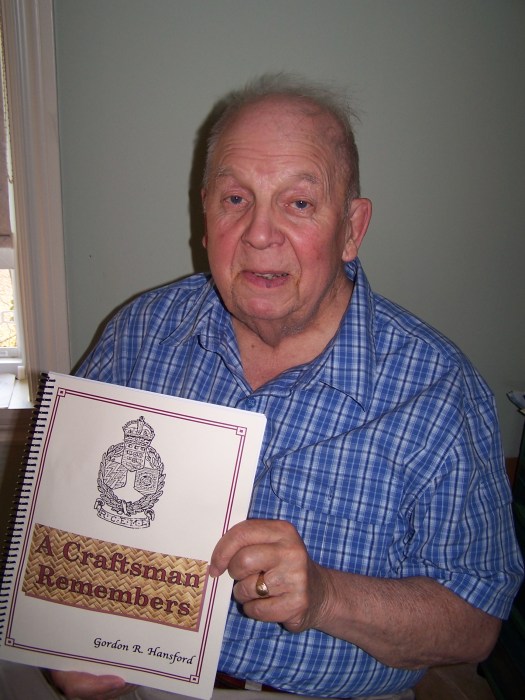
 

Gordon Hansford with his book on WWII

Gordon Hansford, above, with his book on soldiering behind the lines in WWII. (E. Coleman)

THE KINGS COUNTY KARAKULE SHEEP COMPANY (July 16/12)

“I have a unique question,” wrote Kings County Museum curator Bria Stokesbury.  “Have either of you heard of the Evangeline Karakule Arabi Sheep & Fur Company?”

What prompted Stokesbury to contact Louis Comeau and I was an old stock certificate she recently had opportunity to examine.  The certificate was issued in Kentville, representing 4,200 shares in an unusual sheep ranch that just over a century ago attempted to set up in Kings County.

“I’ve never heard of this company,” Stokesbury said when she wrote us about the certificate Jim Noonan had brought into the Museum.  “Apparently it had assets of $84,000 at the time, a considerable amount for that period.”

I had to plead ignorance of the topic.  Until I received Stokesbury’s message I’d never heard of Karakule Arabi sheep or of the sheep company.  It was a different story for Kentville historian Louis Comeau.  Trivial or not, much of Kentville’s history, from at least day one of incorporation until the present, can be found in his data base.

As you’ll see, Comeau was familiar with efforts to raise Karakule sheep in Kings County, an attempt in the early 1900s to profit from of a world-wide market.  Later I’ll get back to what Comeau told Stokesbury about the sheep ranch, but some background info first.

Karakule sheep are interesting animals.  Apparently native to central Asia, these hardy sheep are noted for multiple uses, being raised for their milk, meat, pelts and wool.  Usually spelled Karakul, the Arabi in its name refers to its black color phase.  A 1920s report on the sheep says the animal produces so-called Persian Lamb and Astrakhan Fur when crossed with domestic coarse-wooled breeds; hence its one time popularity.

Wearing Persian Lamb or Astrakhan Fur on a variety of apparel – coats, collars, caps and muffs – was a high society trend in the early 1900s.  “We require $14,000,000 worth of such furs annually,” claims a 1920s U.S. agriculture report, explaining why around 1908 Karakule sheep were imported into Texas and ranches were established to supply this market.

The idea of raising Karakule sheep for profit eventually caught on in Canada.   We have this as evidence:  “The Alberta Karakule Arabi Sheep & Fur Company (was) recently formed to raise Karakule Arabi Sheep,” reads a report in the February 1915 issue of the Boston Evening Transcript.  “The Company secured its first stock from near Topeka, Kansas.”  At that time, the newspaper reported, two other Canadian farms besides the one in Alberta were devoted to raising these sheep – one in P.E.I., the other in Nova Scotia.

This takes us back to the stock certificate that intrigued Bria Stokesbury.  The certificate was rescued from a trip to the dump by Jim Noonan when Judge Roscoe’s old law office on Cornwallis Street, Kentville, was being cleaned out in 1978.

From the certificate we learn that the Evangeline Karakule-Arabi Sheep & Fur Co. Ltd was incorporated on July 15, 1915, with an authorized capital of $125,000.  The head office was in Kentville, the president H. K. MacDonald, the secretary-treasurer J. D. Spidell.  The stock certificate, representing some 4,200 shares in the company, was issued to one William B. Foster a few months after the company incorporated. Shares were valued at $20 each

The attempt to breed Karakule sheep here for their fur was short-lived.  In his reply to Bria Stokesbury, Louis Comeau said the venture only lasted a few years.  “The whole enterprise was unfortunate,” he said.  “As I understand it, they tried to breed for Persian Lamb but didn’t understand the genetics, with the result that the lambs and their skins were of no value.  The company failed quickly.”

In Louis Comeau’s files is a notice dated February 21, 1919, inviting shareholders of the sheep company to a “special general meeting.”  The notice appears to indicate the company is winding up business and the romance with Karakule sheep was over.   The purpose of the meeting as per the notice:  “Electing officers for the Company and considering what shall be done with the stock of sheep remaining on hand and for receiving a statement of the affairs of the Company and determining what action shall be taken in relation thereto.”

While the head office of the company was in Kentville, it isn’t known where the ranch or ranches were located.  Apparently there was at least one in Kings County.  Louis Comeau hints it may have been at Dempsey’s Corner near Aylesford, based on the possibility a company officer, A. E. McMahon, had a farm at this location.

HANGED FOR STEALING SACK OF POTATOES (July 3/12)

Are the courts today lenient with criminals?  This isn’t an appropriate forum to discuss this question, but I will say that in 18th and 19th century Nova Scotia, minor criminals were treated harshly, much more than harshly.  Historical records indicate offences, which today usually result in house arrest and a slap on the wrist, once were crimes calling for capital punishment.

This was pointed out when Ivan Smith sent me a government website listing all the known executions in Nova Scotia between 1749 and 1820.  “This morning, while poking into some dusty corners of the Internet,” wrote the creator of the Nova Scotia History Index, “I stumbled on a purported list of all known executions in Nova Scotia since 1749.  There might be something of interest.”

Indeed, there was.  Logging onto the website, I discovered that as well as being a dusty corner of the web – “dusty” meaning rarely visited – it was also a grisly, shocking site.  From the executions listed and the reasons why the hangings were carried out, it was obvious life throughout the period mentioned was harsh, and the punishment for relatively minor crimes harsher.  Misdemeanours, from theft to murder, were punished severely by the courts with no mercy shown; apparently theft, burglary and murder were lumped together as serious crimes.

Take the case of the man who was hanged in Halifax in 1785.  His crime, if you can believe it, was listed simply as “theft.”  What he stole was a bag of potatoes!  Similar fates were dealt out to seven men hanged in Halifax between 1752 and 1765.  And get this:  All were guilty of burglary.

Four of these men, who were sailors, had conspired to break into the home of one Adam Prester of Dartmouth; they stole “20 pounds worth of gold and silver and some linen.”  By today’s standards this obviously isn’t a capitol offense but keep in mind Halifax was a British port at the time and it was dominated by the military; which could explain the harshness of the penalty.  The burglary occurred in April, 1865, and the culprits were quickly caught and hanged the following May.

Three of the seven hanged for burglary were soldiers, again perhaps explaining why they were dealt with so harshly, Halifax being a military town. No details on their crimes are given but my guess is the culprits were dealt with summarily.

Then there’s the interesting case of one John Oliver Tibo, who when hankering for a feed of cabbage in the summer of 1911 decided to steal rather than buy them.  This led to his being hanged for murder.  Tibo was caught when Edward McGregor came upon him cleaning the cabbage.  In the notes it’s explained that Tibo “killed Edward McGregor with an ax while cleaning stolen cabbage.”

Even more interesting is the case of Jenkin Ratford, who in 1807 was hanged in Halifax for the multiple offences of “desertion, mutiny and contempt.”   Ratford became a footnote in events leading up to the War of 1812.  He was a crewman on the American frigate Chesapeake when it was intercepted by a British warship, the frigate Leopard, on June 22, 1807.

Ratford, a deserter from the Royal Navy, was one of four sailors taken from the Chesapeake and tried in Halifax for desertion.  While he was enjoying his freedom in an American port, Ratford had brazenly paraded around under an American flag as part of an enlistment party; hence the additional charge of contempt.

At the time, the British Navy insisted it had the right to board any American ship and remove deserters.  This was one of many minor irritants that led to war in 1812.  Poor old Ratford was one of the victims of an ongoing feud between America and Great Britain and he paid the price in Halifax.

RICHARD SKINNER: A FASCINATION FOR OLD ROADS (June 18/12)

Drive out Kentville’s west Main Street and continue along it past the point where Park Street branches off; continue on behind the new Kentville school and past the oil company, which would now be on your left.  On your right you’ll see high, sandy banks, remnants of long ago glaciers; motor on and you’ll quickly run out of a navigable road.

Main Street appears to terminate here but it doesn’t; on foot you can explore it along on remnants of an old road; this road, which is actually a trail, runs westerly towards what was once called Moccasin or Bloody Hollow.  Here says folklore, ghosts abound from an 18th century skirmish between British troops and the French and their Mi’kmaq allies.

The old road appears to vanish here, succumbing its seems to a railroad bed laid down in the 19th century.   However, Richard Skinner of Coldbrook, a man whose hobby is researching county cemeteries and studying old county maps, says the old road doesn’t end there and is still traceable.

“Roads have always fascinated me,” Skinner says, and to find where some of them once existed he diligently studies land grants, deed and maps.  After a lot of searching and a bit of guesswork, Skinner figures he knows the direction the old road took after Main Street vanishes near Moccasin Hollow just west of the town.

Once you leave downtown Kentville and go out west Main Street, Skinner says, the old road would have continued on past where Evergreen Home is, passing north of it.  Here the old road turned south, crossing highway #1 and eventually reaching the area where Access Nova Scotia now stands.

His study of land grants and deeds tells Skinner the old road then ran westward passing through the Toyota dealership.  At this point Skinner found the old road was untraceable for a bit but he assumes it ran west, passing just south of the Pineview Inn.  Continuing westerly, the old road likely passed behind Tim Horton’s and McDonalds and eventually crossed Lockhart Road.

In places the old road ran parallel to highway #1 and traces are visible here and there.  But Skinner admits that some of what he postulates re the places the old road ran might not be entirely correct.  Some of it is definitely guesswork, he says.

Skinner figures the old road continued west, passing through Sherwood camp ground, passing south of the Coldbrook cemetery before moving through Hayes subdivision.  Skinner says the old road ran west again, and then apparently north until it eventually connected with the highway #1.

Not once when we were talking about the old road did Skinner speculate on its origin.  However, he believes much of the old road and sections of highway #1 originally were Mi’kmaq trails.  Later, the Acadians used the Mi’kmaq trails.  Some sources say the Acadians had a main track that much of highway #1 now follows.

Anyway, speculation or not, guesswork or not, Richard Skinner continues looking for evidence of the old road.  I’ve only mentioned a few of the sections of old road that he’s found.

So many new roads have sprung up since the time the Mi’kmaq created various trails through Kings County it seems impossible today to determine exactly where they ran.  But I may be wrong.  Richard Skinner is one persistent man when it comes to digging out old maps and old records.  He may eventually have many of the old roads, and especially the old road that’s part of Main Street Kernville, completely mapped out.

BOOK ON GYPSUM SCHOONERS ON WAY (June 11/12)

Speaking at the monthly meeting of the Kings Historical Society recently, Joey St. Clair Patterson said in effect he’s been working for about 20 years on a book about gypsum schooners.   This will be the Hantport native’s second book on the wooden ships that sailed out of ports in Kings and Hants County.

Patterson’s first book, Hantsport Shipping, was published in 2008 and it dealt mainly with shipbuilders in the Hantsport area. While working on the book, Patterson simultaneously collected information on the scores of tiny schooners transporting gypsum from the quarries of Hants County to ports in the Maritimes and the United States.

While a lot has been written about the gypsum industry, which began in Nova Scotia so far back it’s difficult to say with certainty when it started, Patterson says there are few records on the all important sailing ships that serviced it.  The earliest mention of gypsum in this area was made in 1606 by Champlain.  The great explorer sailed up the Minas Basin in that year and in his journal he mentioned the “certain white stones suitable for making lime” that he found there.  By 1867 gypsum was being transported from at least 25 different ports in Nova Scotia, the bulk of it quarried in Hants County.

However, while the gypsum industry has its chroniclers (among them Gwendolyn Vaughan Shand in her 1979 book Historic Hants County) Patterson notes that the schooners and the men sailing them haven’t been given their due. He hopes to rectify this in his book.  “Mainly,” he says, “the book will be stories about these vessels, a record of the vessels hauling gypsum from Nova Scotia, the men who sailed in them, the tragedies and so on.”   Roughly, the book will cover the period from 1892 to the present.

It hasn’t been easy collecting these stories, Patterson says.  The records of these gypsum schooners are buried in the Nova Scotia archives and in museums in Kings and Hants County.  Patterson spent three years looking through archive files, especially the ship registry records.  He had a lot of assistance, he says, from local historians such as Larry Loomer and John Duncanson.  “Whenever these guys found anything about the gypsum schooners they put it aside for me.  They were a great help.”

Being a member of the Hants Historical Society for some 31 years also was a help to Patterson in accumulating schooner records.  “People would often bring material into the Society,” Patterson says, “and once in a while there would be something I could add to my gypsum schooner file.”

As a Navy veteran, Patterson notes that it was second nature for him to write about gypsum shipping in the Hantsport, Windsor area.  “My grandfather sailed on a gypsum schooner,” he says, “and this started my interest in them.”  His tribute to the gypsum schooners and the men that sailed on them will have a feature that should interest historians, amateur and professional.  “There will many photographs of the old-time gypsum schooners,” Patterson says.

BOB PALMETER’S BLOSSOM TIME CHINA (May 28/12)

If you stop at the T-junction where Scott Drive meets Middle Dyke Road north of Kentville and look southeast, you can see remnants of the famous Hillcrest Orchards, which at one time were renowned across Canada.

Arthur W. H. Eaton salutes these orchards in his history of Kings County (page 196) noting the fruit grown there, “apples, pears, plums quinces and cherries are known to fruit raisers all over the continent.” Eaton mentions the orchards again on page 203, referring to Ralph Samuel Eaton and his “famous Cornwallis (township) ‘Hillcrest Orchards’ not far from the county town (of Kentville).”

One of my friends, Jerry Bishop of Coldbrook, is an avid collector of coins and postcards. One of the most remarkable and rarest postcards in his collection has a beautiful color photograph of an orchard in full bloom. This photograph will be recognised by anyone familiar with the orchard pictured on Royal Albert Blossom Time China.

In other words, the orchard on the postcard and the orchard captured on Blossom Time China are one and the same – the famed Hillcrest Orchards of Ralph Samuel Eaton. The year the postcard was printed and released isn’t certain but it’s generally believed that it was circa 1933 or 1934 that Blossom Time China came into existence. Since then the china has been hailed as the most prized and most enduring Apple Blossom Festival keepsake ever.

In 1933, with two successful summer festivals under their collective belts, the Kentville Board of Trade was firming up plans for another event, the first apple blossom festival. On the organizing committee was Kentville jeweller Robert Palmeter. Festival lore has it that Palmeter made a motion at a Board of Trade meeting to hold a festival with an apple blossom theme. Whether this is true or not, it’s a fact that around this time Palmeter submitted a design to Royal Albert China of England that resulted in the manufacture of Blossom Time China.

It likely was 1934 before Blossom Time China was available in retail stores, but that’s only my guess; some sources say the china was available in 1933. Whatever the year, the pattern was popular for decades and was sold worldwide. Eric Lockhart, of R. D. Chisholm Ltd. in Kentville, tells me his store sold the china almost from the day it was first available until it was discontinued in 1991. “It was a good seller,” Lockhart said, even though Royal Albert kept jacking the price up year after year.

Since its “retirement,” Blossom Time China has become a hot collectible. It’s rather pricey today, however, compared to what it sold for when it first came out. At a giant “yard sale” this spring at the Kentville arena, for example, the asking price for a Blossom time cup and saucer was $45.00. In 1936, Robert Palmeter offered the cup and saucer at his Kentville jewellery store for a mere 90 cents!

It may interest readers that Palmeter’s Blossom Time isn’t the only china with an apple blossom theme. There are at least two more with apple blossom themes but these haven’t been as popular as Palmeter’s design. Readers may also be interested in knowing that Palmeter designed another china pattern. In 1953 he submitted a design for a “new, original and ornamental design for a cup or similar article” to the United States Patent Office. Palmeter called this china Evangeline’s Acadian Gardens. The pattern application was approved and Palmeter later advertised the china in his Kentville shop.

As for the photograph of Hillcrest Orchards used in the design of Blossom Time China, I always wondered if it had been taken by A. L. Hardy. Photography expert Larry Keddy says it’s a possibility. “Hardy was the only professional photographer in this area at the time that was capable of doing that kind of work,” Keddy says.

The Valley's Springtime Beauty

One of the earliest advertisements in which Bob Palmeter featured his Blossom Time China (Courtesy of the Kings County Museum.)


CORNWALLIS INN TRIVIA (May 14/12)

In a note I received from Louis Comeau, he mentions an interesting aside on construction in 1930 of the Cornwallis Inn. To make way for the Inn, two houses on the site were removed – “the ‘Chestnuts’ owned by Deaconess Alice Webster #156 and the ‘Birches’ owned by Judge Barclay Webster #157.” And possibly the law offices of Webster and Robertson #72, Comeau said, noting the numbers quoted are from the Price map of 1894.

As I’ve mentioned before, the Cornwallis Inn replaced what in their time were two of the finest houses in Kentville. In the note, Comeau referred to the houses in a detailed list of what went into construction of the Inn. This list, all the facts and figures, must have been newsworthy in 1930. At least the editor of The Advertiser felt it was. The list was published in The Advertiser, the paper devoting its entire 38-page early December edition to the Inn’s opening.

The current renovations ongoing now at the Cornwallis Inn reminded me of Louis Comeau’s note. From curiosity I dug it out of my files, checking to see what the Cornwallis Inn was like originally and who the suppliers were. What amenities were offered when the Inn officially opened on December 8? Was there local input in the furnishing of the Inn? Was it a fact that all those tons of stone used in construction were quarried locally?

Answering the last question first, I see the Inn’s exterior consists of stone with an interesting name, New Minas quartzite. This material apparently came from rock formations, part of the so-called Wolfville Ridge, south of and immediately behind the village of New Minas. The stone is also called pink quartzite (for obvious reasons if you look at the various light shades of red in the exterior walls of the Cornwallis Inn). The quartzite from the New Minas formation was also used in buildings at Acadia University, by the way.

As for the amenities, each guest room in the Cornwallis Inn – there were 100 in all – featured a telephone, bath and radio, which may have been a hotel first for the Annapolis Valley. A formal dining room seating 200, a magnificent ballroom that would be the site of many Apple Blossom Festival dances in the future, and a barbershop, beauty salon and games room were among the other amenities. In addition, there were 10 sample rooms and several salons for meetings.

Work started on the Cornwallis Inn on March 15th and was completed 208 working days, on November 9th. From start to finish, total cost of constructing the Cornwallis Inn was $1,000,000. The Inn officially opened on December 8th with a banquet hosted by the Board of Trade.

Looking at the list provided by Louis Comeau, I see that only a few local retail stores were suppliers. Imagine all the furniture, carpeting, towels, soaps, etc., that was required to set up a spanking new hotel the size of the Cornwallis Inn. Most of this stuff came from provincial businesses but a few outside suppliers were also used.

One of the local suppliers of building material was L. E. Shaw Ltd. of Avonport. Shaw supplied the bricks, all 1200 tons of them. You didn’t need to know this but its interesting trivia.

LOUIS COMEAU’S BLOSSOM FEST DISCOVERIES (May 7/12)

“I surmise that Frank Burns – ‘Mr. Festival’ – being a newspaper man, would have many connections across North America,” Kentville historian Louis Comeau writes. Comeau was commenting on my recent column about the origin of the apple blossom festival. Frank Burns played a prominent role in organising the first festival and was one of the founders.

“Also,” Comeau surmises, “local farmers here were in touch with state-of-the-art farming practices across the continent. These contacts would have exposed them to other communities and the fact that they had festivals of their own.”

Comeau said that a long time ago he became interested in discovering where the idea for our apple blossom festival originated. His research lead to a couple of interesting discoveries. “Firstly, there were many, many other apple blossom festivals (at one time I counted 31 of them). Secondly, several of them were much older than ours.”

And, said Comeau, the format for our festival “was very near exact” to the festivals his research turned up. This was “maybe just a coincidence but it’s an interesting similarity,” he concludes, suggesting that our festival fathers may have been aware of these earlier blossom celebrations.

While our apple blossom festival has the distinction of being the first in Canada, it can’t claim North American honours. Louis Comeau discovered that the earliest festival in North America “seems to be the Washington State apple blossom festival.” This event was founded in 1919.

The Washington State festival website, which Comeau suggested I check, mentions their festival was the brainchild of a Mrs. E. Wagner, a native of New Zealand. Wagner “enjoyed the festivals of her childhood so much,” reads the website, “that she suggested beginning a similar festival in the Wenatchee Valley.”

Now it might be a bit of a stretch to link a New Zealand apple blossom festival with the Valley event. There could be a connection, of course. As Louis Comeau suggested, Frank Burns would have connections across North America and may have heard of the Washington State festival through the newspaper grapevine. Then there’s the apple growers grapevine to be considered. Word could have filtered down from other growers about the blossom celebration in the States that was so popular and so appropriate.

Bottom line, it seems that the idea of an apple blossom celebration isn’t original to the Annapolis Valley. As I mentioned in a previous column, it may not have even been an original idea with Kentville’s Board of Trade, the group that got the ball rolling with the first Valley festival in 1933.

In 2003, Advertiser/Register columnist Annie Bird interviewed Evelyn Tatterie Armstrong for an article in the Hants Journal. Ms. Armstrong recalled participating in an apple blossom festival in Hantsport circa 1931. Armstrong said that the Hantsport celebration began with an apple blossom dance sponsored by a prominent orchardist Laurie Sanford.

The site for the dance was Sanford’s warehouse along the railway track. Armstrong recalled that a blossom queen was selected and she was runner-up.

In the article Annie Bird writes that the blossom dance and the festivities “got so big” Mr. Sanford and other orchardists throughout the Valley met and decided to hold the “Queen’s Ball in the Cornwallis Inn.” Bird mentions as well that later, when Hantport’s mayor B. T. Smith was chairman of the Apple Blossom Festival Committee, he noted that his town had originated the festival. Perhaps he wasn’t aware of the Washington/New Zealand connection.

WHO CREATED THE BLOSSOM FESTIVAL? (April 23/12)

Okay, who came up with the original idea of holding a Valley-wide pageant with an apple blossom the theme?

We don’t know for sure.  What we do know is that 80 some years ago the first apple blossom festival was held in Kentville and various Valley towns participated.   We also know a successful format used in summer carnivals hosted in Kentville (1926 and 1928) was adopted by the festival fathers.  But the identity of the individual – if it was an individual – who first promoted the blossom festival idea has been lost, due mainly due to the passage of time.

However, there are clues to who this far-sighted person might be.  One of the candidates is Frank J. Burns.  He often spoke of the festival as if it was his baby and he told me on more than one occasion he started it.  Burns played a prominent role on the committee organizing the first festival and definitely was a founding father.

As the general manager of Kentville Publishing, Burns played a key role in keeping the festival alive and flourishing.   In his book on the blossom festival, Harold Woodman called Burns “Mr. Festival,” noting he served for 10 years as festival president beginning in 1938 and was honorary president until his death in 1977.  Burns is credited with bringing the blossom festival to the attention of newsmakers across Canada and the U.S.

Perhaps it may be Clifford Baker, publisher of The Advertiser, who deserves credit for conceiving the blossom festival.  “No one can say today who first mentioned the idea out loud, but it very well could have been Clifford L. Baker,” writes Harold Woodman in his festival history.  Woodman mentions a letter published in the Chronicle-Herald by G. M. Masters, who apparently was involved with the early festivals.  Masters declared in the letter that Clifford Baker had been the first to suggest an apple blossom festival.

Baker was prominent in the summer carnivals that preceded the first festival.  In the Kentville history (The Devils Half Acre) Mabel Nichols notes that in the finale of the 1928 carnival, all the performers who were in a musical united to sing a hymn of praise called Hymn to Nova Scotia.  The hymn was written especially for the carnival, by Clifford Baker, writes Nichols.

Looking farther afield in our search for whoever first suggested an apple blossom festival, we turn to the book Mud Creek, the Wolfville history compiled by James Doyle Davison.  In the book Davison refers to an editorial appearing in the Wolfville weekly newspaper, the Acadian.  Early in 1932, Davison writes, the editor of the Acadian suggested an apple blossom festival for the Valley.  The editor (Paul Davidson?) may not have been the first to suggest a blossom festival since the editorial mentions it was an idea proposed years before.

Getting back to Harold Woodman and his festival history, he writes that one of the founders was Bob Palmeter, a Kentville retailer who created the famous pattern for Apple Blossom China.  When the Kentville Board of Trade was exploring the possibility of a springtime celebration, Woodman says, it was Palmeter “who brought matters to a head” by suggesting an apple blossom festival.

Finally, we have to look at the town of Hantsport when discussing the festival’s roots.  There are claims that before Kentville hosted the first blossom festival, Hantsport held several similar celebrations and should be recognized as the home of the event.  I was told by a long-time resident of the town that Hantsport’s blossom celebration began in the 1920s and featured a blossom queen and blossom ball.

Harold Woodman mentions the Hantsport celebration in his book on the apple blossom festival.  Woodman said he was unable to discover “a direct connection” between the Hantsport celebration and the Valley’s apple blossom festival.

CANARD DYKES – AN ACADIAN LEGACY (April 9/12)

From Canard Street north of the Canard River system and from Church Street on the south side, you can look upon hundreds of acres of farm fields with ricks, aboiteaux, farm roads, cross dykes, running dykes and well travelled highways.

This varied series of dyked fields, which start in Steam Mill Village and run down to Lower Canard, didn’t exist at one time.  Former dyke warden Jim Borden points out that when the Acadians arrived in Kings County, all of this land was flooded twice daily by the Minas Basin tides.

“Before the Acadians started dykeing on the Canard River,” Borden said, “the tides pushed up right to North Aldershot Road.”  In effect, twice a day the Canard dykes became a massive tidal lake that ocean going ships could easily sail into, he said.  If you’re familiar with the dykes at all this is difficult to perceive.  But this is the picture Borden painted in a recent lecture (March 26) at the Kings County Museum.  Not only that, Borden said, by the time the Acadians arrived, aeons of twice daily tides had left a flood plain covered in rich soil “with no stones in most places for a depth of at least 25 feet.”

The Acadians arrived in Kings County around 1680, a few families moving up from Port Royal to settle at Grand Pre and along the Canard River.  The Acadians immediately recognised the agricultural potential of  the floodplain, Borden said, and soon after they arrived here, dyking began along the Canard River.

“The first dykes were started on a stream running into the Canard River from the area behind Blueberry Acres,” Borden said in effect.   “Then the Acadians began dyking right on the Canard River, starting in Steam Mill.  They then moved downstream, constructing a dyke and aboiteau where Middle Dyke Road now crosses the Canard River.   The next major dyke was built on the river just below Jawbone Corner, about where the highway crosses the Canard.”

The Acadians likely intended to dyke the entire Canard River system, Borden said, but their work ended with the expulsion of 1755.  However, dyking continued after the Planters and other settlers arrived in this area, culminating after many stops and starts with completion of the Wellington Dyke in 1825.  Borden noted that 44,000 acres are protected by dykes in the province, much of it started by the Acadians; of this about 9,200 acres of dyked land exist in Kings County, a heritage he said that can be traced back to the Acadians.

The sites of the early dyking in Kings County are well known, Borden said.  He lamented that “no markers have ever been posted to identify these historical sites and this should be done.”   No comprehensive history of the Canard dykes existed either until Borden and former dyke warden Charlie Eaves promoted the idea of producing one around 1970.   This eventually was produced and published in 1985. Borden credited former Advertiser editor Brent Fox for completing the huge task of researching and writing the history.  At the time Fox was majoring in history at Acadia University and working as a summer student at the Kings County Museum.

Summing up his talk on the Canard River dykes, Borden said that early on they were used by the Acadians and Planters to pasture cattle and grow a few crops.  “Nowadays the dykes are not used as pasture and all types of crops are grown there,” he said.  “Many of the old dykes are now highways.”