
OLD KENTVILLE LEDGERS DATE FROM 1868 (February 3/15)

Recently three business ledgers used in Kentville drugstores in the 19th century were donated to the Kings Historical Society by the Gerrard family.  The ledgers were found some 20 year ago in the basement of a house on Main Street that was once used as a pharmacy.  Archivists currently are cataloguing the contents of the ledgers and a conservator is tidying them up as much as possible. The archivists working on the ledgers hail them as an “amazing look at the state of pharmacology in the mid-19th to early 20th century in Kentville.”   Here’s more about them:

In his blog on the Kings Historical Society web page, conservator Kelly Bourassa describes the old ledgers as mouldy, musty, water stained, riddled with insect holes and “representing a considerable challenge” when it comes to conserving them.

Archivists Merrily Aubrey and Ken Kaiser, who are cataloguing the ledgers for the Kings Historical Society collection, note that that they indeed are “incredibly fragile.”

The condition of the ledgers is understandable since they date back to the 19th century, to a time when Kentville only had a few stores and was a struggling county village known widely as Horton Corner.

Actually the ledgers are in reasonably good condition given their age.  The dates when the ledgers were used have been determined as 1868 to 1874, 1884 to 1896 and 1887 to 1906.  The oldest ledger was originally used in Kentville’s first drugstore which was opened by Leander J. Cogswell in 1868.  According to Kings County Museum curator Bria Stokesbury, the 1884-1896 ledger belonged to the Kentville Drugstore, operated by R. S. Masters.

Basically, the three books are pharmacy ledgers.  However, one of them originally was used as a register from 1897 until 1898 by a Kentville hotel, the Porter House, and then turned into a “scrapbook for prescriptions” (Stokesbury) by Dr. W. S. Woodworth.  Actual prescriptions were pasted onto the pages of the register over lists of guests who stayed at the hotel between January 1, 1897, and February 26, 1898, but there are pages where guests’ names, addresses and dates of stay can clearly be seen.

Kelly Bourassa, who is president of the Kings Historical Society, says that the ledgers contain hundreds of prescriptions filled by the earliest drug stores in Kentville. As such, “they represent an import record of medical practise at the time, which was much different from modern times,” Bourassa said.  “They’re a fascinating read of (19th century) drugstore dispensing practises.”

Once cleaned and catalogued, the ledgers will be stored in the vaults of the Kings County Museum until funding can be found to properly restore and preserve them.  “They represent a considerable challenge in conservation,” Bourassa says, “since they require rebinding, which essentially is restructuring each ledger.”

Once the ledgers have been restored the long range plan is to digitize them.  Bria Stokesbury said that digital copies of some of the more interesting contents of the ledgers will eventually be viewable on the Museum website.
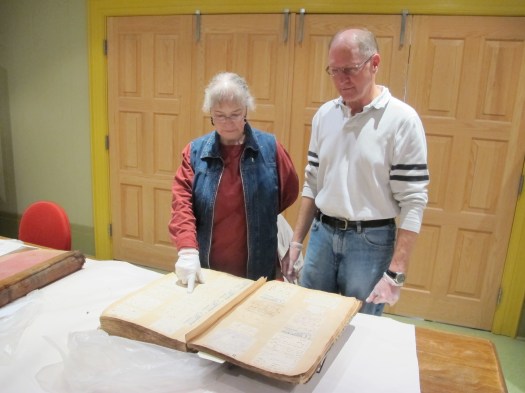
Merrily Aubrey and Ken Kaiser with ledger

Archivists Merrily Aubrey and Ken Kaiser at work on the 19th century ledgers that were donated to the Kings County Museum.

One of three old ledgers donated to the Kings County Museum

One of three old ledgers donated to the Kings County Museum. Originally a hotel register, the ledger also was used by a Kentville pharmacy to scrapbook prescriptions.

FOLK SUPERSTITIONS FROM THE OLD COUNTRY (January 19/15)

Ordinary table salt once was so precious and so scarce a commodity at one time that battles were fought to protect its sources.

An old folk belief that says it’s bad luck to spill salt and to avoid it – the bad luck that is – you must immediately, without any hesitation whatsoever, throw some over your left shoulder.  I assume my mother brought this superstition over from Great Britain since I heard it many a time at the kitchen table whenever I knocked the salt shaker over.

Now I ask you, if salt was once as precious as diamonds – it was  restricted solely to the ruling classes at one time –  how and why did this superstition arise about throwing it away to avoid bad luck?

Anyway, this is one of many beliefs that came to North America with immigrants and you still hear it and other weird superstitions like it today.  Recently, for example, a friend said he thought he could “make it safely to Halifax in a storm, knock on wood.”  He actually looked around for some wood to knock on and then caught himself.  “That’s what my Dad used to say,” he said.

I grew up hearing all those old superstitions and quaint beliefs.  My mother must have brought a cartload of them with her from England and I heard them all, many times over.  There’s the one about tea leaves, to give another example.   Finish your cup of tea, turn the cup upside down on your saucer and rotate it several times.  The tea leaves would form a pattern inside the cup that foretold your future, if you knew how to read them. (Tea was once steeped with loose leaves which explain how a pattern was formed.)

There were other beliefs, courtesy of a mother who was one of the most superstitious persons I ever knew.  Trouble with warts, rub them with raw onion; or if they were large, tie string tightly around them and they’ll disappear or fall off overnight.   Never put a coin in your mouth – this will give you canker sores.  Pick up a penny when you find one and put it in your pocket; you’ll have good luck all day.  Don’t pick up toads; they’ll give you warts. Break a mirror and you’ll have seven years of bad luck (which is an oldie but I heard it for the first time from my mother.)

Save the wishbone from a turkey or goose and make a wish on it.  My mother always dried the wishbone on the woodstove.  The wishbone is “y” shaped and after it was dry, two people could make a wish by grasping each prong of the Y and pulling until it broke.  The person getting the longest piece got their wish.  No umbrellas were ever opened in our house; it was bad luck if you did.  Don’t step on a spider since doing so brings on a heavy rain, I was told.  If your left palm itched you were sure to get money and so on.  An itchy right palm meant the opposite – you were going to lose money.

You probably laughed when your read these old superstitions and beliefs, but keep in mind that at one time they were all that people had to guide everyday living.  People of my mother’s generation and in earlier times took these superstitions and beliefs to heart.  There were many old beliefs, for example, that forecasted the weather. You couldn’t go to the weather channel in the old days so you depended on mackerel skies, red sunsets, rings around the moon and the way smoke issued from chimneys to forecast the weather.

WHICH IS CORRECT – SCOTS BAY OR SCOTT’S BAY? (January 12/15)

“From these temporary residents the place got its name,” writes Arthur W. H. Eaton in the History of Kings County.  Eaton is referring to Scots Bay, mentioning the oft repeated folklore that Scotch emigrants were forced to land there in 1764 and “began the present settlement.”

Like Eaton, a former provincial archivist also mentions the storm-forced landing of Scottish emigrants on the Bay of Fundy shoreline – hence the name “Scots Bay” for the area writes the archivist.  In his book Place-Names and Places of Nova Scotia, the archivist Charles Bruce Fergusson notes that an early name for Scots Bay also was Scotch Bay.

We now turn to the Atlas of the Maritime Provinces, published in 1878.  Here you will find a separate, detailed map of Kings County in the Nova Scotia section.  I’d say this was an authoritative source on the origin of place names and it probably was referenced by Eaton and Fergusson in preparing their books.  And, I have to add, the publishers of the Atlas must also had trustworthy sources as references when preparing their Maritime Provinces maps.  This being said, the Atlas map of Kings County has the community of Scots Bay spelled just that way – Scots Bay.

Another older map of Nova Scotia, dated 1829, also indicates that the community was known as Scots Bay away back then.  I found this map by Googleing Historical Maps of Nova Scotia and checked out provincial maps from the 1800s.

Now, on to the Ambrose F. Church series of county maps produced for the province between 1865 and 1888; there were 18 maps in total and to produce them, Church and his cronies travelled through every county to sell advertising and to map out every road, listing whoever lived along them.  The Kings County map is dated 1864 but according to the Department of Natural Resources, it wasn’t published until 1872.

Ambrose F. Church took it as gospel that the community first settled inadvertently by Scottish immigrants was called Scots Bay and nothing else.  Perhaps confirmation that this was the correct spelling of the community at the time he made his Kings County map was the aforementioned Atlas of the Maritimes Provinces.  We will never know this for sure but it’s guaranteed that Church had a source he trusted when he included place names on his maps.

Now, closer to our time, the road maps produced currently by the Department of  Highways spell Scots Bay as Eaton and Fergusson did, the same way it was spelled in the 1878 Atlas.  Look in the latest telephone directories and you’ll also find the community listed as Scots Bay.

Why then, given historical precedents do we find Scots Bay spelled as Scott’s Bay? – in various publications such as this newspaper, for example. Using Scott’s Bay for the community, instead of Scots Bay, implies that the place name originated from the surname Scott.  Yet this isn’t the case.  As Eaton and other historians tells us, the place name originated with Scottish settlers.   As I’ve also shown, the community was known as Scots Bay on a map dated 1829 and in an atlas dated 1878.

Historically, Scots Bay must be correct as the name for the community.  But to be fair and offer a bit of evidence to the contrary, the official highway map produced by the Department of Highways in 1935 has Scotsman Bay in bold type as the community name.  The Department’s map for 1944 has Scotsmans Bay displayed boldly as well, and near that in small type is the name “Scott Bay.”  Another source, Thomas J. Brown’s book, Nova Scotia Place Names, published in 1922, has the name of the community spelled as Scott’s Bay.

Perhaps Brown’s spelling and the addition of “Scott Bay” to the 1944 road map somehow led to the current spelling of the community’s name in local publications as Scott’s Bay.  But that’s speculation on my part.