LOUIS COMEAU’S BLOSSOM FEST DISCOVERIES (May 7/12)

“I surmise that Frank Burns – ‘Mr. Festival’ – being a newspaper man, would have many connections across North America,” Kentville historian Louis Comeau writes. Comeau was commenting on my recent column about the origin of the apple blossom festival. Frank Burns played a prominent role in organising the first festival and was one of the founders.

“Also,” Comeau surmises, “local farmers here were in touch with state-of-the-art farming practices across the continent. These contacts would have exposed them to other communities and the fact that they had festivals of their own.”

Comeau said that a long time ago he became interested in discovering where the idea for our apple blossom festival originated. His research lead to a couple of interesting discoveries. “Firstly, there were many, many other apple blossom festivals (at one time I counted 31 of them). Secondly, several of them were much older than ours.”

And, said Comeau, the format for our festival “was very near exact” to the festivals his research turned up. This was “maybe just a coincidence but it’s an interesting similarity,” he concludes, suggesting that our festival fathers may have been aware of these earlier blossom celebrations.

While our apple blossom festival has the distinction of being the first in Canada, it can’t claim North American honours. Louis Comeau discovered that the earliest festival in North America “seems to be the Washington State apple blossom festival.” This event was founded in 1919.

The Washington State festival website, which Comeau suggested I check, mentions their festival was the brainchild of a Mrs. E. Wagner, a native of New Zealand. Wagner “enjoyed the festivals of her childhood so much,” reads the website, “that she suggested beginning a similar festival in the Wenatchee Valley.”

Now it might be a bit of a stretch to link a New Zealand apple blossom festival with the Valley event. There could be a connection, of course. As Louis Comeau suggested, Frank Burns would have connections across North America and may have heard of the Washington State festival through the newspaper grapevine. Then there’s the apple growers grapevine to be considered. Word could have filtered down from other growers about the blossom celebration in the States that was so popular and so appropriate.

Bottom line, it seems that the idea of an apple blossom celebration isn’t original to the Annapolis Valley. As I mentioned in a previous column, it may not have even been an original idea with Kentville’s Board of Trade, the group that got the ball rolling with the first Valley festival in 1933.

In 2003, Advertiser/Register columnist Annie Bird interviewed Evelyn Tatterie Armstrong for an article in the Hants Journal. Ms. Armstrong recalled participating in an apple blossom festival in Hantsport circa 1931. Armstrong said that the Hantsport celebration began with an apple blossom dance sponsored by a prominent orchardist Laurie Sanford.

The site for the dance was Sanford’s warehouse along the railway track. Armstrong recalled that a blossom queen was selected and she was runner-up.

In the article Annie Bird writes that the blossom dance and the festivities “got so big” Mr. Sanford and other orchardists throughout the Valley met and decided to hold the “Queen’s Ball in the Cornwallis Inn.” Bird mentions as well that later, when Hantport’s mayor B. T. Smith was chairman of the Apple Blossom Festival Committee, he noted that his town had originated the festival. Perhaps he wasn’t aware of the Washington/New Zealand connection.
WAS THERE AN EARLY SPRING OR WHAT? (May 7/12)

The runs of smelts, gaspereaux and shad many anglers look forward to every spring have what biologists call a seasonal calendar. Which to me means the appearance of these fish in tidal streams varies every spring according to several factors, one of them water temperature.

In other words there is no great seasonal calendar that says on given days in April or May, shad, smelts and gaspereaux make a grand entrance into our rivers. Yet when I talked with several anglers on the Annapolis River this spring, on April 30 actually, and asked if the shad were up earlier than usual, I got a surprising reply. “No,” was the consensus. “The shad run was right on schedule.”

I usually wait until mid to late May to fish for shad, figuring this is the best time to fly fish, so I have no idea when the run starts. But I didn’t think shad came up to spawn on any sort of schedule, at least not one that could be counted on.

The shad run may have started earlier this spring but I’m not sure. Nearer to home, everyone was surprised by what seemed to be an earlier than usual run of smelts and gaspereaux. On a stillwater in early April this spring I saw trout rising to what appeared to be Mayflies. And on a warm first day of the angling season, my grandson cast to a number of trout that were feeding sporadically on stoneflies in the Cornwallis River. A few days later, on April 4, I checked water conditions on two local trout brooks, finding they were more May-like than April-like.

So I guess I’m asking, was this is an early spring or what? It certainly seems like it. This spring a plum tree in my backyard blossomed at least two weeks earlier than other years. The gardener in our household keeps meticulous records and year after year, documents the appearance of various perennials and such in our yard. She tells me that everything in her garden is anywhere from 10 to 14 days earlier than last year.

And last, that annual harbinger of spring and the shad runs, the shadbush, bloomed much earlier this year. The shadbush is the first shrub to bloom in the spring; if the legend is true that its bloom heralds the shad run, then some things definitely are early this year. Perhaps the relatively mild winter, a March with a record-breaking rise in temperature, spurred the early arrival of spring-like, early summer weather.

Actually, I’m not sure what an “early spring” really is. Or what it isn’t. Notice that the short spells of fine weather in March and early April were offset by a bunch of cold days late in April? Early spring, in other words, turned into early winter.

SOME INTERESTING “PROPOSED” WATERFOWL CHANGES (April 23/12)

The annual report of the Federation of Anglers and Hunters issued in March contains a few items of interest that should please waterfowlers. In the report is news about possible changes in the September goose season, for one thing.

No stats are available to tell us if many hunters participated in the September goose season last year but I suspect the turnout was low. Few, if any, of my waterfowling friends hunted geese during the September season. The big drawback on the September season? Hunting for geese was restricted to farmland only – at a time when most farm fields weren’t harvested and you couldn’t hunt on them. Compared to all the harvested fields you can hunt on in late season, there weren’t many place open in September.

However, the folks at the Canadian Wildlife Service must have listened to feedback from waterfowlers re the farmland restriction. The CWS is proposing a longer September goose season this year and best of all, it also proposes removing the farmland hunting only restriction.

The proposed season (“proposed” to me meaning it might or might not happen) in Hants, Kings and Annapolis County will run from September 4 to September 18 inclusive. I didn’t see anything on bag limit changes for the longer season. But the time you can legally keep possession of the birds you bag in September may be changed. The way I read it, geese bagged in the September 4 to 18 season may be kept in the hunter’s possession until the end of September.

Acting on behalf of waterfowlers, the local wildlife association has pushed for a later (mid-October) opening of the waterfowl season and extending it into mid-January. According to changes proposed by CWA, this may be happening in some areas but not in Hants, Kings and Annapolis County. I repeat, it may not be happening here. This is too bad. Many waterfowlers would like to see the season opening in October two weeks later than usual and running to about mid-January.

I see by the annual report Waterfowl Heritage Day will be held again this year. The date for the day is Saturday, September 15 province wide.

WHO CREATED THE BLOSSOM FESTIVAL? (April 23/12)

Okay, who came up with the original idea of holding a Valley-wide pageant with an apple blossom the theme?

We don’t know for sure.  What we do know is that 80 some years ago the first apple blossom festival was held in Kentville and various Valley towns participated.   We also know a successful format used in summer carnivals hosted in Kentville (1926 and 1928) was adopted by the festival fathers.  But the identity of the individual – if it was an individual – who first promoted the blossom festival idea has been lost, due mainly due to the passage of time.

However, there are clues to who this far-sighted person might be.  One of the candidates is Frank J. Burns.  He often spoke of the festival as if it was his baby and he told me on more than one occasion he started it.  Burns played a prominent role on the committee organizing the first festival and definitely was a founding father.

As the general manager of Kentville Publishing, Burns played a key role in keeping the festival alive and flourishing.   In his book on the blossom festival, Harold Woodman called Burns “Mr. Festival,” noting he served for 10 years as festival president beginning in 1938 and was honorary president until his death in 1977.  Burns is credited with bringing the blossom festival to the attention of newsmakers across Canada and the U.S.

Perhaps it may be Clifford Baker, publisher of The Advertiser, who deserves credit for conceiving the blossom festival.  “No one can say today who first mentioned the idea out loud, but it very well could have been Clifford L. Baker,” writes Harold Woodman in his festival history.  Woodman mentions a letter published in the Chronicle-Herald by G. M. Masters, who apparently was involved with the early festivals.  Masters declared in the letter that Clifford Baker had been the first to suggest an apple blossom festival.

Baker was prominent in the summer carnivals that preceded the first festival.  In the Kentville history (The Devils Half Acre) Mabel Nichols notes that in the finale of the 1928 carnival, all the performers who were in a musical united to sing a hymn of praise called Hymn to Nova Scotia.  The hymn was written especially for the carnival, by Clifford Baker, writes Nichols.

Looking farther afield in our search for whoever first suggested an apple blossom festival, we turn to the book Mud Creek, the Wolfville history compiled by James Doyle Davison.  In the book Davison refers to an editorial appearing in the Wolfville weekly newspaper, the Acadian.  Early in 1932, Davison writes, the editor of the Acadian suggested an apple blossom festival for the Valley.  The editor (Paul Davidson?) may not have been the first to suggest a blossom festival since the editorial mentions it was an idea proposed years before.

Getting back to Harold Woodman and his festival history, he writes that one of the founders was Bob Palmeter, a Kentville retailer who created the famous pattern for Apple Blossom China.  When the Kentville Board of Trade was exploring the possibility of a springtime celebration, Woodman says, it was Palmeter “who brought matters to a head” by suggesting an apple blossom festival.

Finally, we have to look at the town of Hantsport when discussing the festival’s roots.  There are claims that before Kentville hosted the first blossom festival, Hantsport held several similar celebrations and should be recognized as the home of the event.  I was told by a long-time resident of the town that Hantsport’s blossom celebration began in the 1920s and featured a blossom queen and blossom ball.

Harold Woodman mentions the Hantsport celebration in his book on the apple blossom festival.  Woodman said he was unable to discover “a direct connection” between the Hantsport celebration and the Valley’s apple blossom festival.

COULDN’T GET A FISHING LICENSE? DON’T BLAME FISHERIES ENTIRELY (April 9/12)

Over 50,000 angling licenses are sold in Nova Scotia every year, said a story in a provincial newspaper on opening day of the fishing season.

I assume that like me, most of those 50,000 anglers were ready to go fishing by the time the first day dawned. There was a problem, however. Some of us couldn’t go fishing on opening day even if we had wanted to; simply because we couldn’t buy a license.

At least I couldn’t without driving some distance, and I assume other anglers were in the same situation. The day before the season opened, I tried to purchase a fishing license at four different vendors in Kings County and was told the same story by all of them – that the Department of Fisheries failed to send them the licenses.

One of the most popular department stores in the Annapolis Valley was sold out of licenses well before the season opened; they told me Fisheries had short-changed them, hadn’t sent the usual quota of fishing licenses and the store couldn’t meet the demand. On top of that, all they received was the licenses and no angling handbooks. Five days after the season opened this store received another package of licenses and again no handbooks accompanied them.

After making a few calls I concluded the Department of Fisheries and Aquaculture had somehow slipped up when it came to getting angling licenses out to some areas in a timely manner, either shipping them late to retailers – as was the case with one vendor I called – or neglecting to send them at all. Besides the department store mentioned above, another vendor also said he received far fewer licenses than usual and couldn’t supply the usual demand.

Now, more than a few anglers I talked to were disgruntled with this situation and were quick to blame Fisheries. Three of the stores I contacted, the vendors who hadn’t received their usual supply of fishing licenses, blamed Fisheries also, telling me the Department failed to send them their usual supply.

I commiserate with anglers who couldn’t buy a license and didn’t get out on opening day. I have no idea how many were in this boat, or maybe it should be not in a boat (pardon the levity) because they couldn’t get a license. At least nine vendors in my home county, who usually have fishing licenses for sale, didn’t have them in time for opening day.

However, don’t blame Fisheries entirely if you had a problem getting a license. In some cases a few vendors hadn’t received enough licenses to meet the demand but generally there was no distribution problem. The fact is that Fisheries clamped down on vendors who “might have had a bookkeeping problem” and …. well, this is a delicate situation so I have to be careful how I put it. Someone or somebody had a bookkeeping problem and as a result there were vendors that didn’t receive the fishing licenses. If some of the vendors were responsible for this happening, then they weren’t serving their clientele very well.

Anyway, it appears the Department of Fisheries and Oceans, Inland Fisheries, Services Nova Scotia or whatever, definitely had the licenses available. That’s the bottom line. However, neglecting to send out angling handbooks, which are part and parcel of the angling license purchase, can’t be blamed on the vendors. Think Services Nova Scotia maybe?

CANARD DYKES – AN ACADIAN LEGACY (April 9/12)

From Canard Street north of the Canard River system and from Church Street on the south side, you can look upon hundreds of acres of farm fields with ricks, aboiteaux, farm roads, cross dykes, running dykes and well travelled highways.

This varied series of dyked fields, which start in Steam Mill Village and run down to Lower Canard, didn’t exist at one time.  Former dyke warden Jim Borden points out that when the Acadians arrived in Kings County, all of this land was flooded twice daily by the Minas Basin tides.

“Before the Acadians started dykeing on the Canard River,” Borden said, “the tides pushed up right to North Aldershot Road.”  In effect, twice a day the Canard dykes became a massive tidal lake that ocean going ships could easily sail into, he said.  If you’re familiar with the dykes at all this is difficult to perceive.  But this is the picture Borden painted in a recent lecture (March 26) at the Kings County Museum.  Not only that, Borden said, by the time the Acadians arrived, aeons of twice daily tides had left a flood plain covered in rich soil “with no stones in most places for a depth of at least 25 feet.”

The Acadians arrived in Kings County around 1680, a few families moving up from Port Royal to settle at Grand Pre and along the Canard River.  The Acadians immediately recognised the agricultural potential of  the floodplain, Borden said, and soon after they arrived here, dyking began along the Canard River.

“The first dykes were started on a stream running into the Canard River from the area behind Blueberry Acres,” Borden said in effect.   “Then the Acadians began dyking right on the Canard River, starting in Steam Mill.  They then moved downstream, constructing a dyke and aboiteau where Middle Dyke Road now crosses the Canard River.   The next major dyke was built on the river just below Jawbone Corner, about where the highway crosses the Canard.”

The Acadians likely intended to dyke the entire Canard River system, Borden said, but their work ended with the expulsion of 1755.  However, dyking continued after the Planters and other settlers arrived in this area, culminating after many stops and starts with completion of the Wellington Dyke in 1825.  Borden noted that 44,000 acres are protected by dykes in the province, much of it started by the Acadians; of this about 9,200 acres of dyked land exist in Kings County, a heritage he said that can be traced back to the Acadians.

The sites of the early dyking in Kings County are well known, Borden said.  He lamented that “no markers have ever been posted to identify these historical sites and this should be done.”   No comprehensive history of the Canard dykes existed either until Borden and former dyke warden Charlie Eaves promoted the idea of producing one around 1970.   This eventually was produced and published in 1985. Borden credited former Advertiser editor Brent Fox for completing the huge task of researching and writing the history.  At the time Fox was majoring in history at Acadia University and working as a summer student at the Kings County Museum.

Summing up his talk on the Canard River dykes, Borden said that early on they were used by the Acadians and Planters to pasture cattle and grow a few crops.  “Nowadays the dykes are not used as pasture and all types of crops are grown there,” he said.  “Many of the old dykes are now highways.”

MORE OF THE MORRIS BOTTLING CO. STORY (March 26/12)

This is the third column on the old plant that once bottled Pepsi Cola and Morris soft drinks literally in downtown Kentville (first column, second column).  And thanks to various readers, I’m able to somewhat flesh out the story of the bottling plant operating in Kentville over half a century ago.

I mentioned in the second column on the Morris plant that the proprietor was W. E. Morris.  A reader called to tell me it was Bill Morris and his brother Jack who had operated the plant.  And, the reader informed me, Bill’s son, Dr. Donald Morris, resides in the Halifax area.  The reader also gave me Dr. Morris’ telephone number.  I’m delighted to report that on contacting him, Dr. Morris provided background on the bottling plant and how it got started.  Here’s what Dr. Morris recalled about the bottling plant his father and uncle set up Kentville.

“In 1939 my father (Bill) who was living in Montreal and his older brother Jack, who was living in Boston, acquired a Pepsi-Cola franchise for the Valley area.  They bought a truck, drove to NS, and chose Kentville.

“Neither of them had any experience in the pop business. Somehow they thought that the old vacant church could become a bottling plant. (I was somewhat surprised when I arrived a month or two later at age 12).  Luckily the Pepsi-Cola people were very helpful.  Somehow they got the place fixed up and started producing Pepsi,

“Jack was in charge of production and Bill was in charge of sales. Shortly after they got started war was declared and sugar rationing was brought in.  The production of soda pop starts with the syrup which comes in large barrels (like wine casks) from some top secret place.  At the local plant a large amount of sugar and water are added.  The rationing of sugar could have been a great problem, but extra sugar rations were allowed for pop sold to army camps, so with the help of Aldershot and Greenwood they were able to keep busy during the war years.

“After the war the business continued to grow.  Jack had gone back to Boston after the first year.  Dave Belcher was hired to run the plant and he was Bill’s right hand man for many years.  In 1949 the Pepsi people asked Bill to take the Pepsi franchise in Halifax.  This was a difficult decision for him but he decided to do it, building a new plant in Dartmouth which became very successful.  They continued to supply Pepsi to the Valley from the Dartmouth plant.”

Dr. Morris added that it wasn’t long after they were in business that his father began to experiment “with his own brand of flavours and they continued to be constantly changing.”  The company name was changed from Morris Bros to Morris Beverages.  According to Dr. Morris, after the move to Dartmouth, the Morris brand soft drinks were “distributed in the Halifax- Dartmouth area, down the east shore as far as Sheet Harbour, as well as the Valley.”

Morris soft drink bottles are treasured by collectors today, by the way.  The Morris bottles are likely all that remains as reminders of the time unique soft drinks were produced in Kentville.

THE EGG ON THE FACE AWARD (March 26/12)

When Fisheries and Ocean released an advertisement late last year on winter angling, it included a one-month extension of the ice fishing season on two Kings County lakes and on Meadow Pond in Hants County. The handbook you get with your angling license has the winter season on these waters running from January 1 to February 28. The Fisheries and Oceans notice listed the winter season for Silver Lake, Sunken Lake and Meadow Pond running from January 1 until the end of March.

More than a few anglers missed this change and some were miffed by what they say was poor communications by Fisheries and Oceans. “As far as I’m concerned, there was no advance notice the ice fishing season would run in March,” one angler said. “I found out by word of mouth.”

Several anglers told me the same thing. Kentville angler Gord MaGee said he didn’t see any official notice on an extension of the ice fishing season. “I found out about it from other fishermen,” MaGee said, “but one angler did tell me he saw an announcement in the paper.”

I may be wrong about this but apparently the powers that be – read Fisheries and Oceans – may have neglected to pass word down the line on the season extension; and they didn’t get enough publicity out to anglers in Kings and Hants. Also, while fisheries isn’t in their bailiwick, staff of the Kentville branch of Natural Resources should have been aware of the extension. However, they weren’t aware of any changes, Coldbrook angler Jerry Bishop said, and he wasn’t happy about what he experienced when he called them.

Right or not, Bishop figured Natural Resources was the right place to call when he heard rumours the winter season had been extended in Silver Lake. “I was told bluntly there was no ice fishing on silver Lake in March. I was also told that if there was, no one had informed them (Natural Resources) about it.”

Not satisfied with being put off, Bishop said he called Ottawa and was given the provincial number for Fisheries and Oceans. When he reached someone at the provincial level, he was told the winter season had been extended to March 31. “They were surprised,” Bishop said in effect, “that Natural Resources staff weren’t aware of the season extension.”

Bottom line, I’m thinking about putting up an egg on your face award for this tempest in a teapot, winter season fiasco. Who should get it? Fisheries and Oceans for not getting the winter season changes at Sunken Lake, Silver Lake and Meadow Pond in the angling handbook and not publicizing the changes adequately? Natural Resources perhaps, since the fisheries enforcement department works out of their Kentville location?

And maybe I’ve earned the award myself. For not being on the ball and using this column to notify anglers that some waters, those named above, now have a January, February and March winter angling season.

IRISH MUSIC FROM KINGS COUNTY (March 12/12)

Did Francis O’Neill, an Irish police Captain out of Boston, visit Kings County in the early 1900s to collect music and visit relatives?

My father Carl believes that such a man came here, an O’Neill who said he had Irish relatives in Kings County.  “He said he collected music for a book,” I remember my father saying and he had served as a policeman in Boston.   “He told us he was from the same area in Cork as my grandfather and he wondered why we had dropped the ‘O’ from our name,” my father said. “He didn’t get much music from here though, just a little.”

If it was the same Francis O’Neill who published several large collections of Irish music, then perhaps a few tunes in his books did come from the Kings County Irish.  O’Neill was cut from the same cloth as the Carter family who spent a lifetime collecting and recording the folk music of  the Appalachian Mountains.  Only O’Neill’s forte was Irish music.  Like the Carters he spent decades collecting Irish music and it can truly be said that without him, much Irish folk music might have been lost for all time.

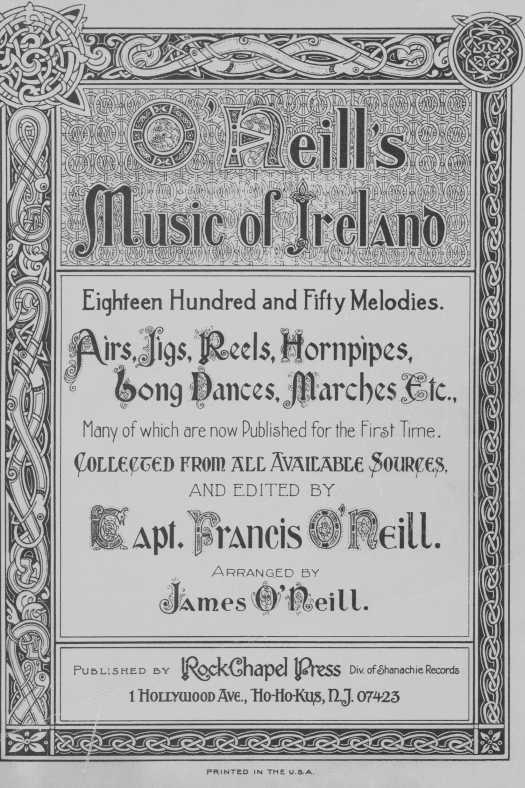
So who was this the same Francis O’Neill and did he really come to Kings County to visit and collect music?  Possibly he did. Many years ago, in an Antigonish book store, I found a collection of music called O’Neill’s Music of Ireland.  The cover boasted that the book contained 1,850 melodies;  in it were airs, jigs, reels, hornpipes, long dances and marches, collected “from all available sources” by Capt. Francis O’Neill and arranged by James O’Neill.

Later I discovered a second collection of Irish music – The Dance Music of Ireland – also by Capt. Francis O’Neil, with arrangements by James O’Neill.  This was another massive collection of over one thousand Irish tunes containing jigs, reels, hornpipes and dance pieces.  Both books had the names of the tunes in Gaelic and in English.

It was only speculation on my part but it seemed too much of a coincidence that there were two Irish policemen Captains by the name of Francis O’Neil’s collecting music to put in a collection.  It was after I showed my father my find in Antigonish that he recalled the Irish policeman who visited here.  This would have been circa 1908, he said, when he was in his teens.

With St. Patrick’s Day upon us I thought I’d mention O’Neill, his collections of Irish music and the possibility he visited here more than a century ago.  Then came Christmas last and the gift of a book on the history of Irish music.  Capt. Francis O’Neill (1848-1936) was written up in the book and I learned as mentioned above that his lifetime hobby was collecting and publishing books of Irish music.  The article on O’Neill said he travelled extensively (after he left the Boston police force) to pursue his hobby and he is saluted as the man who saved Irish folk music.

Perhaps he did visit Nova Scotia and saw his Irish relatives here in Kings County; and perhaps a tune or two from some of the Kings County Irish did end up in one of his collections.  I have this in mind and wonder which ones they might be every time I play one of the many Irish tunes from his books.

O'Neill's book

O’Neill’s book. Were Kings County tunes published in this collection of Irish music?

GIANT CATS – LEGEND OF THE LUCIFEE (March 12/12)

“I was interested in your mention of the ‘lucovie’ in your last column,” writes Reg Baird of Clementsvale. It was called a Lucifee in this area.”

The lucovie or bobcat was referred to in a 1774 report on Nova Scotia wildlife and likely it was a misspelling of Lucifee. I’ve attempted to find the origin of this word and so far no luck. I’ve come across vague mentions of Lucifees several times in my reading; the best I can say is that it is a backwoods term, one used by old-time trappers, and could be a corruption of a British/Scottish word or a native Indian word for bobcat. It may refer to a backwoods demon or spirit or simply be a mispronunciation of Lucifer, the devil.

When he wrote to me, Reg Baird referred to the “legend of the Lucifee in Clementsvale.” Years ago, he said, he wrote a story on the legend for the Voice of the Trapper. In the story, Baird told the tale of Ernest Trimper’s experience with an extremely large cat.

“I listened awestruck as Mr. Trimper related his experiences with the big cat,” Baird wrote. “Bobcat were practically unknown in western Nova Scotia in the 1940s and Trimper dubbed this animal a Lucifee. The name stuck.”

The Lucifee had escaped from one of Trimper’s large traps, simply because it was too big and too strong to be contained by it. “The animal simply overpowered the trap and was gone,” Baird said. “After that the stories of his strength and cunning really mushroomed. I’m sure the cat was blamed for a lot of things he didn’t do.”

Baird says the cat became a legend in his area, lurking around for several years, and there were tales of it following people at night. Adding to the legend were the tracks the cat left; apparently they were monstrous. “The big cat was never caught,” says Baird, “and to my knowledge never seen. But those tracks as big as saucers were very much in evidence for the next few winters.”

In later years when he on his trapline, Baird says he often thought of “the old Lucifee.” I wonder if he or anyone else considered that a wild cat as powerful as it apparently was, and leaving as large a track as it did, might have been something other than a bobcat. I hesitate to mention cougars, knowing many people will laugh, but is this it what it was?

I asked Reg Baird this question and he replied that there wasn’t any talk about cougars at the time. “However,” he said, “the name Lucifee implied something big, vicious and probably with a long tail. I would expect if we could ask Mr. Trimper, he envisioned a long tail as well, although I can’t remember anyone actually saying so.”