
THE PLANTER MIGRATION TO KINGS COUNTY (April 13/10)

On October 13, 1758, the Boston Gazette published a proclamation by Nova Scotia Governor Charles Lawrence that, in effect, invited New Englanders to consider settling in the province.

The Governor’s proclamation informed New Englanders that “since the enemy (the French) which had formerly disturbed and harassed the province was no longer able to do so,” – they have been “compelled to retire and take refuge in Canada,” Lawrence said – it was time to people the land left vacant by deportation of the Acadians.

Governor Lawrence concluded his proclamation with the words that he was now ready to “receive any proposals that may be hereafter made to me, for effectually settling the said vacated, or any other lands, within the Province ….”

Although there had been at least one earlier proposal to settle New Englanders in Nova Scotia, the proclamation likely was the catalyst that spurred the Planter migration to the province. Historians tell us the Lawrence proclamation stirred much interest in New England, and Lawrence and his agents in Boston and New York soon received inquiries from groups and individuals asking for additional information.

To answer the questions being asked, Governor Lawrence felt compelled to issue a second proclamation, dated January 11, 1759. It is this document that is perhaps the most important of the two proclamations since it spelled out in detail land grant conditions and what was expected of each grantee. Thanks to Internet historian Ivan Smith, Canning, who provided the link, anyone wishing to read the proclamation in its entirety can find it at: http://planter2010.ca.

In this second proclamation (for those who have no access to computers) Lawrence stated that no person could receive a grant of more than 1000 acres. Grantees were required to plant, cultivate and improve one third of their holding each decade until all was under cultivation. Land was to be distributed so that each grantee would receive a share of upland, meadow and marsh. Townships containing 100,000 were being established.

Eventually every township would have the privilege of electing two members to the provincial Assembly. No quit rent would be charged for the first 10 years the grantee occupied his land; after that it would be a token amount of one shilling for each 50 acres.

An interesting aspect of the proclamation regards religion. Protestants taking up land grants would enjoy religious freedom and allowed to build their own meeting houses and choose their own ministers. However, in that part of the proclamation dealing with religious freedom one finds the words: “Papists excepted.”
ROBIE’S MEMOIR – SOME STEAM MILL HISTORY (March 30/10)

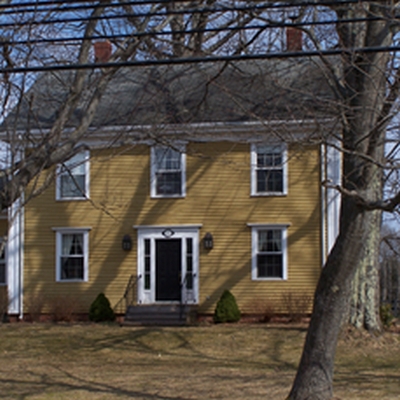
Sherri and Geof Turner’s search for information on their century home in Steam Mill led them to the other side of Canada and at the same time, turned up some of the little-known history of the village.

While the Turners aren’t sure about the exact age of their house, documentation they uncovered indicates it was standing in the middle of the 1870s, and occupies portions of the land granted to Rev. Benaiah Phelps in 1769. Phelps may have built the house but this is conjecture. Eventually, part of his original grant was farmed by Planter descendants with the surname Reid. Robie Lewis Reid was born on his father’s farm there in 1866 and his memoirs describing his early life were discovered by the Turners through the Internet.

The Turners web search took them to the archives of the University of British Columbia. A document stored in the archives, Robie Lewis Reid’s autobiography, was for the most part a description of Reid’s career after he left Nova Scotia. When they obtained a copy of the document, the Turners found that Reid also devoted several pages to describing the Steam Mill he knew as a boy. Reid wrote as well about the Acadian homesteads and dykes, what he called the “mementos of a forgotten people,” that he discovered on the farm.

These “mementos” can be looked upon as evidence Steam Mill was once an Acadian settlement. A small settlement perhaps, but Reid mentions that the “French orchards” on his farm were still bearing apples and had been “grafted to better fruit.” By digging a little, Reid wrote, he found the “ashes of an old French forge.” Evident also on the farm were “depressions in the ground (that) showed where the houses of the French had stood.”

It’s almost certain that Acadians first dyked the tributaries of the Canard River before attempting to tame the main stream. Before being moved to its present site, the Turner house stood beside Reid Road (named for Robie’s grandfather and known earlier as Isaac Reid Road). Along a Canard River tributary near the original site, Robie found “by digging down a foot or so, the timbers of the original floodgate or aboiteau” of the Acadians. Reid speculated that the aboiteau was “the first dyke on the Canard River lands” and he may be right. Most local historians would agree with him.

In his memoir, Robie Lewis Reid included a few interesting tidbits about early Steam Mill. He mentions, for example, that a grist mill once operated on the Canard River, and that Steam Mill Village once had a large school building called Franklin Hall, of which the upper floor was used for public meetings and religious services.

boyhood home of Robie Lewis Reid

The boyhood home of Robie Lewis Reid, in Steam Mill Village, dates from the 1870s.

AN ACT FOR ENCOURAGEMENT OF A STAGE LINE (March 24/10)

“Precisely how early a stage-coach line was established between Halifax and Kentville we do not know,” Arthur W. H. Eaton writes in his history of Kings County. “But in 1829,” Eaton continues, “it is said (that) Mr. John Whidden was instrumental in having the stage line extended from Kentville westward to Annapolis Royal.”

The above quotes are taken from page 130. Later in the history, on page 180, Eaton writes that it “must have been shortly before 1816 that a stage coach line was established between Halifax and Windsor.” Eaton then adds that it “was not until 1829, as we have seen, that the line was extended to Kentville.”

That fine old scholar, to whom we are deeply indebted for compiling the Kings County history, appears to contradict himself regarding coach-line dates. On page 130 he wasn’t sure of the date but on page 180 he appears to be positive that the coach started running to Kentville in 1829.

However, contradictions or not, what’s important is that Eaton records the old time modes of transportation in Hants, Kings and Annapolis County. Early in the 19th century, stagecoaches began running daily (most of the time) up and down the Annapolis Valley, connecting all the major towns and villages along the way.

As I said, Eaton mentions John Whidden as connected with establishing the stage-coach line. Whidden’s name doesn’t appear in early government records on the line. In the Statues of Nova Scotia a page dated 13 January, 1828, deals with an act granting funds to encourage setting up a coach line “between Halifax and Kentville, and Annapolis and Kentville by James D. Harris, Caleb H. Rand, James Tobin and George N. Russell.” Internet historian Ivan Smith, who sent me this information and the link to it, wrote that besides naming the above principals, there are “lots of details” in the Statues about the proposed line.

The “Act for supplying certain Monies” for the proposed line does indeed go into details, stipulating that the coaches “must run with, at least, four horses each, three times a week, from Halifax to Kentville, through Windsor, and so in return, and from Annapolis to Kentville and back again, each three times weekly.”

The Act also stipulated that each run (“the time employed in performing the Journies”) from Halifax to Kentville and from Kentville to Annapolis was “not to exceed, in general, sixteen hours for each respectively,” The coach line was also required to carry mail.

Thanks to Ivan Smith for providing this insight into the early coach line, which once established would run for about 40 years until the railroad’s arrival killed it. You can read the document referred to by going to the following link: http://books.google.ca/books?id=WMQvAAAAIAAJ&pg=PA21.

FLASHBACK: KLONDIKE GOLD LURED COUNTY MEN (March 16/10)

In a scrapbook at the Kings County Museum is a clipping from an 1899 issue of The Advertiser reading, “After a year’s absence, Josiah Bordon, son of George Bordon, Church Street, has returned from the Klondike gold fields.”

No mention is made of Josiah’s success or lack of it in the Klondike. Like more than a few Kings County men, Josiah must have been tempted by stories of easy riches in the Klondike; and like most men who made the long, arduous trip to the Yukon, he probably came home empty handed. Between 1896 and 1899, the community newspapers of Kings County reported that local men of various occupations left home heading for the gold fields. Those newspaper reports never mentioned that the local boys found gold, and from this omission we can assume they didn’t.

However, one man who did strike it rich in the Klondike was North Alton born Everett Ward. A Northwest Mounted Police corporal at the time gold was discovered in the Yukon, Ward quickly retired from the force and headed for the gold fields. His obituary, published in The Advertiser on his death in 1934, says he returned to Kings County a rich man. Apparently Ward’s proximity to the gold fields allowed him to get there early and stake a good claim. Latecomers to the Klondike, such as the Kings County locals, found that the various creeks and rivers with potential already were claimed.

Klondike Ward, as he was known, left his mark on Kentville. Most of the 10 or 12 houses and two or three stores he constructed in the town are still standing. Klondyke Street in Kentville, even though the spelling is slightly different, is believed to have been named for him, but it isn’t known why.

As for the Kings County men – and possibly women – who ventured to the Klondike, I mentioned above that their missions for gold were often recorded in community newspapers such as the Register and Advertiser. Here are a few typical excerpts from those papers, taken with his permission from a website created by Phillip Vogler of Berwick:

“February 2nd 1898. Sheffield Mill. Mr. Will Borden, who returned from British Columbia last autumn, intends going to the Klondike next week. To the Klondike. A party of five, one of whom is Ralph Crichton of Woodville, purpose leaving Halifax today for Edmonton, en route to the Yukon.

“February 23rd, 1898. Hantsport – The western fever has struck our town. One of our boys left last Monday for the Klondike. March 2nd 1898. Gaspereau – On Monday Mr. Mariner Davison started for the Klondike. It is hoped that he will be successful. March 8th 1898. Canning – Dr. G. L. Foster left last Friday for Ottawa, where he expects to join a party for the Klondike. Canning will have quite a showing in the western country before long. There will be quite a number start from here next week.”

TIME, FUNDY FOGS KILLED TELEGRAPH SYSTEM (January 27/09)

In June, 1794, writes Arthur W. H. Eaton in his Kings County history, “his Royal Highness Prince Edward, Duke of Kent …. made a journey on horseback through the valley.” The good Duke stopped in Wolfville, apparently ignoring Horton Corner; but 32 years later, to honor the Duke’s visit to the Valley, Horton Corner changed its name to Kentville.

The name of the county’s shiretown is a constant reminder that the Duke once visited nearby. However, Prince Edward left behind evidence other than a place name that his Royal presence once graced Nova Scotia. Edward is credited with establishing a telegraph/semaphore system that provided communication links between military posts from one end of the province to the other. The Duke planned as well to extend his communications network into New Brunswick and from there into Quebec.

This is well documented; by Thomas Raddall in a 1947 Dalhousie Review article, for example, and by James H. Morrison in a 1981 article in the collection of the Royal Nova Scotia Historical Society.

To establish the communications network, a series of signal stations were constructed, first in outposts around the harbor area in Halifax, then from Halifax to Fort Edward in Windsor and then to Annapolis Royal. The stations were built on high ground and manned by the military. On average, the stations were seven to eight miles apart and communications were conducted with a series of visual signals, using a combination of flags, balls and pennants.

A series of the Duke’s signal stations were built in the Valley; this is what I meant when I said evidence other than place names remains to remind us of the Duke’s visit. A map in the Nova Scotia Archives indicates that the telegraph system was to run from Halifax down the Valley to the Annapolis Basin. “I hear it is to be communicated across from the high grounds back of Cornwallis (Kings County) to the Isle of Haut,” wrote a Captain Lyman to Edward Winslow in 1800.

The “high grounds back of Cornwallis” is likely a reference to the ridges that run from south of Wolfville and westerly, the area we call the South Mountain. Where signal stations were located on the ridges in Kings County) has been difficult to determine. However, a New Brunswick historian, W. E. (Gary) Campbell has unearthed evidence of stations in Falmouth, Mount Uniacke, Wilmot and Aylesford. Folklore passed on from generation to generation speaks of signal stations located on the high ground south of Wolfville, southwest of Kentville and south of Coldbrook and Cambridge.

A rough timeline re the telegraph system: 1794 – Duke of Kent commander of military forces in Halifax. 1795 – began building communications system in Halifax. 1797 – system extended to Windsor and by 1799 to Annapolis. The plan to extend the system across the Bay of Fundy was stalled by the ever present fog and eventually abandoned. By 1802, the Duke having departed Nova Scotia, the line connecting Halifax and Annapolis were abandoned. Only vestiges of the stations through the Annapolis Valley remain today, along with folklore, and only a few have been pinpointed in Kings County.

A WORK WAGON OF YESTERDAY (January 13/09)

“Crushed by a sloven,” read an October 29, 1930, report in The Advertiser on the death of a Kings County farmer while he was working in his fields.

I found the brief report on the farmer’s accidental demise in a scrapbook at the Kings County Museum, and I must admit mention of a “sloven” puzzled me. What is, or what was a sloven? I vaguely recalled that it was a farm vehicle, perhaps a wagon of some kind, but I wasn’t sure. The reference to the sloven intrigued me, and I decided track it down. In doing so, I discovered an arcane wagon, now long gone, that in name at least was not only unique to Nova Scotia and New Brunswick, but could have been perfected here as well.

First of all, the sloven is a peculiar type of wagon with a peculiar name. That much I was able to find out easily. Besides noting that a sloven is a habitually untidy person, the Canadian edition of the Oxford Dictionary says that in the Maritimes and Newfoundland, it is a “long low wagon especially drawn by horses.” The distinguishing feature of the sloven was the low slung loading platform, dropped well below the center of the four wheels, making it possible for one man to load or unload heavy barrels, casks and trunks with ease.

At one time, at least about 100 years ago, the sloven was the work wagon of farmyards and industry. I found old time photographs of the wagon in several community histories – one in the Kingsport history and several in the Port Williams history, for example. There’s an excellent photograph of the sloven on the cover of Nimbus Publishing’s book, Historic Annapolis Valley. Historical articles on early Halifax and other Maritime seaports tell us the sloven was the wagon used to transport goods of all kinds, and was widely used in rural areas as well.

Through an internet search I discovered that in 1975, the New Brunswick Museum published a booklet of some 35 pages, Over the Cobblestones (Notes on the History of the Sloven) by L. K. Ingersoll. Reading the booklet, which I obtained from a book dealer, I found that while Ingersoll ran into a lot of dead ends researching, he (or she) concluded that the sloven most likely was named in Saint John, New Brunswick. Ingersoll also found oral traditions suggesting the sloven originated in Saint John, and was in common use there and in Nova Scotia, but notes that the design of the wagon likely evolved over a long period of time.

Ingersoll also concludes that the sloven appeared in eastern Canada in the middle of the 19th century, was in use for over 100 years before disappearing, and played a major role in transportation and trucking on the farm and in the city. The reference to a sloven in The Advertiser’s 1930 accident report tells us it was a familiar vehicle on farms here in Kings County.

Ingersoll was unable to determine why the wagon was called a sloven, but suggests that it may have been named after Saint John celebrity, one Thomas Sloven, 1835-1900.

TOO BAD DIMOCK HOUSE COULDN’T BE SAVED (January 6/09)

“A number of experts have looked at the house,” Wendy Elliott wrote in the December 9 Advertiser on the deregistering of Dimock House in Pereau, “but nobody was willing to go out on a limb about its age.”

If you look at the rather cursory archeological survey of Dimock House that was conducted some 20 years ago, you’d have to agree that Ms. Elliott, to use a cliché, hit the nail on the head. In the report of the survey, which was published in 1991 and is on file at Acadia University, the conclusions reached were nebulous, to say the least.

If the study on Dimock House had been more conclusive about its origin, or at least said there were Acadian features in the house, perhaps more would have been done by the government to help preserve it. The “curatorial report” on the survey suggested that further research was needed to determine the origin of Dimock House, and there was an “apparent conflict between the architectural elements.” It was a kind of wishy washy report and there was no follow up. I heard rumors that consideration was being given to testing the timbers in the house, to determine their age through carbon dating I suppose, but apparently nothing came of this.

Unfortunately, once the deregistering process is complete, it’s likely the house will be demolished. As Ms. Elliott reported in her Advertiser piece, the house is in sad shape and is practically falling down. Given its rapidly deteriorating condition, deregistration was the only practical way to go.

It’s too bad the house must go. Acadian in origin or not, Dimock House is ancient. Several years ago I talked with Melissa Dimock, the daughter of the current owners, and she told me the house has been in the family since 1873. Dimock also told me the house was built in such a way that it could have been taken apart and moved to another site quite easily. She also said that while they didn’t know the exact date, they were able to trace ownership of the house back to circa 1770.

The curatorial report, Nova Scotia Museum Curatorial Report 69, if you want to look it up at Acadia, suggested the possibility that the house may have been built by Acadians who returned to this area after the expulsion, and was later added to by later owners. An earlier search of deeds revealed that in 1796, the house was owned by a man with an Acadian surname.

THE CHRISTMAS GOOSE – A LOOK BACK (December 23/08)

People of my generation often speak warmly of the old fashioned Christmases they enjoyed when they were kids. For the most part they were country Christmases, replete with sleigh rides, carol singing and that fondly remembered Christmas day dinner, roast goose.

Looking back to the days when I was a kid, I’d say that goose, for the most part, was the traditional Christmas dinner. The now ubiquitous yuletide turkey hadn’t made its appearance, and you could count on every barnyard having a goose or two that was being fattened for Christmas.

I don’t know how some of you seniors feel, but I’m glad the goose, the domestic goose that is, has practically disappeared from the Christmas menu. Good riddance, I say. Bring on the turkeys. They may not be as traditional as the goose; but from what I remember of Christmas dinners some 50 years ago, I’d say the goose wasn’t worth all the effort required to prepare one for dinner.

Rendering the goose, for example, was a tedious – and necessary – practice that was time consuming. I remember my mother spending hours at the oven Christmas morning while the goose was slowly roasting. The fat had to be removed as it dripped from the bird into a pan that was set under it solely for the rendering process. Domestic geese are more fat than meat, and without the rendering they are greasy and hardly palatable.

Never mind that the goose fat was saved and was used later that winter as a chest rub when mixed with Minard’s Liniment, and if my memory isn’t faulty, with oil of wintergreen. I had more than my share of this mixture daubed on my chest when I suffered from colds. Seems to me it worked, too, so you could say the traditional Christmas goose had more than one use.

I must admit that that the geese we feasted on in Christmases half a century ago had something other than medicinal going for them as well. No other fowl, domestic or wild, has the unique flavor of roasted barnyard goose. But the flavor alone wasn’t enough to keep the goose as the traditional Christmas dinner. The turkey replaced it for the simple reason that it was easy to mass produce and a lot simpler to prepare for the table.

Rather than the taste of roast goose, however, what I remember most about those long ago Christmas diners was the stuffing my mother prepared for the goose. She used a recipe she brought with her from England; it was strong in summer savory, high in celery and onions, and tops in taste. Like roasted goose, homemade stuffing has disappeared from the Christmas dinner as well. Nowadays, you buy it in a box.

A GRAND OLD ROAD THROUGH NOVA SCOTIA (December 16/08)

In many of the Kings County community histories you’ll find references to the Annapolis Road, or as it’s called in some areas, the Post Road. In most cases the references are brief. Several local histories mention only that the old road passed through this or that community; usually nothing is mentioned of the road’s origin.

If you like to read about Kings County history, you’ll find the bare bones mention of the Annapolis or Post Road frustrating. I found a one line reference to the old road in one of the first community histories I read many years ago. After, I found the same one line reference again and again in other community histories, with nothing on the road’s origin other than that it passed through the area being documented and traces of it still existed here and there.

What was this old highway, known as the Annapolis Road, the Post Road and in one or two community histories as the “old Stagecoach Road?”

Well, for one thing, the old road at the start was to be a great highway (some sources say 200 feet wide) cutting through the heart of the province to connect Halifax with Annapolis Royal. The plan to build this super road was conceived over 100 years ago, and except for its width, it was much like today’s 101 before sections of it were twinned. From what I’ve read, it seems the original plan was to start the road in Halifax, pass through Hammond Plains and into Hants County; from Hants County the great road would run through the highlands on the southern edge of Kings County, skirt the edge of Lunenburg County and continue on into Annapolis County.

As you can see from this brief description, the grand road would take a zigzag course, apparently with the aim of connecting the major settlement and farming areas between Halifax and Annapolis, the prime agricultural area of the Valley, for example, and major settlements near the South Shore.

The great road was the brainchild of a military engineer, one Joseph DesBarres, who had served with the 60th Foot Royal American regiment during construction of the Halifax citadel. Around 1763, DesBarres submitted a plan to the provincial government, proposing the building of an all-weather road some 21 feet wide with trees cleared for one hundred feet on either side, to run from Halifax to Annapolis Royal.

Nothing came of the DesBarres proposal but the idea of building this super highway surfaced again and is mentioned in government documents in 1783. A map exists in the Public Archives showing a line of road and a notation “markt out by Gov. Parr’s orders in 1784.” G. R. Evans, writing on the history of the Annapolis Road (volume 38, Collections of the Nova Scotia Historical Society) states that Parr’s road was a proposal only. Between 1773 and 1816 the Annapolis Road was surveyed several times. Sections of the road were constructed between Halifax and Annapolis, but by the 1830s the government abandoned plans to complete the highway.

History buffs interested in the location of the old road in Kings County can find references to it in several community histories. Pioneers of Canaan and Memories of Coldbrook, by Marie Bishop are two; others are the Coldbrook history by Laurie T. Ward and the Wolfville history, Mud Creek.

HISTORY BOOKS, CDs MAKE GREAT GIFTS (December 9/08)

I hope what I’m about to suggest doesn’t sound like a sales pitch to help the Kings Historical Society with book and CD sales. But if anyone in your circle of family and friends is a history buff, take a moment to drop into the Kings County Museum and look over the super selection of historical books and statistical CDs on sale there.

Take, for example, my favorite collection of Kings County history books. I like to think of the 10-volume collection of Kings County Vignettes as history in a nutshell and that’s what they are. Each volume in the pocketbook size volumes runs to 50 pages each and contain condensed articles on various aspects of Kings County history. The price is right too – $7 per book.

Also priced right is Historic Kings County, some 66 pages of Kings County history in stories and pictures. With about 100 photographs and profiles on 35 county communities, and a price tag of $3. this is a great stocking stuffer.

Staying with the stuff that’s reasonably priced the Cemetery Map locator book at $5. is worth considering. The A. F. Church Map at $15. – the township map of Kings County photocopied and presented in book format – would make a great gift along with the cemetery map for anyone searching for their ancestors. Brent Fox’s history of Camp Aldershot, covering the period from 1904 to the 1980s is also a great stocking stuffer at $4. and I recommend it for military buffs.

Ron Illsley’s history of Berwick ($25.) and Marie Bishops Coldbrook history ($30.) are also available at the Museum. If the person you’re shopping for has Acadian ancestors you might want to consider the Acadian Census, 1753 – 1763 at $15. They Farmed Well by G. H Gerrits ($15.) makes a great gift book for anyone researching their Dutch ancestry.

In the genealogical line as well are several CDs in the statistical line. Among them are the Kings County Church Records, Annapolis Valley Births and Deaths, 1864 – 1877, and Kings County Marriages, 1864 – 1909.

These are only a sample of the historical books and CDs available at the museum. Keep in mind that the museum closes for the season at noon on December 19.