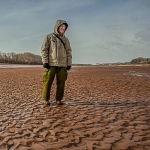
DOWN BY THE OLD DEWEY CREEK BRIDGE (December 12/06)

Find a longtime waterfowl hunter and sometimes you’ll find a person interested in local history, especially history of the dykes, and the old aboiteaux. This may seem unusual when you think about it. But waterfowlers generally spend a lot of time on the dykes and it isn’t unusual for some of them to collect dykeland lore and history.

One of the finest waterfowlers I ever met knew the history of much of the Canard dykes; why the various dyke sections were so named, for example, where the old Acadian aboiteaux and dykes were once located, and historical tidbits of this sort. The old waterfowler, now long deceased, used to say that “knowing some dyke history rounded out my hunting.” He was like a many of the older generation of waterfowlers that were around when I first started to hunt. They knew the dykes like the backs of their hands, to use an old but suitable cliché.

I often duck hunt down the Dewey Creek below the old Dewey Bridge. This is in Canard and the creek or brook is a tributary of the Canard River. The bridge can be found on an old section (now a farm road) of what was the main highway until roughly 70 years ago when the road was straightened. I was curious over how the bridge and brook connected with the Dewey surname – a surname not that common in Kings County – and I asked the old waterfowler who this Dewey was.

A couple of the Deweys came here with the Planters, maybe a bit later that the original grantees,” the old waterfowler said. “They’re a mystery. It seems they didn’t stay around that long and I don’t know what happened to them. I think their homestead was near the head of Dewey Creek.”

The “head of Dewey Creek” could be a mile or two away from where the creek crosses under the highway just below a poultry plant. The creek makes up in wetlands east of the Canning to Port Williams highway, a distance of several miles from the Dewy Creek bridge. Pinpointing the Dewey homestead, if there ever was one, would be difficult since it could be anywhere along the creek.

Anyway, the location of the homestead wasn’t of interest to me. How Dewey Creek came to be named was and the old waterfowler had provided the answer. “Look in your history books if you want to know more about Dewey Creek,” he added.

Dewey Creek in the history books? The old man was right. In his history of Kings County, A. W. H. Eaton devotes nearly a page to the Dewey family. Eaton says that one Moses Dewey received a grant in Cornwallis in 1764 and settled there for a time.

There’s no Dewey mystery, however. Moses Dewey simply must have given up his grant and moved out of Kings County, or out of the province. “For many years the Dewey name has hardly been known in Nova Scotia,” says A. W. H. Eaton. He quotes a historian he names as Dr. Brechin: “All that remains (in Cornwallis) of this family is the name of a small stream called Dewey Creek, on the place where Mr. Simpkins Walton lived.”

Now if my old waterfowler friend were still around I’d ask him where the Walton homestead was located. I’m sure he knew.

A MINI HISTORY OF JAWBONE CORNER (December 5/06)

In earlier times, the crossroads where Canard Street (Route 341) is crossed by the Port Williams to Canning highway (Route 358) was known as Hamilton’s Corner. Arthur Wentworth Hamilton Eaton in his Kings County history writes that this was the local name for the crossroads.

However, Malcolm (Mac) Eaton, a farmer whose family has owned the house on the northwest corner of the crossroads since 1919, tells me he and others in the area often refer to the crossroads as Canard Corner. Relatively few people – and most of them are history buffs – know that the crossroads was once called Hamilton’s Corner. Canard Corner seems more appropriate but it never caught on. Instead, the crossroads is known locally by another name, and a colorful one at that, for a set of whale jawbones that once rested in what is now Mac Eaton’s driveway.

Most local people know how Jawbone Corner got its name, but few know the details. Even fewer people know that the corner was once the commercial center of the area. Like most crossroads in the county, the corner attracted local industry, holding a postal station, a blacksmith and carpenter shop, and a factory that made sleds and wagons. Also, a carding mill once operated nearby on the Canard River. A medical practice was situated there as well, conducted by the gentleman after whom the corner was named, Dr. Charles Cottnam Hamilton.

I got this information from Mac Eaton who told me about the blacksmith shop and factory when we were talking recently about the history of Jawbone Corner. Mac said the equipment in the factory was operated by horsepower. Not the kind of horsepower generated by engines but actual horses that were harnessed to a turntable. Mac remembers seeing the grooves ground into the floor of the factory by the constant circular motion of the horses as they moved the turntable.

Mac told me as well that the whale of jawbone fame was stranded on the Canard River just above the highway that runs between Port Williams and Canning. The jawbones were placed on either side of what is now the Eaton driveway and rested there for decades before ending up at a residence on Church Street. This incident occurred when the Minas Basin tides were unrestricted and ran well up the Canard River; this would be before the Wellington Dyke was completed in 1825.

When I was talking with Mac Eaton about Jawbone Corner he gave me a tour of his house. Built in the early 1800s, the house was purchased in 1835 by Dr. Charles Cottnam Hamilton. Mac showed me the area in his house where Dr. Hamilton had his practice from 1825 until 1880. Mac’s grandfather, Charles Cottnam Hamilton Eaton (who was named after Dr. Hamilton) purchased the property in 1919.

The area around Jawbone Corner apparently was once part of a major Acadian settlement. Jawbone Corner was the junction of two main travels ways between Acadian villages north and south of Canard. The Corner is historically significant but this has never been recognized.

JOHN EDWARD COLEMAN WAS 30 YEARS A JAILER (November 7/06)

I have an amusing story that involves John Edward Coleman the Kings County jailer through the early part of the last century.

One of my friends of many years is Gordon Hansford. Gordon and I played the bagpipes together socially and in various pipe bands for something like 30 years. Whenever I saw Gordon during those years I said to myself that he reminds me of my older brother. The resemblance was amazing, the mannerisms similar.

A few years ago Gordon mentioned that when his mother was a young woman, she occasionally visited her uncle John at the county jail. This stunned me for a moment. Then I realized that from what Gordon had said, his mother was a Coleman. My great uncle and her uncle, the jailer John Edward Coleman, were one and the same. This made Gordon and I cousins – or second cousins, I believe – and it explained why he reminded me so much of my brother.

Thanks to this pleasant discovery I was able to add to the lore I was collecting on the descendants of my great grandfather, Irish immigrant David Coleman. On one visit to her uncle at the jail, for example, Gordon’s mother asked him why he was so good to the men incarcerated there. “I have to be,” John the jailer replied. “So many of them are my relatives.”

I suppose this casts some of my Coleman ancestors in a rather dim light, but most of us have black sheep in the family anyway, so why should ours be different. Stories told in our family about my great grandfather and my grandfather indicate they both were typical Irishmen who carried large, precariously perched chips on their shoulders; undoubtedly a pugnacious attitude was passed on to their children and their children.

But back to Uncle John the jailer. He served as county jailer for at least 30 years at the jail in Kentville. Before he became jailer, John worked as a county constable for 25 years, a position reads his obituary “in which he was known as one of the best police officers (the) municipality ever had.” His 50 years as a county constable and jailer are a remarkable record.

Actually, he may have served longer than 50 years. Mabel Nichols writes in the Kentville history, The Devil’s Half Acre, that John was jailer from 1896 until 1928; more than 30 years, in other words. If his obituary is accurate, John was 93 on his death in 1931, indicating he served as a jailer until age 90. Something is undoubtedly wrong with this since I can’t see anyone performing the functions of a jailer at that advanced age.

When he was jailer, John would have seen a new jailhouse erected in 1907; he served under at least two Sheriffs, Stephen Belcher and Charles Frederick Rockwell. John was jailer when William Robinson was executed for murder in 1904, the last hanging in Kings County. John is almost forgotten today, but a derogatory song composed by some Gaspereau men called The Ballad of John Coleman’s Jail is still floating around out there in the countryside.

THE MAPPING OF KINGS COUNTY (October 31/06)

That genealogical treasure trove, best known as the Church map of Kings County, has a publication date of 1864. However, anyone knowing a little about the history of Kings County and the railway will undoubtedly notice an irregularity – if that’s the right word – in the map.

Church’s map shows the railway line running through the heart of Kings County and it indicates where the rail yard and railway buildings are located in Kentville. If you look at Marguerite Woodworth’s history of the Dominion Atlantic Railway, you’ll find that in October, 1865, two civil engineers representing a British firm arrived in Nova Scotia to propose the establishing of a railway line from Windsor to Annapolis.

In other words, Ambrose F. Church’s Kings County map indicated that a railway line existed in Kings County in 1864, but the possibility of establishing said line was being negotiated late in 1865 In fact, the contract to proceed with the railway wasn’t signed until near the end of 1865, the contract stating that work was to commence no later than the first day of May 1866; it wasn’t until some four years later that the line was officially opened.

So why the 1864 date on the Church map for Kings County?

Let’s go back to 1862. In that year the legislature of Nova Scotia was looking at the possibility of procuring detailed survey maps of the various counties. A contract to produce said maps was given to one Jacob Chace. Mr. Chace died before commencing work on the maps. Enter Ambrose F. Church who in 1864 submitted a proposal to the government to furnish detailed county maps. It appears that no formal contract was signed but on April 28, 1864, Church’s proposal was received by the House of Assembly of Nova Scotia; final approval for Church to proceed with the maps was given a year later on April 28, 1865.

Now perhaps we can see why Ambrose Church saw fit to date his Kings County map 1864. Actually, he didn’t begin work on Kings County until much later. His first map, of Halifax County, was completed in August 1865, and some 200 copies were printed. Work began late that year on Church’s second map, that of Pictou County, which was issued in 1867. The maps of Digby County and Yarmouth County were next and were completed in either 1870 or 1871. The map of Hants County was fifth in the series, and it was published in 1871.

In 1872, Church received a grant from the government to produce a map of Kings County and we have to assume it was published that year. We know from what is shown on the map that the survey of Kings County had to have been done no earlier than 1869, and most likely after work was completed on Hants County. Realistically, the Kings County map probably should have been dated 1872.

WILLIAM H. CHASE – A PIONEER WORTH REMEMBERING (October 24/06)

In my October 3 column, I told the story of how William Henry Chase of Port Williams became a major apple exporter. I based my column on an article Chase wrote for The Advertiser’s 1933 apple blossom magazine. In the article, Chase wrote about his role in building the apple industry, downplaying that he was a major mover and shaker who became a leading figure in Canada’s commercial world.

But despite being a commercial pioneer on the scale of R. A. Jodrey, little is heard today of William Henry Chase. Literally speaking, he is practically unrecognized, even in the little Kings County port where he was born. There are few if any monuments to the man and his accomplishments. In preparing the October 3 column, for example, all I found were brief mentions of Chase in two locally published history books.

Perhaps this is the way Chase wanted it. It was not known for many years, for example, that Chase made a great contribution to the people of Nova Scotia by erecting the Nova Scotia Archives building. Chase was the mysterious “anonymous Archives benefactor,” and he agreed to finance the building only if his role was not disclosed.

On his death in 1933 the Halifax Herald published a lengthy obituary describing Chase’s career and his accomplishments. I’ve been fortunate to obtain a copy. And frankly, after reading it I’m dumbfounded that he accomplished so much and is so little celebrated. Take Chase’s business career, for example, as described in the obituary:

“In 1870 (Chase) undertook to develop the potato trade by an experimental schooner shipment to the West Indies. It proved successful and encouraged him to extend his operations. Five years later he was shipping apples to the United Kingdom, and having bought up all the apples within the district he found it necessary to store them. He accordingly built the first apple warehouse in Nova Scotia. Ten years later (Chase) entered into a contract with a New York dealer to supply all the apples grown in Kings County, sending forward 30,000 barrels. Shipments to the United Kingdom grew until by 1911 he was exporting 500,000 barrels per annum. In later years his operations as an exporter were extended far beyond this figure. One of the highlights of his career was his creation of the port of Port Williams.

“Extending his business after becoming established in fruit, Chase became interested in hydro-power and some 19 years ago, with R. A. Joudrey (sic) and the late C. A. Wright of Wolfville organized the Gaspereau Light, Heat and Power Co. … Out of all this development came the Avon River Power Company … the Gaspereau Co. and the Windsor Electric Co.

“Mr. Chase continued to extend his operations to a wider field,” the obituary noted. “In addition … to being president of the Avon River Power Company, he was a director of the Eastern Trust Company, of the Mersey Power Co., which he helped to form, the Trinidad Electric Co. and the Puerto Rico Railway Co., and more than a (score) of other business organizations. He was one of the prime movers in a scheme that resulted in the Eastern Kings Memorial Hospital.”

CORA’S LEGACY – A HISTORY OF KINGSPORT (October 17/06)

In its heyday, Kingsport could boast of having three hotels, a shipyard, a mill and a shipping trade. A rail line, the Cornwallis Valley Railway, connected Kingsport and its port with the province’s transportation system. As well, the port was linked to other Minas Basin communities via a ferry, the renowned Kipawo.

Today Kingsport is a bustling, attractive seaside community with a popular beach and a rejuvenated wharf. The shipyard, mill, and hotels, along with the railway line and the ferry, are long gone. Gone as well are Kingsport’s glory days as a commercial port, and it no longer ranks as an important county link with other vital ports along the Atlantic shore.

Those days may be gone, but to use a well-worn cliché, they’re far from forgotten.

Thanks to a Kingsport schoolteacher, the history of the community from roughly the period the Planters arrived down to modern times has been preserved. By accessing various historical resources, and more importantly, interviewing longtime residents, Cora Atkinson compiled a history of what was once a vibrant and important Kings County seaport. Kingsport By the Sea was published in 1980.

I’m not sure of the exact number but I believe only a hundred of the original book, with text only, were printed. A second edition, with many old photographs of Kingsport added, soon followed. The second edition has been long out of print and is difficult to find. A few worn copies can still be found in libraries around the county.

However, if you’re interested in Atkinson’s work there’s good news. History buffs will be pleased to hear that last year the community of Kingsport decided to reissue Atkinson’s book. June Barkhouse, whose husband George is Atkinson’s nephew, tells me the community decided to preserve Cora’s legacy and to make sure her book is never out of print. The third edition book was reprinted as a CAP project.

June Barkhouse describes Atkinson’s compilation of the book as “thorough and researched very carefully,” and it required little revising. Barkhouse tells me the only change they made from the original was the addition of civic numbers to the properties that are described. I was pleased to see that those delightful old photographs, many from Kingsport’s glory days, were retained in the reprint.

Only a limited number of the reprints were produced, Barkhouse says, and most have already been sold. A few copies of the book are still available at Kingsport’s CAP site. The cost is $10. However, while a limited number of the third issue were reprinted, the community has plans to issue more in the near future. “We don’t want the book to ever be out of print again,” Barkhouse says.

HISTORICAL TIDBITS AND READER RESPONSES (October 10/06)

Where was the Mill Creek shipyard located? I asked in a recent column on the early days along the Blomidon shore.  In fact, I also wondered about the location of Mill Creek, mentioning that local historian Leon Barron hadn’t been successful in pinning down the exact site.  Establishing the location of Mill Creek is important in one sense, it undoubtedly being the site of one of the earlier shipyards in Kings County.

Where was the shipyard located?  A reader calls to tell me in effect that it’s really no mystery at all.  If you know where the popular Huston (Houston?) beach is located along the Pereau shore towards Whitewaters/Blomidon, then you’re not far from the shipyard site.  Mill Creek, the reader said, is located about one mile north of the beach and until five or six years ago the remnants of a wharf could be seen there.  There’s a road out to the wharf, the reader said, which apparently is a government road since it is still plowed.

In an earlier column I mentioned a great forest fire that in the time of the Acadians, devastated the woodlands of what is now Hants County and a great part of Kings County.  When I found a reference to the fire in the book Historic Hants County by Gwendolyn Shand, I contacted various historians, asking if anyone had heard of the great fire.  I struck out everywhere.  I checked several historical books as well and was unable to find any mention of the fire, even though it was devastating, both to the Acadians and the Planters.

Recently I “lucked out;” I found an indirect reference to the fire while reading James Martell’s paper on early settlements on the Minas Basin.  Martell writes that one of the problems facing the Planters when they took up Acadian lands was a scarcity of wood.  “At Horton (township) the greatest complaint was concerned with the scarcity of convenient woodlands and the fact that there was only half as much marsh and cleared land as had been promised.  Forest fires had destroyed much of the wild wood.”

In another earlier column I speculated on who had the questionable glory of being executed on Kentville’s Gallows Hill, thus giving the rise its grisly but unofficial name.    In James Martell’s work I found a reference to a hanging that took place in this area.  Commenting on Planter life, Martell writes:  “Murders were committed occasionally in the settlements.  In 1776, Peter Manning was convicted for the crime before the Supreme Court at Horton.  A special guard was put over the prisoner for 14 nights while the gallows were being erected in the town.”

According to folklore, this hanging took place much too early to be the one that gave Gallows Hill its name.  I’ll look at this in next week’s column on early jails in Kings County.

Who is the “apple king” of Nova Scotia?  I wrote in last week’s column that this honor belongs to William H. Chase of Port Williams.  However, the Kings County Register’s editor, Sara Keddy, questions this.  “I’ve been raised on Berwick-based history, I guess you’d say for the past dozen years,” Sara writes, “and I was always told Sam Chute was the Apple King, recognized in Boston and known by the Governor General himself on sight.  Help!  Do we need to have a battle for the title?”

Sam Chute is mentioned in several accounts of the apple industry and possibly he deserves to be called an “apple king” as much as Chase.  I’ll look at the evidence and present the case for Chute and for Chase in a future column.

HISTORICAL TIDBITS AND READER RESPONSES (October 10/06)

Where was the Mill Creek shipyard located? I asked in a recent column on the early days along the Blomidon shore. In fact, I also wondered about the location of Mill Creek, mentioning that local historian Leon Barron hadn’t been successful in pinning down the exact site. Establishing the location of Mill Creek is important in one sense, it undoubtedly being the site of one of the earlier shipyards in Kings County.

Where was the shipyard located? A reader calls to tell me in effect that it’s really no mystery at all. If you know where the popular Huston (Houston?) beach is located along the Pereau shore towards Whitewaters/Blomidon, then you’re not far from the shipyard site. Mill Creek, the reader said, is located about one mile north of the beach and until five or six years ago the remnants of a wharf could be seen there. There’s a road out to the wharf, the reader said, which apparently is a government road since it is still plowed.

In an earlier column, I mentioned a great forest fire that in the time of the Acadians, devastated the woodlands of what is now Hants County and a great part of Kings County. When I found a reference to the fire in the book Historic Hants County by Gwendolyn Shand, I contacted various historians, asking if anyone had heard of the great fire. I struck out everywhere. I checked several historical books as well and was unable to find any mention of the fire, even though it was devastating, both to the Acadians and the Planters.

Recently I “lucked out;” I found an indirect reference to the fire while reading James Martell’s paper on early settlements on the Minas Basin. Martell writes that one of the problems facing the Planters when they took up Acadian lands was a scarcity of wood. “At Horton (township) the greatest complaint was concerned with the scarcity of convenient woodlands and the fact that there was only half as much marsh and cleared land as had been promised. Forest fires had destroyed much of the wild wood.”

In another earlier column, I speculated on who had the questionable glory of being executed on Kentville’s Gallows Hill, thus giving the rise its grisly but unofficial name. In James Martell’s work I found a reference to a hanging that took place in this area. Commenting on Planter life, Martell writes: “Murders were committed occasionally in the settlements. In 1776, Peter Manning was convicted for the crime before the Supreme Court at Horton. A special guard was put over the prisoner for 14 nights while the gallows were being erected in the town.”

According to folklore, this hanging took place much too early to be the one that gave Gallows Hill its name. I’ll look at this in [a future] column on early jails in Kings County.

Who is the “apple king” of Nova Scotia? I wrote in last week’s column that this honor belongs to William H. Chase of Port Williams. However, the Kings County Register’s editor, Sara Keddy, questions this. “I’ve been raised on Berwick-based history, I guess you’d say for the past dozen years,” Sara writes, “and I was always told Sam Chute was the Apple King, recognized in Boston and known by the Governor General himself on sight. Help! Do we need to have a battle for the title?”

Sam Chute is mentioned in several accounts of the apple industry and possibly he deserves to be called an “apple king” as much as Chase. I’ll look at the evidence and present the case for Chute and for Chase in a future column.

WILLIAM H. CHASE – THE “APPLE KING” (October 3/06)

“I remember it, as though it were yesterday, this gentleman with his tall white beaver hat coming into the little country store at Port Williams late one afternoon where I was busily waiting on customers.

“Farmers in those days did most of their shopping in the evening and it was not until about nine o’clock that he rather impatiently said to me, ‘young man, when am I going to be favored with a few minutes of your valuable time?’  It was then I asked him in the office and he made known his errand.”

This was how William H. Chase described an encounter with an American agent who “about 1878 … came to Nova Scotia with a view to purchasing apples for the New York market.”  The scenario took place in the store Chase was operating in Port Williams.  The quotes, from an article he wrote for the Advertiser’s apple blossom magazine in 1933, give us a firsthand look at how Chase first got into shipping Valley apples to American markets.

In the article, Chase reveals that he became involved with apple exporting about a decade earlier; he and a cousin had entered the business of buying apples and shipping them to markets in New Brunswick.  It was small scale at first, but this was the modest beginning of Chase’s apple empire.  From buying 500 barrels of apples from farmers near Port Williams and shipping them a market less than 100 miles away, Chase would expand to become Nova Scotia’s undisputed apple emperor.  Anne Hutten writes in Valley Gold that in his heyday, Chase was known to sell as many as 200,000 barrels of apples a year worldwide, and until World War 1 was the king of all apple brokers in eastern Canada.

Chase writes that it was the visit of the agent to his store in 1878 to purchase apples for the American market that “really gave the first big impetus to the industry.”  As a result, “we purchased practically all the apples in the district from Windsor to Aylesford and shipped them to New York, in all some 31,000 barrels.”

Chase concludes that it was from this time that the “apple industry began to be carried on in this Valley on a commercial basis.”  This was also his first step in becoming a leading entrepreneur and a pioneer in several fields besides the apple industry.   He is saluted in the Wolfville history (Mud Creek) as an “outstanding leader in the apple business” who “distinguished himself as a financier and inaugurated an improved apple shipping overseas.”   R. A. Jodrey was his partner in several business ventures, including the Windsor Electric Company, shipping, and apple processing.

A Planter descendant and Port Williams native, Chase was born in 1851.  He died in 1933, a few months after his review of the apple industry was published in the Advertiser’s apple blossom magazine.

IN 1762: TROUBLED TIMES IN KINGS COUNTY (September 26/06)

Some seven years after the Expulsion, James Stuart Martell writes in his work on pre-Loyalist settlement in the Minas Basin, “the Acadian problem in Nova Scotia once more became acute.”

Since the Expulsion of 1755 removed most of the Acadians from Nova Scotia, it seems unlikely that problems with them arose nearly a decade later. A few Acadians avoided the Expulsion by hiding in the countryside, but historians tell us they soon surrendered after nearly perishing in the wilderness. Historians also say some Acadians found their way back into the province immediately after the Expulsion, but apparently not in any number to cause concern.

However, in preparing his thesis in 1933, Martell conducted a thorough search of provincial archives records regarding the Acadians. He found that the number of Acadians remaining in 1762 alarmed the relatively young settlements of New Englanders. To put it bluntly, the Planters simply didn’t trust the remaining Acadians and there were suspicions they were up to no good. Fueling this suspicion was the arrival of a French fleet off the coast.

Martell concludes that the Acadians may have been considering an uprising. “The number of ‘neutral French’ had been steadily increasing since 1756,” he writes, and the provincial government said, “they were incessant in their endeavors to break up the Indian peace treaties.” In 1762, as a result of pressure from settlers, Acadians residing in the province were forbidden “from carrying guns and going at large in the country.” At the highest level of government the removal of “troublesome Acadians” was seriously being considered; a second expulsion, in other words.

Apparently fear of Acadian support for French military action was not unfounded. “The province was ill prepared for internal revolt,” Martell writes, and in Kings County especially, the “numbers and attitude of the Acadians must have been exceptionally menacing.” Due to this perceived menace, some 70 settlers in Horton Township had already departed and more were expected to leave.

In Kings County and elsewhere in the province the militia had been marshaled and a general roundup of Acadians began. In Kings County, Martell writes, “able bodied Acadians numbering 130, under a guard of 100 militiamen, were taken from Kings County for the safety and security of the settlers” and marched to Halifax. After the Acadians were removed it was discovered that they had been “concealing in secret places a considerable quantity of ammunition for small arms.”

But even with the Acadians removed the unrest in Kings County remained. With most men serving in the militia, a new menace arose. From Martell: “The Indians gave the Kings County settlers further cause for worry, threatening destruction to the townships when most of the men were away on military duty. The return of the militiamen, sent back from Halifax to protect the (threatened) settlements, saved the situation. The savages were easily dispersed in the absence of the Acadians who originally incited them.”