EDWARD CORNWALLIS – THE EVIDENCE AGAINST HIM (October 1/04)

“I believe people should consider all aspects of historical criminal actions before trying to defend the indefensible,” Dr. Daniel Paul wrote in a recent letter to the Kings Historical Society. Published in the Society’s September newsletter, the letter was a response to an earlier article which Dr. Paul said was an attempt to “excuse the murderous sins of (Governor Edward) Cornwallis by stating that they stemmed from the standards of his day.”

Dr. Paul further said that “attempts to exterminate a race of people has never been… part of the acceptable standards of any day.” In the future, he asked, “do our descendants someday excuse the actions of Adolph Hitler, Stalin, Pot Pol, Edi Amin, etc., declaring that they were relative to the standards of the 20th century? I think not!”

Cornwallis was governor in Nova Scotia from 1749 to 1753. During that time, Dr. Paul said, Cornwallis instigated policies against the Mi’kmaq people that amounted to genocide. Paul takes the stand that given Cornwallis’ treatment of the Mi’kmaq, he should not be honoured in any way today by perpetuating his name. Locally, for example, we have the Cornwallis River, Cornwallis Square, Cornwallis Inn, and Cornwallis Street, to give a few examples. Cornwallis is also recognized as the founder of Halifax.

To some it may seem a trivial issue since we’re not actually honouring Edward Cornwallis by naming streets, commercial firms, buildings and so on after him. In most cases designating something “Cornwallis” was simply a matter of a lack of originality or laziness on someone’s part when it came to coining a name.

However, Dr. Paul does have a point regarding Cornwallis. Here’s what he wrote earlier in one of his articles:

“On October 1, 1749, in what appears to be ignorance of the existing state of war, Cornwallis called a meeting of Council to deal with the Micmac situation. They decided that to declare war against the Micmac would acknowledge them as a free and independent people, whereas they should be treated as criminals, or as rebels to His Majesty’s government. They would raise a company of up to fifty volunteers locally for immediate field action against the Micmac, and further would raise during the winter a company of one hundred bounty hunters in New England to join with Gorham’s Rangers to hunt the province for human prey. They would pay the bounty hunters a fee for every Micmac taken or killed.”

In keeping with the course decided upon, Paul wrote, Cornwallis issued a proclamation on October 2 authorizing and commanding “all Officers Civil and Military, and all His Majesty’s Subjects or others to annoy, distress, take or destroy the Savage commonly called Micmac, wherever they are found, and all as such as aiding and assisting them, give further by and with the consent and advice of His Majesty’s Council, do promise a reward of ten Guineas for every Indian Micmac taken or killed, to be paid upon producing such Savage taken or his scalp if killed to the Officer Commanding at Halifax, Annapolis Royal, or Minas.”

THE CHIJEKWTOOK RIVER – WHY NOT? (September 24/04)

Last winter when I invited Dr. Daniel Paul to be a guest speaker at a Kings Historical Society spring meeting he graciously accepted. However, during a conversation with Dr. Paul he said in effect that when he saw the Cornwallis Street address of the Society, he had qualms about addressing it.

Frankly, Dr. Paul doesn’t think that Edward Cornwallis, after whom the street was named, should have been honoured by preserving his name. Cornwallis, the founder of Halifax, became the Governor and commander of all British forces in Nova Scotia in 1749. Dr. Paul points out that during his tenure, Cornwallis was guilty of barbaric cruelty amounting to genocidal action against the Mi’kmaq people. He suggests that the correct thing to do is remove Cornwallis’ name from the various streets, edifices, rivers, military bases and that like.

Following Dr. Paul’s talk a member of the Kings Historical Society requested that the group lobby to have the name of Cornwallis removed wherever it is used in the county. A discussion on this request, written by Andrew Clinch, can be found in the Society’s May newsletter. Readers interested in the pros and cons of this issue may also wish to read the follow up in the September newsletter.

It’s unlikely that we will eliminate the use of Cornwallis’ name on our streets, business firms and so on, even if Dr. Paul has made a plausible argument for doing so.

But even if we considered doing it, where would we start and what would be historically correct? Take the Cornwallis River, for example. In Haliburton’s 1829 history of Nova Scotia, the Cornwallis River is shown as Horton River. The Acadians called the river by various names, Riviere St. Antoine in the 1600s and Riviere des Habitants in the 1700s. Then we have the Mi’kmaq name for the Cornwallis, which Dr. Watson Kirkconnell says was Chijekwtook, meaning deep, narrow river. Kirkconnell’s source for the native name for the Cornwallis most likely was Dr. Silas Rand who helped preserve the Mi’kmaq language and compiled a Mi’kmaq dictionary in the 19th century.

It has nothing to do with the fact that the Cornwallis River honours a man of questionable actions but I’ve never liked the name. Even before Dr. Paul spoke up about the use of Cornwallis I toyed with the idea of a tongue in cheek column suggesting we revert to the original name for the Cornwallis and other county streams. To me, Chijekwtook River has more of a flavour and authenticity than commonplace and unoriginal Cornwallis River. Couldn’t our ancestors come up with something better?

I’m surprised, by the way, that the Canard River has retained its Acadian designation and someone didn’t rename it after some dignitary. With apologies to Dr. Paul, the Mi’kmaq name for the Canard is quite a mouthful and probably wouldn’t fit on a roadsign; the Mi’kmaq called the river Apcheechkumochwakade, which Dr. Kirkconnell says, undoubtedly quoting Dr. Rand again, translates into “place abounding in little ducks.”

Dr. Kirkconnell and A. W. H. Eaton in his Kings County history give the Mi’kmaq names for various locales here. I’m not suggesting we revert to these names and I give them only to show that they’re much more original and more interesting that today’s designations. Wolfville, for example, was Mtaban, Gaspereau Lake was Pasedoock, Grand Pre was Umtaban, the Gaspereau River was Magapskegechk, and so on.

AN 18th CENTURY SUPER HIGHWAY (September 17/04)

“We’re all history nuts,” a friend said when we were chatting at a historical society get together. “We like reading about it, talking about it, and looking at it,” he said, pointing towards a display case holding various artefacts.

This was an opening for me to tell the friend about a historical document I had just read, a proposal by a military engineer to build roads in Nova Scotia, which included a description of the province as it was around 1760. The engineer was the then Lieutenant Joseph DesBarres of the Corps of Engineers, who had been posted to the province with the 60th Foot Royal Americans to assist with work on the Halifax dockyards and building a citadel.

DesBarres was later to become famous as a marine cartographer. But around 1760 he was a minor military engineer with little prospect of employment until he conceived a scheme “whereby a road-building regiment would construct a circumprovincial system,” two great roads connecting Halifax with Annapolis Royal and with the South Shore. Desbarres apparently had spent the better part of a year surveying the province and preparing a paper he called a proposal for “the effectual settlement of the valuable colony of Nova Scotia.”

Hoping to gain employment as the engineer in charge, DesBarres paper submitted his proposal to the government; the proposal was filed, apparently never read and never acted on. A copy, dated circa 1763, is on file in the provincial archives.

In his paper DesBarres described Nova Scotia as it was around the time the Planters arrived. At the time the province was sparsely settled. DesBarres mentioned connecting the townships of Kings, Hants and Annapolis County with his great road and building an additional highway connecting Halifax with the settlements around Chester and Lunenburg. The roads were to be all-weather highways some 21 feet wide with “the trees for one hundred feet at least (cleared) on either side.” Desbarres estimated that the road from Halifax to Annapolis Royal “may easily be compleated (sic) … in two years.”

In his proposal, DesBarres has a detailed list of the costs, plus the manpower, materials and horses that would be required to construct his 18th century super highways. But more interesting than this proposal is his description of former Acadian lands in this region.

Of the Kings County townships of Horton and Cornwallis, for example, DesBarres mentions tracts of land “lattely (sic) settled and formerly inhabited by the Acadians” which are “very extensive marshes and great quantities of cleared upland.” These lands, DesBarres says, will produce all sorts of grain, hemp and flax.

The motive in praising the potential of land cultivated by the Acadians was obvious. The more settlements there were, the more likely good roads would be necessary. After submitting his proposal to the government, DesBarres had a number of influential friends go to bat for him as the right man to build his proposed highways. One of them wrote that “we are… of the opinion that Lieutenant DesBarres is a very proper person for conducting the necessary operations, should his plan be approved of.”

It never was.

AMAZING DETAIL IN BICKERTON’S CANNING HISTORY (September 10/04)

At one time three noon hour whistles sounded in Canning – at the Bigelow shipyard, Blenkhorn’s Axe Factory and Melvin’s Mill.

This bit of historical trivia may not seem important but it’s significant. What it indicates is that Canning was not only a thriving centre of industrial and commercial activity but was probably the most prosperous village in Kings County in its heydey.

Some idea of how prosperous Canning was at one time can be ascertained by the book compiled in 1980 by A. Marie Bickerton, Old Timers, Canning and Habitant. Bickerton writes, for example, that Canning once had its own newspaper – the Kings County Gazette – and in the mid-19th century was the “largest and most prosperous village in Kings County.” The population in 1881 was just over 3,000.

In his Kings County history, A. W. H. Eaton called Canning a notable trading centre. Canning had one of the first steam mills in the county, Eaton says. To be explicit, Steam Mill had the first, Canning the second. It was a major shipbuilding area, one of the most prominent in this region, and a major shipping port. Canning also had one of the first private schools for girls in the county.

Eaton glosses over the main features of Canning in its heydey and it’s only in works such as Bickerton’s that we can truly see how prosperous the village once was. Bickerton notes, for example, that between 1839 and 1853 some 14 houses were erected in Canning, seven stores were opened and one hotel was built. Around this time a “cutlery factory” was opened. Canning later had a “soup factory,” the Kerr’s Vegetable Evaporating Co., a butter and cheese factory and a small plant where vinegar was made. And, of course, we mustn’t forget the famous Blenkhorn Axe Factory, which operated for about 120 years (closing in 1962) and was synonymous with Canning.

One of the things that makes Bickerton’s work invaluable is the amazing amount of detailed history and genealogy the author has on various properties and their owners.in Literally going from house to house, Bickerton notes who owned the various Canning homesteads over the years, providing family histories that future genealogists will find most useful.

Bickerton delves into folklore and old-time medicinal treatments as well. Ledger pages from early Canning stores can also be found in the book. Noting the Acadian connection with Canning and area, Bickerton mentions buried treasure and Acadian churches.

While out of print, copies of Bickerton’s book are available in the local library system and at Acadia University in the Nova Scotia section. If I’ve interested you in reading the book, check out pages 13 and 143 for brief references to the Acadian church and Acadian treasure. You’ll also discover that a Canning family, the Spicers, have a link with the American war of independence.

ACADIAN HOMESTEADS ONCE WIDELY SCATTERED (September 3/04)

In his treatise on Acadian settlements in Kings County, John Erskine writes that an “overflow of settlers moved up the Cornwallis River” to what today is New Minas. Erskine and other historical writers practically ignore the Kentville area as being settled by Acadians but it is believed that there were a few homesteads in the town.

Obviously, the Acadians preferred areas where they could reclaim land with their dykeing skills. Thus they probably would have ignored the river area on the north side of town since there appears to be little land there that can be reclaimed by dykeing. Possibly there could have been dykeing lower down the Cornwallis in the Klondyke section of the town, but I haven’t found any mention of it in the works of Erskine or in A. W. H. Eaton’s Kings County history.

It appears that the Acadians concentrated mainly on Grand Pre and along the Canard, Canning and Gaspereau River when they settled here. Even the tiny Pereau River was known to have been the site of a few homesteads, but like New Minas, the Pereau area probably was an overflow region.

Once in a while, I’ll hear stories of Acadian cellars being found outside the main settlement area; in Coldbrook, Cambridge, for example, and south of New Minas well away from known settlement areas on the Cornwallis River. Sheffield Mills is said to have once held a few Acadian homesteads and there’s even some folklore that “Acadian treasure” was dug up in this area.

It seems logical that Sheffield Mills should have been settled by the Acadians, even though John Erskine failed to come up with any sites. The village is located in the upper part of the once tidal Canning River or Petit Habitant, and its lower reaches are believed to have been the area of a small settlement.

Several decades ago a site tentatively identified as Acadian was discovered near Sheffield Mills, in an area which is probably the community of Atlanta. In farmland just off Bains Road, which runs along the northern boundary of Sheffield Mills, a suspected Acadian homestead was extensively examined about two decades ago.

A dig at the site yielded evidence that it was indeed of Acadian origin. A type of nail known to be of French origin and shards of crockery favoured by the Acadians were found at the site which apparently was a homestead.

That the Acadians moved so far from inland from the main settlement areas may seem surprising. However, there’s probably a lot of truth to the folktales that the Acadians had homesteads in what’s now downtown Kentville, and in Coldbrook and Cambridge. There’s even a folktale that Acadian cellars could once be seen near the Cornwallis River as far west as Waterville.


WHITEWASHING THE ACADIAN EXPULSION (August 27/04)

As mentioned in a recent column, Robert R. McLeod’s history of Nova Scotia, or Markland as he called the province, appeared early in 1903. Actually, calling his work a history wasn’t accurate on my part since McLeod also included descriptions of our “natural resources and native beauties.” Thus you’ll find extensive chapters on geology, mining, the Mi’kmaq, the fisheries and so on. There’s even a plug for the province as a tourist stop.

As for the historical part, McLeod included a brief history of each county and a lengthy overview of the province as a whole, beginning with the French occupation. It is this section that is of the most interest since McLeod attempts to whitewash the expulsion of the Acadians, arguing that other people fared far worse. “It was a mere flybite compared to thousands of experiences incidental to such work, or arising out of perverted ideas of religion,” he wrote.

McLeod excuses the expulsion on the grounds that it was a necessity and there was no other alternative. “While all right feeling persons will regret the scenes,” McLeod says, “perhaps not one of us placed in the circumstances of Shirley and Lawrence would know what better course to take,” he writes.

Besides, McLeod continues, the expulsion wasn’t all that bad after all. “In a short time the Acadians were quite content to return (to Nova Scotia) and comply with the conditions required of them, and very largely they found there way back, and began anew to make homes in Digby, Cumberland, Halifax (and) Yarmouth Counties, and in parts of the Island of Cape Breton and their descendants are numerous among us.”

Again, excusing the expulsion, McLeod writes that it really was nothing to be concerned about. “We must not be over captious in these matters concerning the hardships of three or four thousand people,” McLeod claims. Especially when at this “very date far more distressing scenes are being enacted in South Africa and the Philippine Islands by the same world-dominating Anglo-Saxon stock.” McLeod adds that incidents such as the expulsion are “incidental to the progress of the world; they are the growing pains of the race.”

As for the often-expressed view that New England coveted the rich dykelands of the Acadians and this explained the expulsion, McLeod says that this simply wasn’t so. He points out that after the Acadians were removed, the authorities had problems in colonising the land that was vacated and it took years to do it.

“Lawrence issued a proclamation, inviting British settlers to take the confiscated land of the Acadians, or select any desirable point, and come along,” McLeod explains. “There was a response from New England but it was tardy. For six years, the fields and furrows of the expelled (Acadians) lay unclaimed, and then people came from the State of Connecticut and took possession of the region of Grand Pre, Canard and Habitant, and they were joined into the Township of Cornwallis.”

McLeod overlooks the fact that it took a couple of years to have the land of the Acadians properly surveyed and divided into lots. And that colonisation by the New Englanders was also delayed by a spat over who would underwrite the immense cost of moving settlers here and supplying them with food for the first year.

REMEMBERING THE CANSO CAUSEWAY OPENING (August 20/04)

A certificate on the wall in my home office proclaims that on the 13th day of August, 1955, I “formally participated in the March of the Hundred Pipers celebrating the official opening of the Canso Causeway, forever bonding the Celtic Isle of Cape Breton to the mainland of Nova Scotia.”

I took part in that grand march half a century ago, but it seems like yesterday. It’s hard to believe that the 50th anniversary of the causeway opening will be celebrated next August. However, even though it’s still a year away, plans are already being made to mark the occasion. Attempts are being made to contact pipers and drummers who took part in the march; they say a re-enactment is planned to which the original participants will be invited.

There have already been a couple of newspaper mentions of the causeway anniversary. And as the anniversary date approaches, you’ll hear more about that “glorious march of 100 pipers” as a newspaper account called it at the time. But as you read accounts of the “100 pipers” opening the causeway, you should know that this description of the march is a bit inaccurate.

First of all, there were more, many more than 100 pipers. I recall a conversation taking place just after we tuned up that day. I was standing nearby when the Parade Marshall told our band leader, Pipe Major Carl King, that they’d just taken a count of the pipers participating in the march. “There are 140 and we probably missed a few,” he said. For years after I used to joke that I was one of the 140 pipers that took part in the march of the 100 pipers over the causeway. I heard later that there was close to 200 pipers but this number seems high since the provincial government only planned to invite 100.

Apparently no one counted the drummers that day. But based on the fact that at least 100 pipers were invited there would have been around 50 to 60 drummers participating as well. I remember that we made quite a… I almost said “racket” but we all know the bagpipe makes music, not noise. Anyway there was a lot of volume and it was difficult to play with at least 140 sets of pipes skirling and half a hundred or more drums beating around me.

Recently, in anticipation of the 50th anniversary, I’ve been compiling a list of the pipers and drummers from Kings County who participated in the causeway opening. The band I played with was the Royal Canadian Air Cadet pipe band, which was sponsored by the Kentville Lions Club. When it was organised in 1950 it may have been the only air cadet pipe band in Canada. Some dozen or so members of the band participated in the causeway opening, many of whom were from Kentville.

The Pipe Major was Carl King, who along with Pipe Sergeant Blair Campbell were the band’s original leaders. Other pipers besides myself were David Stokes, Donald Chisholm and Doug Neary. At 13 years old, Doug Neary was likely one of the youngest pipers participating in the opening. Doug’s brothers, Charles and Robert participated as drummers and the three probably were the only brother trio taking part in the march. Drum Major Alex and his brother Base Drummer Arthur Bailey marched that day. Other band members were drummers Larry Eaton and Gerald McGarry.

LUMBER BARON AND MYSTERY ENTREPRENEUR (August 13/04)

“The most considerable lumber merchant in the county for the past 20 or 30 years has been Mr. S. P. Benjamin,” A. W. H. Eaton notes in his Kings County history, published in 1910. “His ownership of lumber woods and his large shipments of lumber give him a conspicuous place in the county’s long role of enterprising men.”

Ivan Smith of Canning has several references to S. P. Benjamin’s business activities on his massive historical website; he writes that Benjamin is “one of the bigger mysteries of Kings County history. It is clear that he was important during the years about 1870-1910.”

A mystery man, indeed! I’ve been looking for biographical information on Stephen Peter Benjamin for several years and until recently the most I could come up with are one and two line references in local histories and the tidbits on Ivan Smith’s website. Benjamin is mentioned three times in the Wolfville history Mudcreek, for example, but the references are mainly about business transactions.

Recently, thanks to Doris Atwell of White Rock, I obtained a copy of Benjamin’s obituary dated 1912, the year he died. But even this is vague about his business activities and accomplishments, reading more like a social note than a death notice.

A Pugwash native, Benjamin apparently controlled a lot of Nova Scotia timberland at one time; he also appears to have been an early pioneer in the hydroelectric business, possibly predating R. A. Jodrey. Ivan Smith writes that Benjamin’s “entrepreneurial drive… seems to have rivalled that of Roy Jodrey a couple of generations afterward.”

Smith’s website contains references to Benjamin being involved with the Nova Scotia Electric Light Company Limited. The website mentions several Acts of the Nova Scotia Legislature, one referring to Benjamin re incorporation of the Nova Scotia Electric Light Company, another to construction of “a tramway from White Rock Mills, by S. P. Benjamin and others.”

There are tantalising references to Benjamin’s lumbering activities as well on the website. One, from the February 17, 1897 issue of the Berwick Register reads, “W. R. Huntley, master shipbuilder of Parrsboro has obtained a contract from S. P. Benjamin, Port Williams, to build five scows and a steamer to be used in bringing his lumber down from the Avon River to a place of shipment.” Similar newspaper references from 1897 note that Benjamin plans to use the scows and steamer to bring lumber to Hantsport for shipment to points beyond.

Those “points beyond,” we learn from his obituary, were markets in the West Indies, Great Britain and the United States. Benjamin eventually sold out his lumbering interests, however, and retired to Wolfville where he became a leading citizen and merchant. Mud Creek, the Wolfville history, refers to his operating the S. P. Benjamin Company which in 1900 was selling lumber and building supplies. Mud Creek also notes that Benjamin owned the first telephone in Wolfville.

Benjamin died in Wolfville at age 75 in March of 1912. He was known all over Nova Scotia, his obituary said, for “promptness, business methods and honorable dealing in all his transactions with others,” and he was held in “high esteem in both in Bridgewater and Wolfville.”

AN ANCIENT FOREST UNDER OUR FEET (August 6/04)

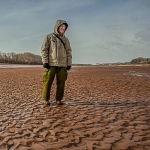
Out on the mudflats between Evangeline Beach and Boot Island, near that treacherous channel called “the guzzle,” are remnants of an ancient forest of pines and hemlocks.

Some three to four thousand years ago the ancient forest was destroyed by rising sea levels; today the remains of the forest, stumps and fallen logs, can only be seen at low tide.

Recently marine biologist Sherman Bleakney told me about the guzzle when I spent a morning with him examining the remains of an old forest. Unlike the trees in the guzzle, these are located about 8 miles from the sea at Upper Dyke. Like the guzzle stand, however, these trees also were destroyed by rising sea levels and were eventually covered by silt.

The old trees at Upper Dyke lie under some 12 feet of dykeland and their presence was suspected but never confirmed. They were discovered recently when major renovations were made to a sewage treatment plant situated on the south bank of the Canard River several miles from Kentville. Leon Barron happened to be driving by the excavation site when he noticed what appeared to be a large tree trunk sticking up out of a pile of debris. If he hadn’t stopped to check it out, we may never have known that the old forest had been uncovered.

As mentioned, the old trees at Upper Dyke are part of the forest that’s visible at the guzzle. Sherman Bleakney estimates that the trees in Upper Dyke were killed by rising sea levels at least 500 and perhaps as long ago as 700 years ago. The guzzle area trees were killed by rising sea levels much earlier due to the sea bottom being lower there. From Upper Dyke, which is 19 feet above sea level, the land gradually drops off into a deep hole that’s the Minas Basin

Several years ago a waterline was being laid between Kentville and Camp Aldershot. To run the waterline under the Cornwallis River a tunnel had to be bored some 10 to 12 feet under the riverbed. During the tunnelling, workmen dug up segments of tree trunks and brush. This was reported at the time but the news that trees, the remnants of an old forest, had once existed in Kentville didn’t cause much of a stir at the time.

We can assume that the trees discovered under the Cornwallis River were part of a ubiquitous ancient forest. In fact, Sherman Bleakney says that wherever there’s dykeland in Kings County, an ancient forest can be found under it.

If you think this is unusual, the picture painted by naturalist Merritt Gibson is even more interesting. Mr. Gibson tells me that under the dykeland are vast lakes and streams. Gibson says that much of the dykelands is literally floating on these lakes. He also told me about the discovery of ancient trees under the soil when a highway bridge just outside Canning was being replaced. When these trees were killed by rising sea levels they were 200 years old. Carbon dating of a long-buried tree uncovered out on the Canard dykes indicate it had been destroyed by the sea some 800 years ago.


MARINE LORE FROM STANLEY T. SPICER (July 30/04)

“It was good to see mention of my grandfather’s old vessel, the E. J. Spicer,” writes marine historian Stanley T. Spicer in a recent letter.

Mr. Spicer was referring to my June 11 column where I referred to “mystery entries” in an 1880s ledger. One entry was purchase by Canning shipbuilder Ebenezar Bigelow of water closet tanks for the ship he was working on. After consulting with a local marine buff, I speculated that the tanks likely weren’t for the ship, since sailing vessels weren’t known to have flush toilets.

Anyway, I speculated incorrectly as Stanley Spicer kindly points out in his letter. The author of several popular books on sailing ships, which are standard references today, Mr. Spicer is a recognised authority on sailing in Atlantic Canada. He writes that the E. J. Spicer did have a “bathroom of a kind,” as family records indicate. “My grandfather’s diaries comment on water closets (i.e. toilets) and copper bathtubs,” Mr. Spicer said.

Mr. Spicer explained why some sailing ships had water closets. “Like many master mariners of the time (my grandfather) frequently took his family to sea with him until the children reached school age and I’m afraid buckets just would not cut it with most wives of the time. As an example, my father had been to London and Shanghai before he ever set foot in school.”

On the vessel mentioned in the column, the E. J. Spicer, Mr. Spicer writes that it was built “in Spencers Island, not in Canning,” an inference I made in the column. “The Bigelows were 12/64 shareholders in the ship and I suspect Gideon Bigelow was the designer,” Mr. Spicer said.

Mr. Spicer wrote that much of the equipment for the E. J. Spicer came from Canning, Windsor and Saint John. This explains the entry for “two tanks for water closets” in the ledger of the Canning firm of Sheffield and Wickwire, which led me to assume the ship was being constructed in Canning by Ebenezar Bigelow.

Being an ignoramus when it comes to ships, I incorrectly called the E. J. Spicer a barque. Mr. Spicer writes that the E. J. Spicer “was a full-rigged ship, not a barque. A ship had four square sails on all masts while a barque carried fore and aft sails on her mizzen masts. A barque or a ship carried at least three masts.”

As I mentioned, Mr. Spicer is a noted expert on sailing ships and has written extensively on them as well as on Mi’kmaq legends and lore. For his contributions to local history and his documentation of our sailing heritage, Mr. Spicer was awarded a Doctor of Civil Laws by Acadia University. A Canning native, Mr. Spicer was educated at Kings County Academy, the University of New Brunswick, Springfield College and received a B.Ed. from Acadia University. Mr. Spicer also has a Kentville connection. His father was a dentist in Kentville from 1929 until 1956.