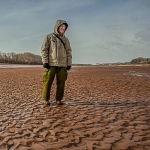
ACADIA PROF. SPURRED 1916 PLAN TO HARVEST ELECTRICITY FROM FUNDY TIDES (January 23/24)

Before the First World War “there was much coming and going to Cape Split by an odd little Physics professor at Acadia,” Esther Clark Wright wrote in her book, Blomidon Rose. “Some materials were transported across and around the mountain (to Cape Split) but nothing came of the affair.”

Wright doesn’t tell us which Acadia professor she was referring to as odd and little – three were involved in the so-called “affair” – but she was referring to an attempt in 1916 to harness the tides at Cape Split and generate awesome amounts of electricity.

The odd little man Wright refers to may have been Acadia’s engineering professor, Ralph C. Clarkson, an American who had joined the University’s faculty in 1912. He had patented a unique tide-generated turbine, the Clarkson Hydraulic Current Motor. The motor was the key ingredient in a scheme, originating apparently with Clarkson, to generate electricity at Cape Split and potentially light up the entire Maritimes.

Continue reading

IRISH IN YOUR GENES? CHECK OUT THESE BOOKS AND ONLINE SITES (January 24, 2023)

In a census conducted by the province in 1766, Windsor’s population was 243, of which 60 were from Ireland.

So writes L. S. Loomer in his book on the history of Windsor, which in the index has at least 20 references to the Irish and Ireland.

Elsewhere, circa1860, the population of East and West Dalhousie was about 50 percent Irish. Near Kingston, between 1880 and 1920, there was an Irish community called Irishtown. In her writing, historical author Hazel Foote (the history of Woodville) refers to a substantial Irish settlement at Black Rock in Kings County. And as I mentioned in a recent column, Centreville and Atlanta, in Kings County, also had Irish settlements.

Continue reading

COMMUNITY TELEPHONE COMPANIES WERE EVERYWHERE ABOUT 100 YEARS AGO (November 15/22)

For anyone living in Windsor, say around 1887, a five-minute telephone call to Hantsport or Brooklyn would have cost them 20 cents. On the other hand, if one had lived in Falmouth and called Windsor or Hantsport, the charge for five minutes was 15 cents.

According to the Hants and Halifax Telephone Company, these calls were considered long-distance. The Company’s rate sheet, published by Ivan Smith in his Nova Scotia History Index (now inactive) noted also that telegraph service was available, at a charge of 15 cents per 10 words.

In contrast, with my smartphone and for about 20 odd dollars a month, I have unlimited calling anywhere in Canada, and no time limit on the calls.

But I digress. The point is that by today’s standards, the cost of telephone calls in the 1880s was expensive – if you consider that making a dollar or so a day in that period was excellent pay.

Continue reading

MAKING A GREEN AND PLEASANT LAND – MORE VIEWS ON THE DYKELANDS (October 4/22)

In this column, I recently covered the contrasting views historians have on the Acadians and the dykelands, quoting, in turn, Brent Fox, J. Sherman Bleakney and L.S. Loomer.

The column should have included quotes by Arthur W. H. Eaton, the author of History of Kings County, John Mack Faragher and Esther Clark Wright. Eaton wrote about the “important work of dyking the marshes, that the Acadians had long pursued,” and he described the various problems the Planters faced in maintaining the dyke system.

Faragher devoted several pages to the origin of dyking in Nova Scotia: “In one of the most remarkable developments of 17th century North America,” he observed, “French settlers in l’Acadie developed a distinctive agricultural economy based on the farming of reclaimed marshland, diked in from the tides.”

Continue reading

WRITERS AND HISTORIANS HAVE CONTRASTING VIEWS ON ACADIANS AND THE DYKELANDS (September 20/22)

In an unpublished paper about building the Wellington Dyke on the Canard River, Brent Fox speculates that the dyke-building expertise of the Acadians possibly could have Dutch origins.

“The people of the Netherlands have been noted for [dyke-building] for many centuries,” Fox wrote. “In an indirect manner, it is possible that [centuries ago] the Dutch provided the special knowledge that helped convert the marsh and tidal lake areas of present-day Kings County into… valuable agricultural land.”

 In various papers I’ve read on the Acadians and dyke-building I’ve never found any references to historic Dutch connections. We could assume that Fox was speculating about this connection, but he may not have been. Further on he writes that in the 16th century, “Dutch engineers were brought into France to oversee massive dyking projects.”

Continue reading