EATON TALKS ABOUT COUNTY HISTORY IN 1888 (April 25/11)

“There ought to be a general ransacking of the garrets of this County – of Horton, Cornwallis and Aylesford (townships) – for objects of interests …. old books, manuscripts, letters, seals, household furniture, farming implements, bits of wood from old houses, all should be gathered in.”

On an August evening in 1888, Rev. Arthur Wentworth Hamilton Eaton made this appeal at a meeting in Kentville. Many of the prominent citizens of Kings County had gathered together at the time to organize a Kings County historical society and Eaton was the guest speaker.

This was over two decades before Eaton published his greatest work, the history of Kings County. He apparently had already started collecting historical papers, possibly with a county history in mind, and the intent of his talk that August evening in 1888 may have been to stimulate interest in compiling one.

Eaton said, for example, that “of county histories (in Nova Scotia) we have as yet few and none I believe of the highest value. Of this, certainly one of the most interesting counties in the province (Kings), we have no printed history.”

Eaton then referred to a partial work on Kings County that had already been compiled by one Jonathan Hamilton, which “possess much value” but by the author’s admission “needs careful revision.” The original compilation by Hamilton probably sits in a museum or university vault somewhere in New England but Eaton must have incorporated this early research in his county history.

Eaton then refers to his efforts to collect county history: “My own work this summer in gathering facts and through the courtesy of the editors of our local newspapers, presenting them to the public, and so preserving them for future reference, has been the outcome of a profoundly felt interest in the county where I was born and reared.”

Readers must admit this is an interesting insight. Due to a “profoundly felt interest” Eaton was diligently working on compiling a history of Kings County and urging others to take an interest in such a work. As we can see, Eaton worked on this compilation for over two decades before the history was published. But when he spoke before that gathering in Kentville in 1888 he had collected “only a few of the facts that are available for the future histories of the county.”

Actually, when he spoke in Kentville in 1888 about organizing a historical society and preserving county records, Eaton had already been working on genealogical records for at least a decade. “During the past 10 years I have given a great deal of time,” he said, “to genealogical records.” Much of what he had compiled up to that time undoubtedly found its way into his county history.

I’ve taken this report on Eaton’s talk from a newspaper account, The Western Chronicle. The heading on the account read: “Address at the Organization of the Kings County Historical Society in Kentville.” This implies that a historical society was formed. If it was, and I assume it was, I’ve never seen mention of it anywhere in Kings County records. Perhaps it was a short lived organization.
KENTVILLE’S FIRST MAYOR WAS A SCOT (April 18/11)

As the county’s shire town and headquarters of the Dominion Atlantic Railway, Kentville was expanding rapidly. By 1885 the citizens of Kentville decided the town had “attained sufficient importance” and was large enough to ask for incorporation.

On 7 December, 1886, Arthur W. H. Eaton writes in his county history, “articles of incorporation were granted” the town. The following month, on January 21st, the first annual meeting of Kentville’s ratepayers was held, followed in February by the election of town officers.

John Warren King was elected as the first Mayor of Kentville and he would remain in this office until 1888. From King down to the current Mayor David Corkum 30 Kentville citizens would serve as Mayors of the town, several with multiple terms. The longest serving Mayor to date is R. W. Phinney who beginning in 1974 would remain in office for 15 years.

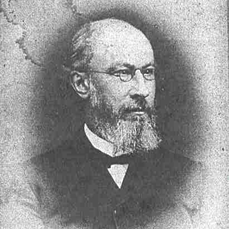
While John Warren King only served for two years (some records show it was three years) he may have been the most interesting of the early Mayors. The photograph of King, which is on display at the Kings County Museum, shows a man of austere visage. Indeed, King was a Scot – he was born in Scotland in 1836 – and a lawyer, the nationality and the occupation lending an inherently serious mien to all men of this nature.

Kings occupation may explain his presence in Kentville. He appears to have been a railway lawyer, residing in Kentville because the DAR was headquartered there. His obituary, published in The Advertiser on his death in 1922, notes that he was a “pioneer in railway work, being legal adviser to P. Innes, general manager of the Windsor and Annapolis Railway, now the Dominion Atlantic Railway.”

In 1889, King succeeded Innes as general manager of the DAR, an undoubtedly demanding position that likely explains his short term as Mayor. The Advertiser obituary portrayed King as a man of “deep intellectuality, of sterling integrity, who by his ability and worth had won the confidence of the entire community and had been placed in the highest positions of honor, Mayor of the Town of Kentville and general manager of the Dominion Atlantic Railway.”

King was saluted in The Advertiser as one of the outstanding citizens of Kentville. “He early identified himself with the interests of the community,” says The Advertiser, “so it was no wonder when Kentville became an incorporated town, his outstanding ability and marked personality made his election as first Mayor by acclamation a natural sequence.”

John Warren King died in Kentville at 85, shortly before his 86th birthday. On display at the Kings County Museum is a desk of ash and birch handcrafted in the “Victorian style” by King. “The Mayor’s Desk,” as it is called, is believed to have been used by King when he served as Mayor.

Kentville’s first Mayor, John W. King

Kentville’s first Mayor, John W. King

Kentville's current Mayor, David Corkum

Kentville’s current Mayor, David Corkum (Kentville town website)

REDDEN ROW – KENTVILLE’S OLDER HOMES (April 12/11)

(Third in a series celebrating Kentville’s 125th year of incorporation. (Column 1, Column 2)

When William Redden died on 4 December, 1894, The Advertiser saluted him as one of Kentville’s prominent citizens. The newspaper named Redden and another longtime resident who passed away at the same time as “landmarks of a former generation (who) have passed away from the view of Kentville citizens.”

What had William Redden achieved to earn this distinction? We have to look to Arthur W. H. Eaton’s Kings County history for the answer to this question. Redden was a builder, trader, real estate developer, farmer and mill operator. As Eaton points out, Redden was “in a marked degree identified for many years with the material growth and prosperity of the town.” Apparently a large part of residential Kentville (up until Eaton published his history in 1910) owed its existence to Redden’s single-handed enterprise. “To his foresight, courage and industry, The Advertiser said, “the large number of buildings he erected are an enduring monument.”

Many of those “enduring monuments” stand today. “He bought much land and built many houses to sell and rent,” writes Eaton. Exactly how many houses and other buildings Redden built in Kentville might be difficult to determine today but some of his handiwork can be identified. As Eaton writes in his county history, “a large number of the houses in that part of Kentville known as ‘the flat’ are the result of his enterprise.”

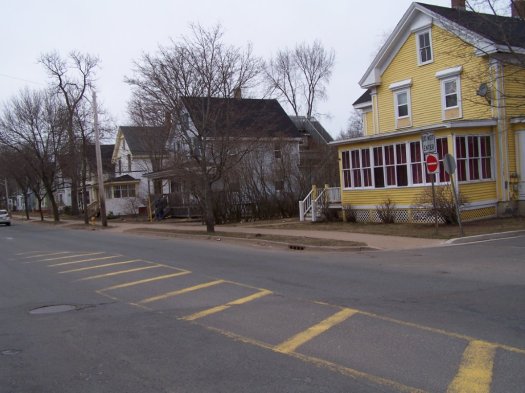
These houses, eight in all, stand along east Main Street between the ends of Crescent Avenue. All were built immediately before and just after 1886, the year Kentville was incorporated. Once this area was farmland; but Kentville’s rapid growth created a demand for housing and William Redden obliged by building affordable single family homes along the stretch of Main Street some deeds refer to as Redden Row or Redden Road.

As we can see today, Redden constructed his houses close to the street on narrow lots, using a building style that was standard at the time. However, while they may have been average houses for the period, they were once the residences of some of Kentville’s elite business and working class people.

A census taken in the early 1890s reveals that residents of seven of the eight homes along Redden Row ranged from office workers to traditional craftsmen. Included were the general manager of the Windsor and Annapolis Railway, accountants, a cooper, stone mason, a hotel clerk and a customs officer. It is believed that Kentville’s first mayor, John W. King, lived on the Row as well, at 227 Main Street. King served as mayor from 1887 to 1889.

William Redden built these houses on east Main Street around the time Kentville was incorporated

William Redden built these houses on east Main Street around the time Kentville was incorporated. This area is known as “the flat” today. Various old deeds refer to the street as Redden Row and Redden Road. (E. Coleman)