
A SCHOOL ON WHEELS – THE SHOPMOBILE (April 20/15)

“With 1942 in its first month, a brand new manual training shop on wheels, a hitherto untried method of bringing technical training to rural districts, set out on its mission.

“This first ‘shopmobile’ has already created attention outside the province.  The Department of Education has high hope it will give to the boys in farming communities elemental skills in the mechanical field …. providing a base for subsequent trade training.”

In a few words, this was the purpose of a “unique experiment,” a pioneering effort that began here in Kings County early in 1942.  The January 1942 issue of the Family Herald on this “experiment in rural education” said it originated when the Department of Education “discovered with shock that for over a century Nova Scotia had been educating boys and girls in rural districts away from the farm by giving them an education consisting almost entirely of book learning.”

This, the Department said, was preparing kids exclusively for college, overlooking a much greater need, especially in rural areas, for training in vocational and industrial arts.  The answer to this need was the shopmobile, a mobile vocational school that from 1942 to 1964 trained kids in rural areas, providing basic skill in manual arts.

In Kings County the shopmobile traveled the area from Kingsport to Greenwich, stopping once a week in every school district along the way.  It’s difficult to determine how many boys studied manual arts in the shopmobile (and it was boys only since the girls had a separate program in the schools).  However, I recently talked with a former rural school student who trained in a shopmobile during the 1940s and I got a glimpse of what it was like.

Arnold Burbidge of Centreville fondly remembers those weekly visits to his school in Canard.  Burbidge says he benefited greatly by studying  carpentry basics and small engine repair.  “Among several things, I remember making a whippletree for my father’s horse team to haul our sloven,” he said. The bus stopped every week at his school in Canard except in the spring. “When the roads were closed because of the spring thaw,” he recalls, “the shopmobile parked in Port Williams and you had to go to it.  I’d bike to the bus for the morning class and go back to our own school in the afternoon.”

This experiment in rural education, said to be unique to Nova Scotia, was possibly the first of its kind in Canada.  The shopmobile eventually evolved into a series of vocational schools around the province.  Look at those gleaming high tech halls of the Kingstec campus today. It’s difficult to imagine it  originally was a bus weighing several tons – a bus that was a self-contained carpentry shop, tool shop, machine shop, an iron working shop, a leatherworking shop, a plumbing shop and much more all rolled in one; a bus that  rumbled up and down rural roads in Kings County for 22 years.

In its early days the shopmobile, as it eventually came to be widely known, was called by many names since no one knew for sure what it actually was – for example it was called an industrial arts school on wheels, a mobile manual training shop, and a mobile vocational school.  These descriptions are self-explanatory but the Department of Education summed up the shopmobile’s role precisely:  “The shopmobile is capable of providing …. preparatory training for vocational schools and industrial arts,” stated the  Department at the time the first vehicle hit the road.

And hit the road it did to wide acclaim.  In fact the experimental in mobile vocational training worked so well that eventually five shopmobiles were built to serve other rural areas around the province.   But the experiment started first here and many kids who attended rural schools in Kings County fondly remember it.
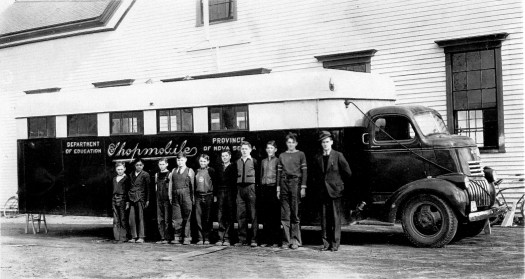
Shopmobile in the early 1940s in Canard

The shopmobile as it appeared in the early 1940s in Canard. Arnold Burbidge (fifth from the left) supplied this photograph. At the far right is George Adams, the first shopmobile instructor.
THE “WHITE STORE” WAS THE LAST OF ITS KIND (April 6/15)

It used to be said you could buy anything from a needle to a ship’s anchor in the old C. L. Wood general store in Kentville.

The ship’s anchor may be an exaggeration but the store did carry a wide variety of merchandise in its heyday.  When it opened on Aberdeen Street about 85 years ago, Wood’s store (or the White Store as the owner advertised it) was the equivalent of today’s Walmart. This was in 1929 and Charles L. Wood ran what was then known as a general store; meaning simply that it stocked all the necessities of life, its inventory reflecting a time most people lived and worked on farms and life revolved around agriculture.

In effect, the White Store was a grocery, drug store, hardware store, a clothing store, a footwear store, a horse and buggy store and much more.  For a time there were even hand-operated gas pumps in front of the store where automobiles could fill up and where you fill your kerosene jug.

It may be difficult for younger generations to picture this but when the store opened, hitching posts were still found in Kentville; and it wasn’t uncommon at the time to see horses tethered here and there alongside automobiles.

When Charles Lamert Wood moved to Kentville from Bridgetown in 1917 he opened his first Kentville store on the east side of Aberdeen Street, a grocery store he operated for 12 years.  Late in 1928 he purchased a property across the street – a former garage and service station – that after being renovated and enlarged became a general store.  Wood was born in East Halls Harbour in 1885.  As a youth he ran a store on the family homestead, later opening one in Sheffield Mills where he was also the postmaster.  A move to Bridgetown followed where Wood was postmaster until 1917 when he moved to Kentville.

The C. L. Wood store has the distinction of being one of the last stores of its kind in Kings County.  The store’s closed in 1960, marking the end of an era, an era when a single store could feed, clothe and outfit entire communities and keep them warm and on the move as well.  In a brief history of the store, C. L. Wood’s son Malcolm noted that he drew customers from near and far.  “On weekends, cars, trucks and horses and wagon lined the backyard of the store and the street front,” Malcolm said.  “On Saturday nights people flocked in from a large surrounding area; from Scots Bay to Harbourville on the Bay of Fundy and (from) the North Mountain and from Middleton to Grand Pre.

“There was little or no self-service.  Customers brought a list of wanted articles and were waited on by a clerk.  On weekends especially, the store had as many as 10 clerks on the grocery and candy counter and three at the meat counter.  Besides regular grocery items people came in to buy meat, flour and feed, men’s work clothes, rubber boots, work boots, hardware, fuel, kerosene oil, nails, window glass, barbed wire, medicine for farm animals, many drug items and patent medicine.  After (my father) purchased a farm on the edge of town he also sold baled hay and straw.”

Right up until the year it closed the C. L. Wood store maintained the atmosphere of an old-time country emporium.  When you walked through the front door into a somewhat dingy interior – as I did many a time after I started to work at The Advertiser in 1955 – you were immediately hit by the smell of pickled pork and sauerkraut.    There was sawdust on the floor in the meat section and partially butchered beef hanging on meat hooks.  Once when I dropped into the store freshly snared rabbits were hanging on the  wall near the meat counter.  I went into the store to buy a “hobo sandwich,” sauerkraut wrapped in a slice of bologna, which Woods was famous for around the county.  It sold for five cents at one time.

Within five years of my first visit the store closed down.  Malcolm Wood said his father’s store was a victim of changing times, finding that after WWII he couldn’t compete with large grocery marts and other chain stores that moved into his trade area.  Wood closed his store in 1960 and  died the following year.

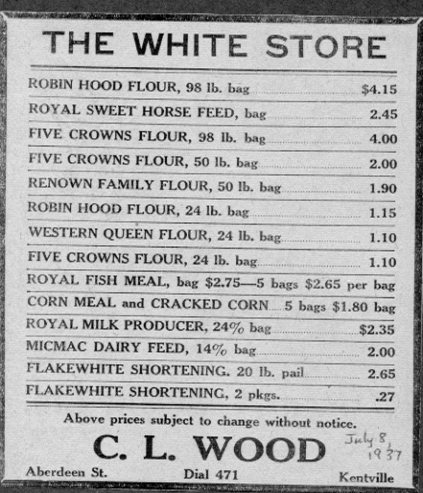
The White Store advertisement, 1937

An advertisement C. L. Wood ran in The Advertiser in 1937. Note that flour sold for as low as $1.90 for a 50lb. bag (Louis Comeau collection)