Between 1843 and 1846, a parish of the Anglican persuasion was opened in Kentville on Church Street (now Aberdeen Street) “not far from the present post office.”
This was the original location of the St. James Anglican Church. In 1883, a move was made to its present location on Prospect Avenue. Louis Comeau said that “the whole church, minus its steeple and powered by several teams of oxen, was hauled around the corner of Main Street, hoofing their way to their future home.”
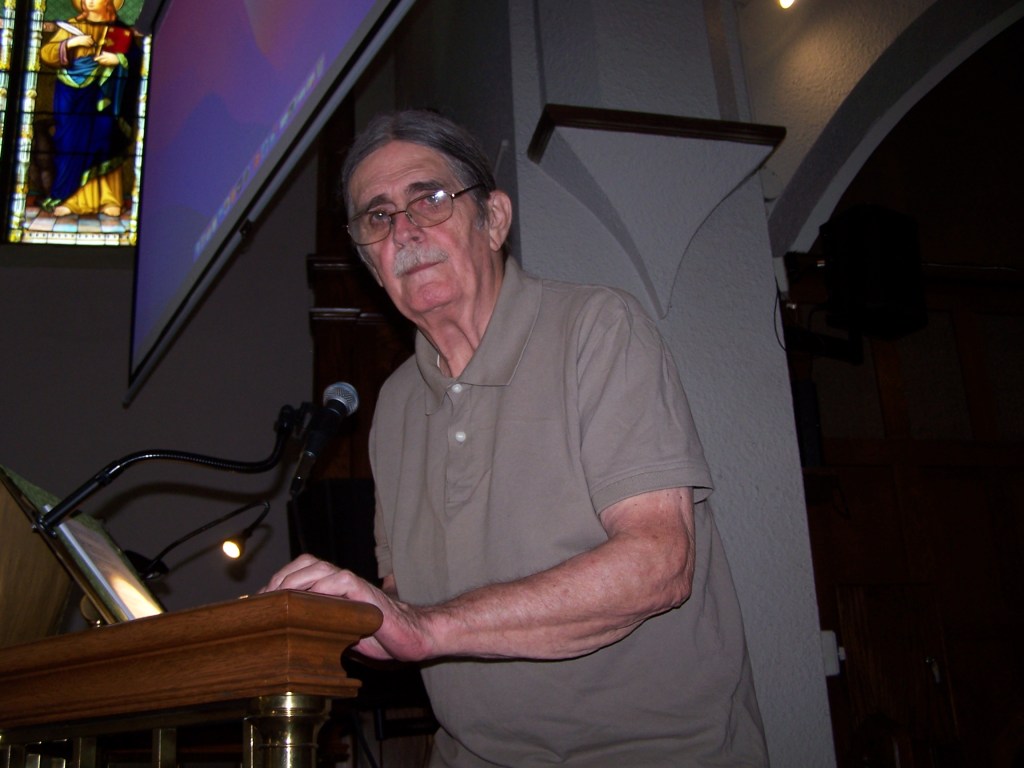
I’m quoting from a talk and tour Comeau emceed in June on the stained glass windows at the Anglican Church. The move, by oxen power, was one of his interesting asides. In another aside, Comeau said the church, in its original location, “contained three (possibly four) stained glass windows” that went along on an ox team to the new premises. These windows can be seen in the church today at the rear of the pulpit.
There are 26 stained glass windows in the church, four of which were made in Czechoslovakia; the balance were crafted in Toronto by a firm that has been making stained glass windows for over 150 years. All are works of art, and superb examples of a craft that has been practiced for thousands of years – which no doubt are clichés, but there’s no better way to describe them. They all tell stories as well, both biblical and historical.
A lifelong collector of Kentville-based artifacts, Louis Comeau maintains a large database on the town dating back to its infancy. He’s been researching the stories behind the windows in the Anglican Church for some time now, since many prominent Kentville residents relate to them. His talk was based on this research.
In the presentation, Comeau noted that one window was dedicated to George E. Graham, who was manager of the DAR from 1915 to 1940. He was an important figure. Under his auspices, the railway built the Cornwallis Inn, purchased land encompassing what was to become Grand Pre Park, and expanded the railway’s holdings in the Valley.
One of Canada’s most renowned Scouters, Kentville’s Walter Wood, is featured in one of the windows, entitled Jesus and the Boy Scout. Nova Scotia’s first Minister of Highways, Harry Hamm Wickwire, is featured in another window. Wickwire, a member of the Nova Scotia Assembly from 1894 to 1922, built one of Kentville’s most spectacular houses on a hill named after him.
Some of the windows in the church are over a century old, the three (or four) that once journeyed through Kentville via oxen, for example. As mentioned, these windows and those of relatively recent vintage have tales to tell. Throughout his presentation, Comeau referred to those stories often. As well as the Woods, the Grahams, and the Wickwires, we heard about the Wades, (the pioneering grocery family), the Youlds, railway men and Mayors, the Websters, town builders all, and other Kentville citizens whose memory is preserved forever in the stained glass windows of the Anglican Church.
How many of us take the time to admire these windows, to read the stories they tell, the St. James Church asks on its website. Thanks to Louis Comeau’s talk and his tour, many of us now know how relevant – and historical – those stained glass windows are.