ACADIAN TIES WITH KENTVILLE (March 7/16)

On the Cornwallis River, near the Silver Link Bridge in Kentville, lays “Mrs. Lyon’s dike,” writes Edmond Cogswell in an 1895 review of the town.  Referring to the dike by that name in the review, Cogswell places it near the “old ford.”  On that dike, and well within the town limits, once stood an Acadian mill, says Cogswell, noting in the review that the “old race (mill channel) can still be traced.”

Not only that, but Cogswell says an Acadian village was situated at the old fording place, which is about where the bridge is now.  He also says the Acadians built a bridge over the Cornwallis near the present structure.  This, he says, was the first Acadian bridge over the Cornwallis, imply that the Acadians built more than one bridge on the river.

To date no one has disputed Cogwell’s claim of a solid Acadian presence in Kentville.  Actually, no one but Cogswell says the Acadians had a village in what is now the town.  Eaton, the dean of county historians, implies for example that little if any of the land in and around the town was taken up by the Acadians.  Eaton does mention one possible Acadian homestead in the town limits, which I mention farther on, but that’s it.

However, Cogswell and Eaton are not the only historical writers/researchers to place the Acadians in the area comprising the town of Kentville; or to be exact, in what was the town area when its northern border was the Cornwallis River.  There are various claims regarding an Acadian presence in Kentville, which are for the most part speculation since no documentation is provided. Here are some of them:

In a treatise released in 1975 (The French Period in Nova Scotia) John Erskine writes that on Elderkin Brook at the eastern edge of Kentville there was a tidal mill he speculates might have been Acadian.  We cannot be sure it was Acadian, Erskine says, but species of trees and shrubs associated with and introduced by the Acadians have been found on the site.

Erskine was careful about claiming the mill definitely was Acadian, but not so the editors of A Natural History of Kings County.  Mentioned in the chapter on the Acadians is a plant they introduced, the Red Fly Honeysuckle, which occurs at the site of a tidal mill “on Elderkin Brook in Kentville.”  The editors don’t say outright that the mill was Acadian but to me at least that implication is there.  In this case, Erskine may have been their source of information and he’s noted as a contributor to the book.

In the Kings County history Eaton writes that the Acadian settlement of Minas extended as far west as Kentville, “the site of which town it included.”  Eaton adds that it is “doubtful if beyond Kentville there were ever any French houses or farms.”  The implication here, of course, is that the area comprising present day Kentville held Acadian homesteads.

The exception to unsubstantiated claims about an Acadian settlement, or at least a few Acadian farms in Kentville, is found in Eaton’s Kings County history.  The dean himself notes that a Kentville dwelling, the Terry-Young house, was built on what is believed to be an Acadian cellar.  This house still stands at 229 Main Street and has been declared a heritage property; there’s little doubt that its Acadian roots are authentic.

It is also doubtful that the Terry-Young house is the site of the only Acadian homestead in the town.  Nearby to the north and northeast, on both sides of the Cornwallis River, are tidal flats ideal for diking.  Diking has been done on these flats for generations and I believe archaeological surveys will reveal that some of them originated with the Acadians.

HISTORICAL GLIMPSES (February 15/16)

It apparently was after retiring in Wolfville that provincial archivist W. C. Milner compiled and published a collection of historical articles on the Minas Basin.  As I said before when I wrote about the collection in this column, it likely was published circa 1930 in Wolfville. It’s an extremely rare book. I was fortunate to find a copy in Ottawa; there’s a copy (the only other one I know of) in the Kirkconnell Room at Acadia University.

As the provincial archivist, W. C. Milner was in an ideal position to access historical records, but why he decided to publish a historical collection on the Minas Basin isn’t known; however, the result of his decision to do so is an excellent collection of historical articles – about 70 in all – on the early days around the Minas Basin and especially in and around Kings County.

From the Acadians to the Planters and to the shipbuilding period, Milner covered a lot of early Kings County in his collection.  The collection is not as extensive a work as Eaton’s county history, however. Yet I’d rank it at least next to Eaton’s book for in-depth historical glimpses of Kings County.

One excerpt from Milner’s book, the Moccasin Hollow massacre (or battle) around the west end border of Kentville, is an example of what I mean.  Eaton is skimpy on the details, only devoting a paragraph or two to the event, all of it based on second hand reports of another historian.  Milner’s book contain an article written in 1895 by a Kentville researcher who says that the Moccasin Hollow event took place shortly after the Noble massacre in Grand Pre; the two events were connected in other words – Eaton doesn’t make this connection – and involved some of the same combatants.

In his book Milner included short historical sketches of Kentville, Wolfville, Canning, Greenwich, Port Williams and Kingsport.  The book takes in the broad area Kings County comprised before it was downsized, explaining why there are historical sketches on communities in areas adjacent to Kings County, like Parrsboro and Hantsport, for example.

While it probably isn’t complete, Milner’s book lists many of the sailing ships built in greater Kings County during the 19th century and the early part of the 20th century; said list contains the names of the ships, the tonnage and the names of the shipbuilders or owners, making it a valuable reference for marine historians.   Such a list, by the way, wasn’t included in Eaton’s Kings County history.

Getting back to Milner’s book being published in Wolfville (and printed at the Wolfville newspaper office) he may have had family connections there.  Wolfville historian John Whidden tells me there a record of Milner purchasing a house in Wolfville.  However, I was unable to find any mention of Milner in the Wolfville history, Mud Creek, or in other lists of Wolfville occupants in the 20th century.

One more by the way.  I mentioned Milner’s book being rare.  Possibly only a limited number of copies were printed and most appear to have disappeared.  One of my pastimes is searching the online inventories of book dealers for historical books, and for Milner’s book especially.  If copies of the book exist besides the two mentioned, they must be privately held.

ANYONE FOR BOBCAT OR BEAVER BURGERS? (February 8/16)

To cook a muskrat, reads a wild game book published in Alberta, make sure after skinning and cleaning it to remove fat, scent glands and the white tissue inside each leg. After these cleaning pointers, two recipes are given, one for braised muskrat, the other for muskrat in tomato sauce.

The cookbook also gives recipes for cooking beaver, porcupine, squirrel, woodchuck and black bear.

If you’ve said “thanks, but no thanks” after reading this, you belong to the majority of people turned off by the idea of eating the flesh of wild creatures like muskrat, beaver, squirrels and so on. Normally we don’t think of fur-bearers as food sources and traditionally they aren’t.

On the other hand …. in some quarters those “non-traditional meats” are looked upon as food fit for an epicure. On beaver meat, for example, the Alberta cookbook claims it closely resembles the texture and taste of domestic roast pork and has “one of the most refined and savoury tastes of all wild game.” Muskrat meat is comparable to chicken, according to this cookbook and “squirrel and porcupine seem to produce their own unique, delicious taste.”

Before mentioning a Valley outdoorsman who has sampled the meat of various furbearers, I admit I’ve tried some myself. I’ve eaten black bear steak, roasted porcupine and baked bobcat. Yeah, I said bobcat, only the trapper who prepared it for a wild game supper called it recycled rabbit. Which is a little joke based on the fact the bobcat’s diet consists entirely of rabbits.

I didn’t care for the cat, the porcupine wasn’t much, and the black bear I’ll pass on it next time I’m offered some, thank you. Though I do hear that “pepperoni” made with bear meat is excellent.

Now, I have to tell you about a long-time friend, an outdoor writer and trapper, Reg Baird of Clementsvale, who has much more experience than me in sampling the meat of fur-bearers. Baird is a trapper with decades of experience in the woods and on the water. He has two books to his credit, on trapping and fishing and for many years he was the fishing columnist for Eastern Woods and Waters.

Thinking Reg Baird must have been tempted to cook and eat the flesh of the various fur-bearers he trapped, I asked him how they tasted. Contrary to what is written in the Alberta cookbook, Reg said that “muskrat is strong smelling and swampy tasting (and) not very palatable.” Bobcat, he said, is “bland and not strong tasting at all.” Reg apparently sampled coyotes (“it tastes miserable”) as well beaver (“good as long as all the fat is removed from the meat”) and raccoon (“I don’t think it was very tasty”). Black bear, he says, is “bland but makes good mincemeat.”

Based on what Reg Baird said and at least what one cookbook author writes, I have no doubt that muskrat, beaver et al, are sort of edible. Perhaps so, but I doubt you’ll ever see them offered in restaurants. Don’t look for bobcat or beaver burgers, or muskrat and fries, at fast food places in the near future, either.

However, if you have the desire to try these different meats, just ask any trapper you know and request a carcass. Trappers are obliging sorts anyway, and since many fur-bearer carcasses usually are discarded after skinning, one or two are probably yours for the asking.

On that note, in the 2014-15 season trappers caught 17,000 muskrat, around 3,500 beaver, 700 bobcat and 1,700 raccoon – and this was just an average season. None of the meat from these furbearers makes it into our food chain, as far as I know. Maybe we’re wasting a potential food source, so epicures take note.

WARM CIDER SATURDAYS (February 2/16)

Once in a while on Saturday afternoons in warm weather, Al Beckwith would bicycle down the road past our house, his trousers clipped back in the old style, a ball cap on his head. Al always carried a mouth organ and if you asked politely, he’d get off his bike and play a tune. Al was what they called a “quick stepper,” meaning he could really step dance, and this is what he did while playing the mouth organ at the same time.  Al called his dancing “my Irish two steps.”

It was the likes of Al Beckwith who inspired kids in my neighbourhood to play the mouth organ.  Back in the late 1940s and early 1950s, many of the kids in the neighbourhood carried mouth organs in their pockets.  Not everyone played with any expertise; but at the time mouth organs were only a dollar or two in the T. Eaton catalogue and were considered to be inexpensive entertainment and a good way to keep kids out of trouble.  Like other kids, I often found a mouth organ in my stocking at Christmas.  Usually they were Hohners who by then were mass producing mouth organs for the entire countryside.

Recently I joined a harmonica band in New Minas and it brought back memories of those mouth organ days.  Those of us who grew up in the late 40s and early 50s played the kind of music the Valley Harmonica Band has in their repertoire; all the jigs, reels and waltzes usually played by contemporary fiddlers.

Back in those boyhood days, usually on Saturday afternoons, we held what everyone today calls jam sessions.  A guitar player or two, maybe four or five mouth organ players who sat around in kitchens many an afternoon and played country songs and old time fiddle music.  It was the era of the B Westerns and cowboy music was in.  It was all cowboy or western music.  At that time Bill Haley and His Comets were just getting underway and Rock and Roll was little more than twinkle in Elvis Presley’s eyes.

At our home on Saturday afternoons kids would drop in and out all afternoon and join in the jams, maybe learn a new tune or a different way to get sounds effects out of their mouth organs. On those sound effects, we had some kids who were whizzes at making train noises and talking into their mouth organs.   No one could produce those sound effects as well as a close friend but I can’t remember him or anyone bending notes like players do today.

My father called our mouth organ jam sessions soft cider Saturdays. He made sure there was always a large jug of freshly pressed sweet cider in the pantry for anyone that was thirsty. It wasn’t hard cider, the fermented juice of the apple.  This was a kid’s drink, applejack that was brown and tangy with apple pulp floating in it.  The hard cider came out later that night, along with a bucket of raw scallops, after the kids were chased off to bed.

Our mouth organ playing was often inspired by the likes of Jimmie Rodgers and Vernon Dalhart, both of whom could still be heard on the Kentville radio station in those days. Hank Williams was just hitting his stride then and if radio reception was exceptionally good, you might catch the Grand Ole Opry.

What we never heard on the radio in those days was mouth organs being played – we didn’t call them harmonicas until much later – but that didn’t matter.   Our real inspiration was local fiddlers who played the tunes we all wanted to learn; the music that came with immigrants from Scotland, Ireland and Great Britain.

TOWN BRIDGE HISTORY (January 18/16)

The province announced last year that the bridge over the Cornwallis River, in downtown Kentville, would be replaced in 2016. There’s speculation about when the bridge was first built. Was it Acadian or Planter or what? Here’s some interesting background on the bridge in which this question isn’t quite answered.

In 1895 probate court judge Edmond J. Cogswell convincingly argued in a Kentville newspaper (the Western Chronicle) that the town owes it existence to a “geological formation (that) is very peculiar.”

What Cogswell meant was that geological forces had created a huge sandbank and a shallow ford – “the principal ford” on the Cornwallis river as he calls it- where Mi’kmaq and Acadian trails converged to take advantage of a crossing place. It was a natural place for an Acadian village to spring up, says Cogswell, and the village was located about where the town bridge spans the river. Also, said Cogswell, it was a natural place for a bridge to be built over the river.

Arthur W. H. Eaton in his History of Kings County also mentions the ford (caused by geological forces depositing an “enormous sandbank which narrowed the river”) where “naturally a village sprang up.”   While Cogswell says this village originally was Acadian, a seasonal Mi’kmaq encampment likely was there as well.

In his 1895 article Cogswell also writes that the Acadians built a bridge over the river at the ford. If this is so, this likely was the first bridge to span the Cornwallis River. If Cogswell is correct, it also means a bridge has spanned the Cornwallis River at this spot for well over 200 years. However, in his 1895 article, Cogswell contradicts what he wrote earlier about the Kentville bridge. In an 1892 article, also in the Western Chronicle, Cogswell wrote that “whether there was ever a French bridge or not I cannot find out, but I think there was not. I think the old ford was used, but very shortly after the English or rather Colonial advent a bridge was built. It was not built exactly at the old ford.” In the same article Cogswell said the first bridge on the Cornwallis River was built in Coldbrook on Lovett Road.

If this is confusing let’s just say that an Acadians bridge on the Cornwallis River, in what was to become Kentville, is disputed. In her book the Devil’s Half Acre, Mabel Nichols doesn’t mention an Acadian bridge, noting only that the Planters built one at the ford in the 1870s. Further on in her book Nichols says that the bridge was built “soon after the Planters came to Horton” and there’s a record of repairs being made to it in 1893.

Nichols doesn’t give her source for the 1870s or the 1893 dates but the Town of Kentville website quotes her as if this is factual. What we do know is that Cogswell writes in 1892 that there is no evidence of an Acadian bridge at the ford and in 1895 he writes that a bridge of Acadian origin was there. As noted, Nichols, writes that it was the Planters that built the first bridge, giving the dates mentioned above without telling us how she arrived at them.

We also know that the bridge existed before 1931 since newspaper records show this was the year it was improved upon and expanded. Brent Fox, writing in The Advertiser, gives 1931 as the year the old bridge was replaced. In an April 29, 1994, article Fox writes that the bridge was officially opened on October 13 and at the time was recognised as the widest traffic bridge in eastern Canada.

Quoting Mabel Nichols, Fox noted that when it was opened the bridge was given a coat of aluminum paint. “The massive trusses gleamed pleasantly on the landscape in their aluminum coat painting,” writes Nichols, which may explain why the bridge was dubbed the Silver Link.

I’ve scoured other sources referring to Kentville, the Cornwallis River and the town bridge and this is all I’ve come up with. In closing, I must mention what Kentville historian Louis Comeau has in his archives regarding the bridge. Comeau has a photograph of the town bridge, dated 1890. He tells me the photograph probably was taken by L. C. Swain who operated a shop called the Kentville Photographic Studio from about 1890 to 1892. This photograph establishes that the bridge was standing at least as early as 1890.

Kentville Bridge circa 1890

This photograph was taken circa 1890 by L. C. Swain, verifying that the Kentville bridge was in place at least 125 years ago. (Louis Comeau archives)


JOHN DALY’S DEER (January 11/16)

As hunters sit in their blinds and tree stands every fall hoping to bag a deer, does a minor controversy involving this game animal ever come to mind? Put another way, do hunters think white-tailed deer are native to the province or do they believe they were introduced. The question is moot, I suppose. The deer are here, so introduced or not, thousands of hunters enjoy hunting them year after year and that’s all that really matters.

However, once there were opposing sides to this question. And as far as any controversy existing over deer being native or an introduced species, this isn’t correct either. Controversy is the wrong word. It’s just that if you go back a generation or two you’ll find people either believed deer were native or were introduced by some far-seeing visionary who did future hunters a huge favour.

So, are deer native to the province or not? What do you think?

If you think “introduced,” you probably heard of John Daly and what once was known far and wide as “Daly’s deer.” Sometime in the 1890s John Daley conceived the idea of capturing deer in New Brunswick and releasing them in various areas around the province. In 1893 he was given the authority by the Surveyor General “to take alive within the province of New Brunswick twenty-five Red Deer and export same to the province.”

Daly was to meet certain conditions before proceeding. As Daly told it, he eventually ran an advertisement in a New Brunswick newspaper asking for live deer. As a result, Daly writes that he “got over in February, 1894, 7 does and 4 bucks, eleven in all.” These deer were released in Digby County, “about twenty miles from Digby town.” This was his first release and apparently Daly continued with the stocking the following year.

Unfortunately I don’t have the complete Daly story. The above quotes are taken from letters I was privileged to read (in the files of the late L. St. Clair Baird of Kentville) in which Daly spoke of his efforts to stock deer. In the letters Daly boasted that “unaided and of his own accord (he) secured and imported what is known all over western Nova Scotia as Daly’s Deer.”

Now, jump forward to the research on deer made by the late biologist and teacher, John Erskine (1900-1981). In the late 1950 s and early 1960s Erskine excavated Mi’kmaq winter camp sites dating from around the year 1060. Erskine unearthed deer bones from this and an earlier site. “Deer antlers, often on skulls were frequent” at the sites Erskine wrote. Further proof that white-tailed deer were in Nova Scotia well before Europeans arrived is examined by former Wildlife Director Dr. Donald Dodds and Dennis A. Benson in their 1977 book, The Deer of Nova Scotia. The authors concluded that Daly’s release in 1894 was a stocking, in other words a reintroduction in the province, since evidence indicates deer were always here. In a later work co-authored by Dodds and Frederick F. Gilbert (The Philosophy and Practice of Wildlife Management) the authors refer to 1894 as the year Daly stocked deer in the province, noting this was a stocking and not an introduction.

So there you have it. Wildlife experts the likes of Dodds, Benson and Gilbert, and biologists the likes of John Erskine conclude that deer are a native species. The evidence supports their conclusions. In historical footnotes, John Daly must be remembered as the man who re-introduced deer, perhaps at a time when their numbers were low. His stocking possibly may have spurred a population explosion in the areas where he made his releases. John Daly must not be forgotten, however. Daly’s Deer are forever part of the white-tail lore and legends that all hunters should and do cherish.

COUNTY PLACE NAMES (January 5/16)

When a friend suggested it would be interesting to look into the origin of Kings County place names, I told him the research had already been done and was published. Actually, it was done in three separate publications. One is a massive book of some 750 pages which gives the origin of place names in every county in the province.

This “massive book” is C. Bruce Fergusson’s Place-Names and Places of Nova Scotia, which was published in a limited hardcover edition by the Public Archives in 1967. Of the other two publications dealing with the origin of place names, one is a little known hardcover book published in 1922. Compiled by Thomas J. Brown, Nova Scotia Place Names is tiny compared to Fergusson’s work, containing 158 pages. However, it must be looked upon as a “first” for this sort of publication and possibly it inspired Fergusson who was the provincial archivist.

The third book (actually a booklet) was compiled by a past president of Acadia University, Dr. Watson Kirkconnell. Place-Names in Kings County was published (perhaps privately) in 1971. While only containing 39 pages, this is a much more readable, more interesting publication than Fergussons and Browns since Kirkconnell also discusses surnames long associated with various county communities from the Acadian period and from the time the Planters arrived.

All three publications are out of print. At least the original edition of Fergusson’s book is, but Mika Publishing released a facsimile edition in 1976 and a copy can be found in the local library.   As mentioned, Brown’s work must be considered a rarity and I know of only two hardcover copies that are extant locally. A paperback issue was released last year by an American publisher but I haven’t seen it in local bookstores.

Of the three publications, Fergusson’s work is the more authoritative. As the provincial archivist, Fergusson could delve into historical records Brown and Kirkconnell had no access to. But even with the archives at his fingertips, Fergusson sometimes skipped over some of the more interesting details on the origin of place names. One example is the community of Melanson on the Gaspereau River. Fergusson notes that it originally was an Acadian village of that name, overlooking the Scottish origin of Melanson.

Of course with the entire province to cover, Fergusson of necessity had to keep his place name descriptions concise. But there are omissions in his book. I’d like to know, for example, how Atlanta, a community near Sheffield Mills got its name. Kirkconnell mentions Atlanta briefly, as an example of a community that came into being due perhaps to the railway running through the area. There’s no listing for Gibson Woods either, or Harriston and Blue Mountain on the road to New Ross, and Chettaly on the north mountain behind Canning. I’m sure other place names have been left out as well by all three writer/researchers.

However, despite a few omissions, Kings County has many interesting place names, which thanks to Fergusson and also to Kirkconnell generally have their origins explained. Some of it is guesswork, of course. On Medford, Black Rock and Auburn, for example, Fergusson guesses that the first two were named after natural features, the latter after a village in England. The same with Aylesford and Burlington which may have British connections, Fergusson suggesting they were named after British Lords.

Kings County has various place names like Aylesford and Burlington that originated in England, Scotland and Ireland. Canard, with its divisions into Upper and Lower Canard, is an exception, being one of the few Acadian place names that survived after the Planter and Loyalist influx. It’s really unusual that the people who ousted the Acadians would let this place name survive and also keep the Acadian name for the river. In contrast, the Planters quickly changed the Acadian name for the Cornwallis River (which was the Grand Habitant) first calling it Horton River until someone decided to rename it in honour of Governor Edward Cornwallis.

DISASTROUS WINTER ON GAME (December 21/15)

There are only a few words to describe the effect the weather last winter had on wildlife – not so good, perhaps even disastrous

Not good when it comes to deer, not so good for pheasants; and possibly not so good for ruffed grouse as well, as time will tell when the hunting season wraps up and harvest tallies are eventually made.

On deer, I heard early that road kills were down across the province, which isn’t a good sign.  A road kill count is one of the “tools” record keepers and statisticians at the Natural Resources wildlife division use to estimate the deer population.  Natural Resources say high deer numbers often result in high road kills, while low road kills generally indicating low numbers of deer.

Even more troubling are the reports of winter deer kills coming in from various sources (woods workers, hikers, trappers and hunters, for example) which indicate many deer starved to death last winter due to deep snows.  I’ve had reports of people finding as many as eight or more deer carcasses in the spring after the snow melted.

There are too many stories floating around of deer die offs last winter to pass them off as fiction.  I’ve asked for verification of this from the Wildlife Division and was told by Natural Resources biologist Peter MacDonald that there were the normal reports on deer losses as is typical of any year. As is also typical, the reports were inconsistent, some areas reporting few deer losses, others the opposite.

However, MacDonald said last winter was harder than normal on deer.  “The deep snows staying on through March and April were a factor.” he said.  “Due to this we lost fawns, yearlings and bucks that would’ve been in poor condition due to rutting.”

The examination of road kill deer this past summer indicates that some 50 percent were at starvation levels, MacDonald said.  Deer weakened by lack of food are more likely to become roadside statistics.

All being said, there definitely was a negative effect on deer by last winter’s severe weather.  How much is yet to be seen.  While all hunting statistics aren’t in yet, MacDonald estimates there could be a 20 percent decline in the deer harvest.  On the positive side, MacDonald noted that in the past three years deer numbers have been increasing.

On pheasants, I hunt some of the best coverts in Nova Scotia and while there were tiny pockets of plenty in places, it’s my estimation that overall, last winter was extremely hard on these birds.  In Kings County, the area where most of the provincial harvest is taken, some of the prime coverts are absolutely barren.  I’ve been hunting pheasants for more than 50 years and I can’t recall a season as bad as this for finding birds.  I know most of the good coverts in Kings County and I’m speaking from experience when I say there are few pheasants in them.  Even more disturbing is the lack hens, which appear to be fewer in number than male birds.

If pheasant numbers are down drastically (and I expect they will be once harvest estimates are made) perhaps Natural Resources look at reducing the bag limit and shortening the season. Pheasants could reach an all time low, especially if the upcoming winter is as bad as the last, and action isn’t taken on lessening hunter impact.

I hope Natural Resources will take a serious look at making adjustments but I’m not expecting much.  Look at what happened with Hungarian partridge.  The hunting season on Huns was closed only when it became obvious few birds were left in the province.  Natural Resources mismanaged the Hun situation; let’s hope they don’t do the same with pheasants.   This magnificent game bird deserves better.

KENTVILLE AS IT WAS IN 1900 (December 21/15)

“On the main line of the Dominion Atlantic Railway, Kentville is the county seat of Kings.  The small hamlet, which clustered round a ford on the Cornwallis River was originally called Horton Corner, and formed a convenient meeting and trading point for the scant population of the district.  Eventually it became a somewhat important station on the old military and post roads from Halifax to Annapolis and its name was changed to Kentville on the occasion of a visit of H.R.H. the Duke of Kent.

“Gradually the little village grew and prospered with the growth of the county, but its vigorous expansion really began with the opening of the railway.  It is the seat of the county municipal government, where all public business is transacted, has regular sittings of the Supreme Court and municipal courts, has a well equipped county academy, a commodious county exhibition building, and a handsome new post office building.  The court house, however, is old and inconvenient, but is expected to be replaced shortly by an edifice creditable to the county and the town.”

Edited some for brevity, this introduction to a report on Kentville is from the Canadian Trade Review, dated August 24, 1900.  Much more was to be said about the town in the report, all of it flattering except for the remark about the old, inconvenient courthouse (which was replaced the year the review came out).

Again edited for brevity, here’s an overview of Kentville as it was in 1900.

“Situation:  Kentville is delightfully situated at the confluence of the Kentville Brook ad the Cornwallis River.  The latter flows through the center of the town and being a tidal river, provides a natural sewer system.  The business quarter lies along a narrow strip of intervale south of the river, and the residential and suburban quarter cluster in the little valleys and along the sloping hillsides, or are boldly perched on the bluffs.

“Amenities:  The town is supplied with water from lakes some three-and-a-half miles distant.  It is lighted by electricity on the incandescent system, its streets and sidewalks are broad.  Five religious denominations minister to the spiritual needs of the community – the Roman Catholic, Episcopal, Presbyterian, Baptist and Methodist.  There are three newspapers published in the town, two weekly (The Advertiser and Western Chronicle) and one bi-weekly, The Wedge.  There are two public halls besides the halls of the Masonic, Oddfellows, Y.M.C.A and other private societies.  The people are genial, warm-hearted and hospital, and their general intelligence and culture are of a high order.

“Kentville is the headquarters in Canada of the Dominion Atlantic Railway and not only is the General Manager and staff located here, but also the locomotive and car construction and repair shops.  This naturally gives permanent employment to a large number of persons and has been one of the most important factors in the growth and prosperity of the town.

“There are two bank agencies, that of the Bank of Nova Scotia and the Union Bank of Halifax.  There is also a Dominion Savings Bank.  Under the energetic initiative of M. G. DeWolfe and G. E. Calkin, Kentville was among the first of the smaller town to organize a local board of trade.

“Until recent years, Kentville had been looked upon rather as a charming and attractive residential than as an industrial town.  Its commanding situation in the centre of a populous and productive country, and its unrivalled railway and other facilities, are now being more fully recognised, and have led to the establishment of various manufacturing industries.  Among them are the Nova Scotia Carriage Company, the Lloyd Manufacturing Company and the Cornwallis Valley Packing Company. The Kerr Vegetable Evaporating Company is another Kentville enterprise for preparation of a patent vegetable soup for use by the British Navy.  There are also lumbering, woodworking, stave and barrel factories, marble cutting and other industries in the town.

“Hotels and boarding houses. Kentville is exceptionally well supplied with hotels and other accommodations.  Special mention may be made of the Hotel Aberdeen, a spacious and elegant structure occupying an excellent open site near the railway station.  Two other hotels, Townsend’s and MacIntosh’s, are commodious and high class.  Special mention must also be made of Miss Webster’s Sanitarium near the centre of town.  This establishment, which is open year around, enjoys the benefit of competent medical advice and is becoming widely known.”

The review of Kentville closes with mention of various prominent buildings and residences.  Among the former is the Margeson block “with a commodious Opera House,” and among the latter the residence of H. H. Wickwire, MPP, on the former site of the Royal Oak Tavern.  Today, this house, saluted in 1900 as a “large and handsome residence with terraced and beautified grounds,” is the Wickwire House Bed and Breakfast.

ACADIAN CHURCHES (December 7/15)

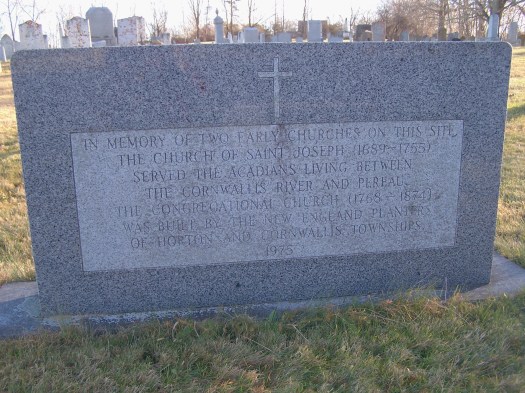
Chipman's Corner Memorial Stone

This stone in the Chipman Corner cemetery marks the possible site of an Acadian and a Planter church.  

A memorial stone in the Chipman Corner cemetery indicates it was placed in memory of two early churches on this site, the Church of St. Joseph and the Congregational Church. According to the stone’s inscription, the Church of St. Joseph was established by the Acadians in 1689 (Wikipedia gives 1670 as the establishing year).  The Church of St. Joseph reads the stone, “served the Acadians living between the Cornwallis River and Pereau.”

Writing about the Acadians in the History of Kings County, Arthur W. H.  Eaton states that the “large district of Minas” was divided into two parishes, “St. Joseph at Riviere aux Canards and St. Charles at Grand Pre.”  Eaton states that the church of St. Joseph stood in Chipman Corner, serving the Riviere aux Canards parish; Eaton doesn’t give the date it was established.

Further, a website containing the history of St. Joseph’s Roman Catholic Church of Kentville states that the first St. Joseph’s Church “was built in 1688-89 in the area we now know as Chipman Corner.”  In a booklet published by the Kings Historical Society (Sketch of Chipman Corner c.1670-1985 by James Fry) the author also places the Church of St. Joseph in Chipman Corner as well.

It would appear from what Eaton wrote, from Fry’s sketch, the Catholic Church history of St. Joseph Church and the memorial stone’s inscription that an Acadian church once stood in what may be a historically important community.  Not everyone agrees, however.  In a recent email Susan Surette-Draper, the president of Les Amis de Grand-Pre, asks if Chipman Corner actually was the site of the Church of St. Joseph.  In effect, she questions that it was, or that it hasn’t been proven convincingly that it was.

“This summer our group has done quite a few guided tours of the Riviere aux Canards area since many Acadian families were documented as living there,” Surette-Draper wrote.  “We always take them to the Chipman Corner cemetery since this is identified as being the site of the Acadian church of St. Joseph de la Riviere aux Canards, but something about that place doesn’t seem right.”

Ms. Surette-Draper gave several reasons why she says this about the Chipman Corner site.   “It seems inland, not at the mouth of the (Canard) river.  The dykes had been built by the time of the deportation in 1755 but the church was just built in 1727 so blocking off the river was underway when the church was constructed, thereby blocking water access.

“It (the church) doesn’t seem to be in a prominent place.  Usually Acadian churches are on high ground where they would be visible from the water.  Jawbone Corner seems more likely (as a church site).

“Here’s another reason why it doesn’t make sense.  Why would the Planters want to establish their church on the site of a Roman Catholic cemetery and former location of a Roman Catholic Church?  When you think of the animosity of the religions at the time, this doesn’t seem likely.”

Is there any justification for claiming that Chipman Corner was the site of the Acadian church, Surette-Draper asked.  “What have you found on the subject?”

As I said in replying to Ms. Surette-Draper, I’ve never found any confirmation, official or otherwise, that an Acadian church was located at Chipman Corner.  Arthur W. H. Eaton says it was, as did James Fry who was using Eaton as a source.  And I suspect the Roman Catholic Church history used the same source that Fry did.  What’s obviously missing from all this is the source Eaton used to place the Acadian church in Chipman Corner.

There definitely was an Acadian Church somewhere near the Canard River, which is practically a stone’s throw from Chipman Corner.  This is implicated by a map on the website called Minas Acadian History, which was established originally by Roger Hetu.  The map, dated 1714, came from the government and it indicates that an Acadian church was located along the Canard River.

You will note above the conflicting dates on when the church of St. Joseph was established.  Wikipedia, the stone monument at Chipman Corner and the Catholic Church history all differ on the date of the establishment.  Some sources claim Chipman Corner was said to be the church site by Charles Morris, an army officer who surveyed the Minas district in 1748.  Morris wrote a 107-page document on his findings (A Breif (sic) Survey of Nova Scotia) and this may be Eaton’s source.  I did a Google search for this document and found an inaccessible copy at a university in the United States.

If you want more confusion about the location of the church of St. Joseph, some sources (Eaton among them) claim that in addition to the Church of St. Joseph and the church of St. Charles in Grand Pre, there were Acadian chapels, with priests serving them, located north of Canning around the Pereau area and in New Minas, the latter only a short distance from Chipman Corner.

I should mention here the Journal of Col. John Winslow. He was the army officer charged with carrying out the expulsion of the Acadians in 1755 and he is often quoted as describing the Acadian church in Chipman Corner as beautiful.  Winslow’s journal is on line and after reading it I found no mention of an Acadian church in Chipman Corner and no entry where he described this church as beautiful.

Where this incorrect attribution probably came from is an entry in Winslow’s journal where he quotes a fellow officer’s report about an Acadian church: “Septr. Srd. This morning Capt Adams returned from their march to the River Cannard &c and reported it was a fine Country and Full of Inhabitants, a beautiful Church & abundance of ye Goods of the world.”

Here we have confirmation that an Acadian church was situated somewhere near the Canard River, but not confirmation that the site was Chipman Corner.  As Susan Surette-Draper says, tradition places the church at Chipman Corner, but who started the tradition?  And, I add, what proof, if any, exists that Chipman Corner was the site of the church of St. Joseph.