HISTORICAL GLIMPSES (February 15/16)

It apparently was after retiring in Wolfville that provincial archivist W. C. Milner compiled and published a collection of historical articles on the Minas Basin.  As I said before when I wrote about the collection in this column, it likely was published circa 1930 in Wolfville. It’s an extremely rare book. I was fortunate to find a copy in Ottawa; there’s a copy (the only other one I know of) in the Kirkconnell Room at Acadia University.

As the provincial archivist, W. C. Milner was in an ideal position to access historical records, but why he decided to publish a historical collection on the Minas Basin isn’t known; however, the result of his decision to do so is an excellent collection of historical articles – about 70 in all – on the early days around the Minas Basin and especially in and around Kings County.

From the Acadians to the Planters and to the shipbuilding period, Milner covered a lot of early Kings County in his collection.  The collection is not as extensive a work as Eaton’s county history, however. Yet I’d rank it at least next to Eaton’s book for in-depth historical glimpses of Kings County.

One excerpt from Milner’s book, the Moccasin Hollow massacre (or battle) around the west end border of Kentville, is an example of what I mean.  Eaton is skimpy on the details, only devoting a paragraph or two to the event, all of it based on second hand reports of another historian.  Milner’s book contain an article written in 1895 by a Kentville researcher who says that the Moccasin Hollow event took place shortly after the Noble massacre in Grand Pre; the two events were connected in other words – Eaton doesn’t make this connection – and involved some of the same combatants.

In his book Milner included short historical sketches of Kentville, Wolfville, Canning, Greenwich, Port Williams and Kingsport.  The book takes in the broad area Kings County comprised before it was downsized, explaining why there are historical sketches on communities in areas adjacent to Kings County, like Parrsboro and Hantsport, for example.

While it probably isn’t complete, Milner’s book lists many of the sailing ships built in greater Kings County during the 19th century and the early part of the 20th century; said list contains the names of the ships, the tonnage and the names of the shipbuilders or owners, making it a valuable reference for marine historians.   Such a list, by the way, wasn’t included in Eaton’s Kings County history.

Getting back to Milner’s book being published in Wolfville (and printed at the Wolfville newspaper office) he may have had family connections there.  Wolfville historian John Whidden tells me there a record of Milner purchasing a house in Wolfville.  However, I was unable to find any mention of Milner in the Wolfville history, Mud Creek, or in other lists of Wolfville occupants in the 20th century.

One more by the way.  I mentioned Milner’s book being rare.  Possibly only a limited number of copies were printed and most appear to have disappeared.  One of my pastimes is searching the online inventories of book dealers for historical books, and for Milner’s book especially.  If copies of the book exist besides the two mentioned, they must be privately held.

WARM CIDER SATURDAYS (February 2/16)

Once in a while on Saturday afternoons in warm weather, Al Beckwith would bicycle down the road past our house, his trousers clipped back in the old style, a ball cap on his head. Al always carried a mouth organ and if you asked politely, he’d get off his bike and play a tune. Al was what they called a “quick stepper,” meaning he could really step dance, and this is what he did while playing the mouth organ at the same time.  Al called his dancing “my Irish two steps.”

It was the likes of Al Beckwith who inspired kids in my neighbourhood to play the mouth organ.  Back in the late 1940s and early 1950s, many of the kids in the neighbourhood carried mouth organs in their pockets.  Not everyone played with any expertise; but at the time mouth organs were only a dollar or two in the T. Eaton catalogue and were considered to be inexpensive entertainment and a good way to keep kids out of trouble.  Like other kids, I often found a mouth organ in my stocking at Christmas.  Usually they were Hohners who by then were mass producing mouth organs for the entire countryside.

Recently I joined a harmonica band in New Minas and it brought back memories of those mouth organ days.  Those of us who grew up in the late 40s and early 50s played the kind of music the Valley Harmonica Band has in their repertoire; all the jigs, reels and waltzes usually played by contemporary fiddlers.

Back in those boyhood days, usually on Saturday afternoons, we held what everyone today calls jam sessions.  A guitar player or two, maybe four or five mouth organ players who sat around in kitchens many an afternoon and played country songs and old time fiddle music.  It was the era of the B Westerns and cowboy music was in.  It was all cowboy or western music.  At that time Bill Haley and His Comets were just getting underway and Rock and Roll was little more than twinkle in Elvis Presley’s eyes.

At our home on Saturday afternoons kids would drop in and out all afternoon and join in the jams, maybe learn a new tune or a different way to get sounds effects out of their mouth organs. On those sound effects, we had some kids who were whizzes at making train noises and talking into their mouth organs.   No one could produce those sound effects as well as a close friend but I can’t remember him or anyone bending notes like players do today.

My father called our mouth organ jam sessions soft cider Saturdays. He made sure there was always a large jug of freshly pressed sweet cider in the pantry for anyone that was thirsty. It wasn’t hard cider, the fermented juice of the apple.  This was a kid’s drink, applejack that was brown and tangy with apple pulp floating in it.  The hard cider came out later that night, along with a bucket of raw scallops, after the kids were chased off to bed.

Our mouth organ playing was often inspired by the likes of Jimmie Rodgers and Vernon Dalhart, both of whom could still be heard on the Kentville radio station in those days. Hank Williams was just hitting his stride then and if radio reception was exceptionally good, you might catch the Grand Ole Opry.

What we never heard on the radio in those days was mouth organs being played – we didn’t call them harmonicas until much later – but that didn’t matter.   Our real inspiration was local fiddlers who played the tunes we all wanted to learn; the music that came with immigrants from Scotland, Ireland and Great Britain.

TOWN BRIDGE HISTORY (January 18/16)

The province announced last year that the bridge over the Cornwallis River, in downtown Kentville, would be replaced in 2016. There’s speculation about when the bridge was first built. Was it Acadian or Planter or what? Here’s some interesting background on the bridge in which this question isn’t quite answered.

In 1895 probate court judge Edmond J. Cogswell convincingly argued in a Kentville newspaper (the Western Chronicle) that the town owes it existence to a “geological formation (that) is very peculiar.”

What Cogswell meant was that geological forces had created a huge sandbank and a shallow ford – “the principal ford” on the Cornwallis river as he calls it- where Mi’kmaq and Acadian trails converged to take advantage of a crossing place. It was a natural place for an Acadian village to spring up, says Cogswell, and the village was located about where the town bridge spans the river. Also, said Cogswell, it was a natural place for a bridge to be built over the river.

Arthur W. H. Eaton in his History of Kings County also mentions the ford (caused by geological forces depositing an “enormous sandbank which narrowed the river”) where “naturally a village sprang up.”   While Cogswell says this village originally was Acadian, a seasonal Mi’kmaq encampment likely was there as well.

In his 1895 article Cogswell also writes that the Acadians built a bridge over the river at the ford. If this is so, this likely was the first bridge to span the Cornwallis River. If Cogswell is correct, it also means a bridge has spanned the Cornwallis River at this spot for well over 200 years. However, in his 1895 article, Cogswell contradicts what he wrote earlier about the Kentville bridge. In an 1892 article, also in the Western Chronicle, Cogswell wrote that “whether there was ever a French bridge or not I cannot find out, but I think there was not. I think the old ford was used, but very shortly after the English or rather Colonial advent a bridge was built. It was not built exactly at the old ford.” In the same article Cogswell said the first bridge on the Cornwallis River was built in Coldbrook on Lovett Road.

If this is confusing let’s just say that an Acadians bridge on the Cornwallis River, in what was to become Kentville, is disputed. In her book the Devil’s Half Acre, Mabel Nichols doesn’t mention an Acadian bridge, noting only that the Planters built one at the ford in the 1870s. Further on in her book Nichols says that the bridge was built “soon after the Planters came to Horton” and there’s a record of repairs being made to it in 1893.

Nichols doesn’t give her source for the 1870s or the 1893 dates but the Town of Kentville website quotes her as if this is factual. What we do know is that Cogswell writes in 1892 that there is no evidence of an Acadian bridge at the ford and in 1895 he writes that a bridge of Acadian origin was there. As noted, Nichols, writes that it was the Planters that built the first bridge, giving the dates mentioned above without telling us how she arrived at them.

We also know that the bridge existed before 1931 since newspaper records show this was the year it was improved upon and expanded. Brent Fox, writing in The Advertiser, gives 1931 as the year the old bridge was replaced. In an April 29, 1994, article Fox writes that the bridge was officially opened on October 13 and at the time was recognised as the widest traffic bridge in eastern Canada.

Quoting Mabel Nichols, Fox noted that when it was opened the bridge was given a coat of aluminum paint. “The massive trusses gleamed pleasantly on the landscape in their aluminum coat painting,” writes Nichols, which may explain why the bridge was dubbed the Silver Link.

I’ve scoured other sources referring to Kentville, the Cornwallis River and the town bridge and this is all I’ve come up with. In closing, I must mention what Kentville historian Louis Comeau has in his archives regarding the bridge. Comeau has a photograph of the town bridge, dated 1890. He tells me the photograph probably was taken by L. C. Swain who operated a shop called the Kentville Photographic Studio from about 1890 to 1892. This photograph establishes that the bridge was standing at least as early as 1890.

Kentville Bridge circa 1890

This photograph was taken circa 1890 by L. C. Swain, verifying that the Kentville bridge was in place at least 125 years ago. (Louis Comeau archives)


COUNTY PLACE NAMES (January 5/16)

When a friend suggested it would be interesting to look into the origin of Kings County place names, I told him the research had already been done and was published. Actually, it was done in three separate publications. One is a massive book of some 750 pages which gives the origin of place names in every county in the province.

This “massive book” is C. Bruce Fergusson’s Place-Names and Places of Nova Scotia, which was published in a limited hardcover edition by the Public Archives in 1967. Of the other two publications dealing with the origin of place names, one is a little known hardcover book published in 1922. Compiled by Thomas J. Brown, Nova Scotia Place Names is tiny compared to Fergusson’s work, containing 158 pages. However, it must be looked upon as a “first” for this sort of publication and possibly it inspired Fergusson who was the provincial archivist.

The third book (actually a booklet) was compiled by a past president of Acadia University, Dr. Watson Kirkconnell. Place-Names in Kings County was published (perhaps privately) in 1971. While only containing 39 pages, this is a much more readable, more interesting publication than Fergussons and Browns since Kirkconnell also discusses surnames long associated with various county communities from the Acadian period and from the time the Planters arrived.

All three publications are out of print. At least the original edition of Fergusson’s book is, but Mika Publishing released a facsimile edition in 1976 and a copy can be found in the local library.   As mentioned, Brown’s work must be considered a rarity and I know of only two hardcover copies that are extant locally. A paperback issue was released last year by an American publisher but I haven’t seen it in local bookstores.

Of the three publications, Fergusson’s work is the more authoritative. As the provincial archivist, Fergusson could delve into historical records Brown and Kirkconnell had no access to. But even with the archives at his fingertips, Fergusson sometimes skipped over some of the more interesting details on the origin of place names. One example is the community of Melanson on the Gaspereau River. Fergusson notes that it originally was an Acadian village of that name, overlooking the Scottish origin of Melanson.

Of course with the entire province to cover, Fergusson of necessity had to keep his place name descriptions concise. But there are omissions in his book. I’d like to know, for example, how Atlanta, a community near Sheffield Mills got its name. Kirkconnell mentions Atlanta briefly, as an example of a community that came into being due perhaps to the railway running through the area. There’s no listing for Gibson Woods either, or Harriston and Blue Mountain on the road to New Ross, and Chettaly on the north mountain behind Canning. I’m sure other place names have been left out as well by all three writer/researchers.

However, despite a few omissions, Kings County has many interesting place names, which thanks to Fergusson and also to Kirkconnell generally have their origins explained. Some of it is guesswork, of course. On Medford, Black Rock and Auburn, for example, Fergusson guesses that the first two were named after natural features, the latter after a village in England. The same with Aylesford and Burlington which may have British connections, Fergusson suggesting they were named after British Lords.

Kings County has various place names like Aylesford and Burlington that originated in England, Scotland and Ireland. Canard, with its divisions into Upper and Lower Canard, is an exception, being one of the few Acadian place names that survived after the Planter and Loyalist influx. It’s really unusual that the people who ousted the Acadians would let this place name survive and also keep the Acadian name for the river. In contrast, the Planters quickly changed the Acadian name for the Cornwallis River (which was the Grand Habitant) first calling it Horton River until someone decided to rename it in honour of Governor Edward Cornwallis.

ACADIAN CHURCHES (December 7/15)

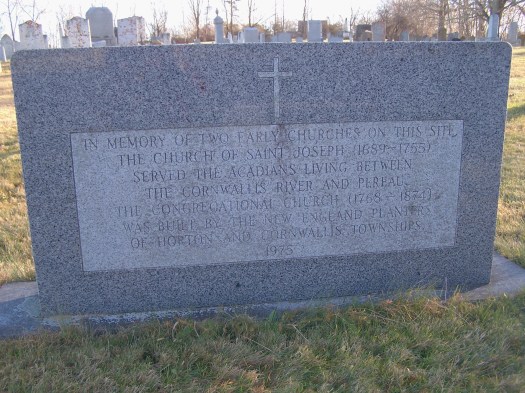
Chipman's Corner Memorial Stone

This stone in the Chipman Corner cemetery marks the possible site of an Acadian and a Planter church.  

A memorial stone in the Chipman Corner cemetery indicates it was placed in memory of two early churches on this site, the Church of St. Joseph and the Congregational Church. According to the stone’s inscription, the Church of St. Joseph was established by the Acadians in 1689 (Wikipedia gives 1670 as the establishing year).  The Church of St. Joseph reads the stone, “served the Acadians living between the Cornwallis River and Pereau.”

Writing about the Acadians in the History of Kings County, Arthur W. H.  Eaton states that the “large district of Minas” was divided into two parishes, “St. Joseph at Riviere aux Canards and St. Charles at Grand Pre.”  Eaton states that the church of St. Joseph stood in Chipman Corner, serving the Riviere aux Canards parish; Eaton doesn’t give the date it was established.

Further, a website containing the history of St. Joseph’s Roman Catholic Church of Kentville states that the first St. Joseph’s Church “was built in 1688-89 in the area we now know as Chipman Corner.”  In a booklet published by the Kings Historical Society (Sketch of Chipman Corner c.1670-1985 by James Fry) the author also places the Church of St. Joseph in Chipman Corner as well.

It would appear from what Eaton wrote, from Fry’s sketch, the Catholic Church history of St. Joseph Church and the memorial stone’s inscription that an Acadian church once stood in what may be a historically important community.  Not everyone agrees, however.  In a recent email Susan Surette-Draper, the president of Les Amis de Grand-Pre, asks if Chipman Corner actually was the site of the Church of St. Joseph.  In effect, she questions that it was, or that it hasn’t been proven convincingly that it was.

“This summer our group has done quite a few guided tours of the Riviere aux Canards area since many Acadian families were documented as living there,” Surette-Draper wrote.  “We always take them to the Chipman Corner cemetery since this is identified as being the site of the Acadian church of St. Joseph de la Riviere aux Canards, but something about that place doesn’t seem right.”

Ms. Surette-Draper gave several reasons why she says this about the Chipman Corner site.   “It seems inland, not at the mouth of the (Canard) river.  The dykes had been built by the time of the deportation in 1755 but the church was just built in 1727 so blocking off the river was underway when the church was constructed, thereby blocking water access.

“It (the church) doesn’t seem to be in a prominent place.  Usually Acadian churches are on high ground where they would be visible from the water.  Jawbone Corner seems more likely (as a church site).

“Here’s another reason why it doesn’t make sense.  Why would the Planters want to establish their church on the site of a Roman Catholic cemetery and former location of a Roman Catholic Church?  When you think of the animosity of the religions at the time, this doesn’t seem likely.”

Is there any justification for claiming that Chipman Corner was the site of the Acadian church, Surette-Draper asked.  “What have you found on the subject?”

As I said in replying to Ms. Surette-Draper, I’ve never found any confirmation, official or otherwise, that an Acadian church was located at Chipman Corner.  Arthur W. H. Eaton says it was, as did James Fry who was using Eaton as a source.  And I suspect the Roman Catholic Church history used the same source that Fry did.  What’s obviously missing from all this is the source Eaton used to place the Acadian church in Chipman Corner.

There definitely was an Acadian Church somewhere near the Canard River, which is practically a stone’s throw from Chipman Corner.  This is implicated by a map on the website called Minas Acadian History, which was established originally by Roger Hetu.  The map, dated 1714, came from the government and it indicates that an Acadian church was located along the Canard River.

You will note above the conflicting dates on when the church of St. Joseph was established.  Wikipedia, the stone monument at Chipman Corner and the Catholic Church history all differ on the date of the establishment.  Some sources claim Chipman Corner was said to be the church site by Charles Morris, an army officer who surveyed the Minas district in 1748.  Morris wrote a 107-page document on his findings (A Breif (sic) Survey of Nova Scotia) and this may be Eaton’s source.  I did a Google search for this document and found an inaccessible copy at a university in the United States.

If you want more confusion about the location of the church of St. Joseph, some sources (Eaton among them) claim that in addition to the Church of St. Joseph and the church of St. Charles in Grand Pre, there were Acadian chapels, with priests serving them, located north of Canning around the Pereau area and in New Minas, the latter only a short distance from Chipman Corner.

I should mention here the Journal of Col. John Winslow. He was the army officer charged with carrying out the expulsion of the Acadians in 1755 and he is often quoted as describing the Acadian church in Chipman Corner as beautiful.  Winslow’s journal is on line and after reading it I found no mention of an Acadian church in Chipman Corner and no entry where he described this church as beautiful.

Where this incorrect attribution probably came from is an entry in Winslow’s journal where he quotes a fellow officer’s report about an Acadian church: “Septr. Srd. This morning Capt Adams returned from their march to the River Cannard &c and reported it was a fine Country and Full of Inhabitants, a beautiful Church & abundance of ye Goods of the world.”

Here we have confirmation that an Acadian church was situated somewhere near the Canard River, but not confirmation that the site was Chipman Corner.  As Susan Surette-Draper says, tradition places the church at Chipman Corner, but who started the tradition?  And, I add, what proof, if any, exists that Chipman Corner was the site of the church of St. Joseph.