
GASPEREAU RIVER LOG DRIVE (February 20/17)

Hanging on a wall in the White Rock community centre is an oil painting of a long ago log drive on the Gaspereau River. The painting is one of a few remaining records of a period when a grist and lumber mill operated on the Gaspereau River in White Rock.

This was the S. P. Benjamin Mill which opened in 1885, employing 50 to 75 men summer and winter in the 15 years it was in operation. In effect, the mill was a tiny community in itself. On the site besides the grist and lumber mills was a boarding house with a full-time cook, a blacksmith shop and stables for horses and oxen. The entire operation was tucked into an area on the left bank of the river immediately above the White Rock bridge.

Looking at the Gaspereau River around White Rock today, it’s difficult to believe there actually were log drives. However, Wolfville entrepreneur S. P. Benjamin, who in the late 19th century owned or leased thousands of acres of woodland around the river and around Gaspereau Lake, needed access to the Minas Basin for his timber after it was harvested. The Gaspereau River was conveniently nearby. Obtaining permission from landowners along the river to cart timber over their land, Benjamin went about building a sprawling mill. Every winter, for nearly two decades, timber was harvested and hauled to vantage points along the river. In the spring the logs then were dumped down the bank into the river and an old fashioned log drive followed.

What were those logs ultimately used for? Any references I found about Benjamin’s mill mention only that it was a grist and lumber mill but it is often confused with a pulp mill which was lower down the river. For a story I did In 1965 I interviewed Raleigh Eagles whose father had worked for Benjamin; Eagles told me that Benjamin’s was solely a grist and lumber mill. Another source, a story in a Wolfville newspaper published in 1937, mentions S. P. Benjamin hauling millions of board feet of lumber, using horses and oxen, from his mill to Port Williams. From the Port, says this source, the lumber was shipped worldwide.

Bert Young (1911- 2004) was the artist who more than half a century ago painted the picture of the log drive found in the White Rock community hall. In the picture, working to keep the logs moving down the river with peaveys, are his father Walter Young and Howard Smith.
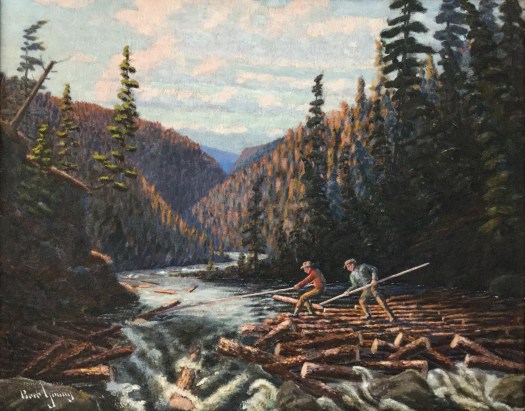
Log Drive on the Gaspereau River, painted by Bert Young

A long ago log drive on the Gaspereau River. The drives were a common sight on the river for at least 15 years beginning circa 1885.

CENTREVILLE HISTORY PUBLISHED (February 6/17)

Mack Frail’s interest in history first began when boyhood friends told him about rock foundations around Centreville that were sites of Acadian homesteads. Around the sites were willows, Daphne and other plants the Acadians brought here from France.

Around Centreville also was other evidence suggesting a one time Acadian presence: Old roads (one often referred to as the “Old French Road”) a mill site rumoured in local folklore to be of Acadian origin, and ancient changes in local waterways also believed to be the work of the Acadians, all of which further whetted Frail’s interest in Centreville’s history. Two historical writers, Eaton in the history of Kings County and Erskine in The French Period in Nova Scotia refer to Acadian homesteads in Centreville, further confirming what Frail already suspected.

Mack Frail writes about the Acadian settlement and other aspects of Centreville’s history in a book he began compiling a decade ago. The book was recently published and it’s an important addition to the history of Kings County. Frail points out that Centreville has “somehow failed to be properly recognized for its history,” and he sets out to correct this in his book. It’s a task that he accomplishes admirably and the book is an excellent historical read.

Centreville, says Frail, may have been one of the earliest Acadian settlements in Kings County. The area was an ancient Mi’kmaq foraging and camping area as well, which Frail tells us about in his book. He traces the history of Centreville from the Mi’kmaq and Acadians up to fairly recent times. Some solid documentation from the Planter period exists in the provincial archives and Frail accessed these records to flesh out Centreville’s role in the history of the county.

In effect, Frail expands upon what is the token mention of Centreville found in Eaton’s History of Kings County. As well as including details on the Acadian and Planter period, his book looks at farmsteads, mills, inns, churches, roads, schools and some of the stores that served the village so well over the years. There’s a tantalizing bit of Irish history connected to Centreville as well – the Irish cemetery and a nearby somewhat mysterious Irish settlement, for example.

All in all, this is an excellent historical collection; and a comprehensive read as well since it shines some historical light on areas such as Centreville that typically are neglected by mainstream historians.

Centreville native Max Frail

A Centreville native Max Frail is a regular contributor to the Centre Post where he writes about farm life.

LTTLE KNOWN COUNTY HISTORIANS (January 16/17)

For the most part, the writers who have researched and compiled the histories of communities, villages and the towns in Kings and Hants County are little known and rarely celebrated outside their immediate areas.

But without the efforts of these writers – often they devoted years researching – most of their work would never see the light of day. These writers deserve to be recognised much more than they are. With this in mind, I’d like to profile those “local historians” in an occasional series beginning this week. I welcome input for the series; if you are aware of a Kings or Hants historian that should be recognised, please contact me.

Larry Sinclair Loomer (1930-2003). Born in Windsor, Loomer was noted as a historical writer, artist and antiquarian. Early in his career Loomer worked as a journalist for several Maritime newspapers. While he authored and published books on art, his main interest appears to have been Hants County history. He has three historical works to his credit. His book, Windsor Nova Scotia: a Journey in History is a brilliant retelling of Windsor’s history and the period when Kings and Hants were a single county. This is one of my favourite historical books and Loomer is one of my favourite historical writers. I recommend his Windsor book to anyone who likes history served with humour and irony.

John S. Erskine (1900-1981). A teacher in the Annapolis Valley for many years, John Erskine was noted as a keen student of natural history and was a published writer on the botany of Nova Scotia. Erskine liked to investigate archaeological sites as well; his life long study of Acadian sites resulted in a book entitled The French Period in Nova Scotia, A.D. 1500-1758. In effect, this is a historical and archaeological survey of the Acadian period. In the book Erskine identified many Acadian homestead sites in Kings County. The book, a paperback, is out of print but occasionally copies shows up at yard sales. Copies can also be found in the archives of the Kings Historical Society.

Ernest L. Eaton (1896-1984) Born in Upper Canard, Kings County, Eaton was a Professor of Agronomy and Senior Horticulturist with the Department of Agriculture. He was a devoted historian as well and wrote many invaluable papers on the Planters, early Kings County farms and the dykelands, several of which were published by the Nova Scotia Historical Society. Most of his historical research is unpublished and is held privately. However, Eaton’s historical articles can be found on the Internet at: http://nseaton.org/Eaton/Library/E.L._Eaton_Archive.html.

Marie C. Bishop (1929-2011) Born in the United States to Canadian parents, her family returned to Coldbrook when she was three and eventually settled in New Minas. Bishop was noted early in her career for the crafts she created. While she was a paraplegic since age eight, she was active in various Valley organizations and clubs throughout her life. Her interest in history resulted in her compiling several books. Two of her best known works are The Pioneers of Canaan (1994) and Memories of Coldbrook (1999). Bishop was also one of the major compilers of genealogy for the four volume Tangled Roots, a Bishop Family Association publication.

Douglas E. Eagles (1927-2008) One of the most prolific historical writers and researchers in the Annapolis Valley, Douglas E. Eagles was born in North Grand Pre, Kings County, attended school in Wolfville and graduated from Acadia University with an Honours B. Sc. Degree in 1948.

Eagles has four major publications to his credit, most of which can be found in the provincial archives and in museum collections. Eagles’ major works include: A History of Horton Township (1975) A Genealogical History of Long Island, also Eagles Families of North America (1982) and Lockhart Families of Nova Scotia and New Brunswick.

Besides these works Eagles has at least eight historical papers to his credit, all either privately published or stored in the provincial archives and in local museums. Among these papers are works on several Kings County churches, papers on Horton Township records (deaths, births, marriages) and the cemeteries of Horton Township.

HANSFORD ON SHIPS (January 3/17)

When the French made a coasting craft in Louisburg in 1604, they didn’t realise it would one day be hailed as a Canadian first.

“Reliable sources” record that this pioneering event took place in Cape Breton, writes Gordon Hansford* in the introduction to his 1953 Master’s thesis on shipbuilding. Based on this, Nova Scotia can “technically claim the first shipbuilding in Canada and New England,” Hansford concludes.

From this starting point Hansford takes an in depth look at shipbuilding. He conjectures that Nova Scotia’s early prominence in shipbuilding was partly due to its long, greatly indented coastline, which induced people to look to the sea for a living. There were other factors that led to this prominence, of course, but the marine environment was a key element.

For a long time Kings County, which included present day Hants County, was one of the most productive shipbuilding areas in Canada. Reading the thesis courtesy of Hansford, I was amazed by how many prominent shipbuilders once thrived in Kings/Hants and the great number of superbly crafted sailing ships that came out of their yards.

For a time, the coastline in and around Canning, Kingsport, Wolfville Hantsport and Windsor were the chief shipbuilding areas and its shipbuilders were known all over eastern Canada and beyond. While there were shipyards of various sizes all along the Bay of Fundy, Minas Basin coastline, these were the most productive areas.

Some of the noted shipbuilders early on were the Bigelows, Coxes and the Churchills. Hansford says that the two Ebenezers – Ebenezer Bigelow and Ebenezer Cox – operated in Kingsport and Canning and their names for a long time were synonymous with local shipbuilding. In Canning and in Kingsport ships were being built as early as 1790.

One of the most prominent builders was Ezra Churchill of Hantsport. As Hansford notes, Churchill was known as one of the largest ship builders and ship owners on the eastern coast of Canada. Another prominent ship builder and owner was Shubael Dimock of Windsor. Hansford says Dimock began building ships in 1867, noting that while he made Windsor a shipbuilding centre, there was activity all along the coast in places like Noel, Cheverie, Walton and other small Hants communities.

So there you have it. In the golden age of sail, in Kings and Hants County, shipbuilders turned out countless hundreds of ships, making this area renowned in Canada, the United States and well beyond. Hansford admirably chronicles that era in his thesis and I hope this short review of his work will stir readers into looking up the likes of Ebenezer Cox, Ebenezer Bigelow, Ezra Churchill and Shubael Dimock.


*A Wolfville native. Gordon Hansford taught in Kings County schools for 30 years. Retired, he lives in Kentville. Hansford is the creator of the Annapolis Valley tartan for which he was recently honoured. His thesis, quoted here, was a requirement for a Master of Arts degree, which he received at Acadia University in 1953.

** “Ships,” as used here, is a generalization. Actually, when it comes to sailing vessels, ships refers to three-masted vessels, while other two and three masted vessels, depending on how their sails are rigged, are known as barques, brigs, brigantines, schooners, etc.