THE WORK OF A BIRD DOG (December 10/12)

At the bottom of a cornfield, where the uplands merge with the dykes, a farmer clearing debris on his land had deposited a huge brush pile near a patch of bog grass.

From instinct or from past experience, my bird dog usually gravitates towards brushy, boggy areas when I hunt pheasants. This morning was no exception. Jake zeroed in on the brush as we approached it. I wasn’t totally surprised when he froze on point, his nose only inches from the tangle of brush.

I expected a pheasant to flush but instead Jake broke the point and crashed into the brush pile. There’s no other way to describe what he did – one moment he was rock solid, the next he was ripping and tearing in the jumble of alders and blackberry cane. Then I heard the flutter of bird wings. Seconds later Jake emerged from the brush carrying a live rooster pheasant.

By an unusual coincidence, this was the same brush pile the dog caught a crippled cock bird in last season. That brush pile rooster and the rooster he caught this season were both wing-tipped, probably by hunters who weren’t using dogs.

Last season my bird dog caught two pheasants other hunters had crippled. This year so far Jake caught three pheasants hunters had left in the field. In a typical pheasant season my bird dog usually picks up a couple of cripples. The dog has saved the day many a time for me as well, running down and retrieving birds our hunting party – myself included – had made sloppy shots on.

The point here is that bird dogs are great conservationists. Besides adding an element of satisfaction to the hunting of game birds – the satisfaction and enjoyment of seeing bird dogs at work in fields, woods and water – bird dogs, as an old friend used to say, are “good cleaner uppers.” Meaning they’re good at finding birds other hunters lost and good at finding birds we might’ve lost if we’d been hunting without a dog.

I’m really surprised, by the way, when I meet hunters who say they’re in the field a lot, are serious about waterfowl and upland hunting, and they don’t have a bird dog. I realise keeping a bird dog is time consuming and can restrict everyday activities. Bird dogs need a lot of care and attention and some hunters find it’s too much responsibility to take on. Yet how can anyone who doesn’t keep a bird dog claim they’re serious, conscientious hunters?

After keeping and hunting bird dogs for over 50 years, I can’t imagine ever going afield without one. They add so much joy to the hunt and the benefits are endless. I’ve had goods bird dogs and so-so bird dogs, but you know what? Even the dogs I’ve had that were run-of-the-mill were a thousands times better than no dog at all.

To that I say “Amen.”
GLIMPSES OF EDMOND J. COGSWELL (December 10/12)

Readers of this paper who follow my column will recall the name of Keith Barry of Edmonton, whom I’ve mentioned numerous times; especially Barry’s connection with the noted Canard horticulturist and historical writer, the late Ernest L. Eaton.  Mr. Barry created and maintains a website on Eaton with many of the latter’s historical sketches on Kings County.

Recently Barry e-mailed me about the column on Edmond J. Cogswell, sending along information that gives us a better picture of this little known historical writer.

“I read with interest your article and have a few items to mention” Barry wrote, pointing out Cogswell is mentioned several times in Arthur W. H. Eaton’s Kings County history.  On page 31, for example, Eaton quotes from Cogswell’s research on the Acadian settlement in New Minas.  Readers interested in the early day in New Minas and haven’t seen this quote will find it interesting.  (One of my future projects will be to locate the complete paper from which Eaton quoted.)

Getting back to Barry’s letter, he writes that Cogswell graduated from Harvard with a Bachelor of Law degree with the Class of 1868-1869; that while he’s not mentioned in the Nova Scotia Census of 1861, the 1871 Census found him at age 32 living in Centreville with Gideon and Ruth Reid.  In the 1881 Census he is living with his mother and a housekeeper in Centreville.  The 1891 finds him in the same situation. In this Census his first name is incorrectly given as Edward.  As for his religion, Edmond is listed as a Baptist in both 1881 and 1891.

I mentioned in the earlier column that there was confusion about Edmond’s marital status.  An extract from the Berwick Register, dated April 3, 1913, clears this up:  “Cogswell, Mrs. Bessie Randall, d/o Charles D. Randall, wid/o Edmund J. Cogswell, died at Wolfville, 23 March 1913.”

Barry writes that he can find no other record of her death or marriage. A challenge as well, Barry says, is determining when Cogswell married Bessie. “There are several options.  He married early, between 1869 and 1871.  Between any one of the Censuses.  Late in life between 1891 and 1901.  (His mother died 31 March 1894, so possibly after that?)

“In any event,” Barry concludes, “it would have been a brief marriage.”

What is even more puzzling about Cogswell is his lack of recognition as a historical writer.  From what I’ve read of his work he apparently delved deeply into the Acadian settlement in New Minas and did a lot of research.  He had an interest as well into the early road and trails of Kings County and published an article or two on them in the Kentville newspaper that preceded the Advertiser.

IRISH PROJECT: THE SEARCH IS STILL ON (November 26/12)

I like to think of it as the Irish Project, the search for the Irish of Kings County. The project was started just over a year ago and is an effort by the Community and Family History Committee of the Kings County Museum to trace Irish families.

As mentioned in this column last year, the main focus of the Committee is on tracing families that emigrated from Ireland and settled in Kings County during the 1700s and 1800s. I spoke recently to Committee member Glenda Bishop and she said their efforts to date generated 27 responses. “The project is going well,” Bishop said, “but a lot of research still has to be done.”

I assume that at a future time a database will be created on the Irish families of Kings County. If you have Irish roots, your ancestors settled in Kings County and you have a story to tell, I urge you to contact the museum so you can be included. Nelson Labor is the chair of the Committee and he can be reached via email at genealogy@okcm.ca.

One of the intriguing questions about the Irish that came to Kings County, by the way, is why most of them settled in outlying areas. Were they outcasts and unwelcome? Was religion a factor in why the Irish appear to have been relegated to hardscrabble areas on the North Mountain and far out on the New Ross Road? Is it a fact that most of the good farm land had already been claimed by Planters and Loyalists and as latecomers, there was little left for Irish settlers?

Perhaps some of these questions will be answered after the Community and Family History Committee finishes its Irish project. Glenda Bishops tells me there were many interesting stories in the responses received to date by the Committee. What stands out in these tales is that Irish families usually wound up in unsettled places, never or hardly ever on or even near the prime farmlands of Kings County.

Of course this isn’t true of all the Irish who arrived here. Take Henry Magee, for example. A Loyalist who was chased out of the States when the American Revolution succeeded, Magee became a prominent Kentville businessman. In 1788 Magee built a home, a store and a mill here. In his time, to quote from a Kings County Vignette, Magee was saluted as a “merchants, miller, trader, pawnbroker and friend of the whole community.”

There were few Irishmen like Magee, of course. Most were like my great grandfather, David Coleman, who according to family lore was a rough farmer who scratched out a living on the North Mountain. David was like those other Irish settlers who came here before, during and after the famines in Ireland. Hopefully, once the Irish project of the Community and Family History Committee is completed, the stories of the likes of David Coleman will be recorded for posterity.

HUNTERS, FARMLANDS OFTEN A BAD MIX (November 25/12)

“There was quite a ruckus here Saturday,” the farmer said. “Hunters with dogs came into my pasture from two different directions and stampeded the cattle. The cattle ran into my fences and tore them down. It took a long time to round them up.”

I couldn’t believe what I was hearing. First of all, to get anywhere near the farmer’s cattle pasture, hunters had to cross dykeland and through alder stands well posted with no hunting signs. Secondly, hunters are aware dogs and cattle are a bad mix and are best kept apart. Either dogs panic cattle into running into fences or cattle charge en masse at the dogs, often with damage to fences and to the cattle.

So how could this happen? Actually, I should ask why it happened, why some hunters ignore game laws, why they fail to respect landowner rights, and why they never think of the repercussions other hunters eventually face due to their careless actions.

I have one answer to all these “whys.” Some hunters – and especially some pheasant hunters – have the attitude that game laws were written for someone other than them and they have the right to go on anyone’s field, dyke or pasture to hunt.

It was pheasant hunters who stampeded the farmer’s cattle and fortunately there were no injuries. The majority of farmer-hunter problems that arise are caused by pheasant hunters, by the way. Ever hear of farmers having problems with rabbit, grouse, duck and deer hunters? Rarely ever. Ask any landowner why his land is posted, why he firmly says “no” when you ask for permission to hunt, and you’ll discover 99 percent of the time he’s had problems with pheasant hunters.

The majority of pheasant hunters, in fact the majority of small and big game hunters are responsible people. They respect the rights of the landowner, observe game regulations, and are considerate of fellow hunters.

But not that tiny minority, the proverbial bad apple in the proverbial barrel. Their thoughtless action, such as the recent incident with the farmer’s cattle, tars all hunters with the same brush.

It was an unfortunate incident but similar things have occurred before where pheasants are hunted. What group of hunters do you think is most responsible for legislation re hunting on cultivated land, asking for permission to hunt, for the shorter upland season in the Valley and so on. Right on if you guessed pheasant hunters.

RARE BOOKS: CLARKES, MILNERS HISTORY (November 19/12)

Clarke’s history of the railway, written by a Kentville train conductor and published circa 1920 is difficult to find today. The Dominion Atlantic Railway’s website notes that the book was printed in a limited run “on inexpensive acidic paper,” meaning I suppose that time eroded and destroyed most of the copies.

I’ve only seen one copy of Clarke’s work and it occupies a special place in my bookshelf. I was told by a long-time railroader, whose father worked with Clarke, that 200 to 300 copies were printed, some of which were given to friends and fellow employees. While produced inexpensively and not made to last, surely more than a few of those books are extant, most likely in stored away belongings of old railroad families.

Beside my copy of Clarke’s work, another can be found in the book collection at the Kings County Museum. Don Foster, a railway collector in Grafton, has two copies, one autographed by Mr. Clarke. This makes the book rare indeed. As for the dollar value of the book, it would depend on what a railroad buff/collector would be willing to pay for it.

Above, I mentioned the circa 1920 publishing date. The late Leon Barron, an avid collector or railway artefacts in his day, told me the book may have been printed in Windsor in 1925, by the printing company that published the Hants Journal. Based on employee lists published in the book, Don Foster believes that 1925 was the year of publication.

William W. Clarke was an employee of the Dominion Atlantic Railway and the Windsor & Annapolis Railway, where he started as a water boy. On his demise in Kentville at age 64 he had been a railway employee for about 50 years. He was hailed as an “outstanding figure in railway history” by The Advertiser when his death notice was published in 1929.

While I have many details on the life of William W. Clarke (thanks to the scrapbook collection at the Kings County Museum) I can’t say the same about the author of another rare historical book.

At sometime in the 1930s W. C. Milner published a collection of historical sketches in Wolfville. The Basin of Minas and its Early Settlers is the title of his collection. Like Clarke’s book, I’ve quoted from Milner’s work many times in this column. Also like Clarke’s work, Milner’s book is difficult to find. I’m aware of the existence of only four copies. One is in the rare book collection at Acadia University; another copy is in the collection of Wolfville historian Ivan Smith, the creator and caretaker of the Nova Scotia History Index; a third copy is in my bookcase and the forth in the hands of a book collector in Truro.

Milner was the head archivist for the province of Nova Scotia, having at his fingertips sources some historians would kill to access. In his book are some 70 short historical essays in 132 pages, many of them about towns, villages and historical events in the Annapolis Valley. The essays apparently were first published as a series in Wolfville’s weekly newspaper, the Acadian, and then put together and published as a book.

What’s the Wolfville connection with Milner? Apparently Dr. Milner retired to this town, possibly in the 1920s. John Whidden, who recently published a book on the older homes of Wolfville, tells me he found a reference to Milner in his research. Whidden say that in 1926, L. Fairn designed and E. S. Langille built a house for Dr. Milner at 147 Main Street in Wolfville.

We can speculate that after retiring to Wolfville, Milner wrote his series of historical essays in his new home. Exactly when the book was published is anyone’s guess but I believe it was in the early 1930s. As I said, the book is rare, extremely rare. And costly as well compared to Clarke’s book. One of those four copies I mentioned sold for $125 over a decade ago when it was offered for sale by an Ottawa bookdealer.

HUNTERS, FARMLANDS OFTEN A BAD MIX (November 19/12)

“There was quite a ruckus here Saturday,” the farmer said. “Hunters with dogs came into my pasture from two different directions and stampeded the cattle. The cattle ran into my fences and tore them down. It took a long time to round them up.”

I couldn’t believe what I was hearing. First of all, to get anywhere near the farmer’s cattle pasture, hunters had to cross dykeland and through alder stands well posted with no hunting signs. Secondly, hunters are aware dogs and cattle are a bad mix and are best kept apart. Either dogs panic cattle into running into fences or cattle charge en masse at the dogs, often with damage to fences and to the cattle.

So how could this happen? Actually, I should ask why it happened, why some hunters ignore game laws, why they fail to respect landowner rights, and why they never think of the repercussions other hunters eventually face due to their careless actions.

I have one answer to all these “whys.” Some hunters – and especially some pheasant hunters – have the attitude that game laws were written for someone other than them and they have the right to go on anyone’s field, dyke or pasture to hunt.

It was pheasant hunters who stampeded the farmer’s cattle and fortunately there were no injuries. The majority of farmer-hunter problems that arise are caused by pheasant hunters, by the way. Ever hear of farmers having problems with rabbit, grouse, duck and deer hunters? Rarely ever. Ask any landowner why his land is posted, why he firmly says “no” when you ask for permission to hunt, and you’ll discover 99 percent of the time he’s had problems with pheasant hunters.

The majority of pheasant hunters, in fact the majority of small and big game hunters are responsible people. They respect the rights of the landowner, observe game regulations, and are considerate of fellow hunters.

But not that tiny minority, the proverbial bad apple in the proverbial barrel. Their thoughtless action, such as the recent incident with the farmer’s cattle, tars all hunters with the same brush.

It was an unfortunate incident but similar things have occurred before where pheasants are hunted. What group of hunters do you think is most responsible for legislation re hunting on cultivated land, asking for permission to hunt, for the shorter upland season in the Valley and so on. Right on if you guessed pheasant hunters.

THE KINGS COUNTY MUSKRAT FARM (November 5/12)

In 1887, in Prince Edward Island, Charles Dalton began raising foxes commercially. In yet another little-known Maritime first, Dalton and other farmers in P.E.I. laid the foundation for successful fox farming, creating and pioneering techniques eventually used world-wide.

The success Dalton and others enjoyed apparently created an interest in fur farming here in Kings County. The folklore about long ago attempts to set up a fox farm on Boot Island in Grand Pre mention a Prince Edward Island connection, suggesting P.E.I. farmers and stock were involved.

In its heyday, when clothing markets world-wide were clamouring for wild animal pelts, the success of fox farming in places like P.E.I. led to serious attempts to commercially raise mink and other furbearers. A 1945 report on miscellaneous fur farms in Canada indicates besides mink and fox, Canadians attempted to commercially breed raccoon, marten, fisher, coyote, badger, fitch, beaver and lastly, the muskrat. In 1927 alone there were 172 muskrat farms in Canada. By 1938, according to Dominion Bureau of Statistics reports, most had folded.

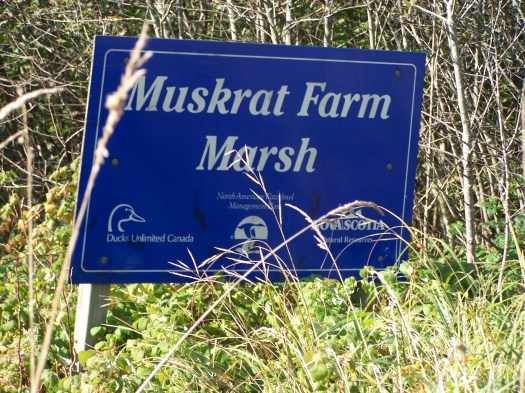
There was a little known attempt here in Kings County to commercially raise muskrats. Muskrat farming was tried in Lower Canard in the late 1930s or early 1940s. The farm failed for various reasons and all that remains of it today are a few memories and a sign marking the ranch site. I discovered the site over 50 years ago. Puzzled by what seemed to be large pieces of sheet metal in a swamp off the Canard River, I asked around and was told I had found the fencing of a muskrat farm.

Information about the ranch has been hard to come by. Local talk has it the ranch failed in short order, leaving says local folklore a few embarrassed Kings County farmers in its wake. I have the names of people supposedly involved in the ranch but have been unable to confirm they were involved or how far along the enterprise got before it shut down.

Besides the folklore – call it folksy country gossip if you wish – and the sign marking the site near Jawbone Corner, the only concrete evidence of the muskrat farm’s existence I have is a letter dated November 23, 1944. I discovered the letter tucked in a book I was thumbing through at a yard sale; the letter was a reply from the Department of Lands and Forests to an inquiry about the legality of pelting muskrats kept in captivity.

From the letter’s content it was obvious a muskrat farm was being contemplated here. The letter was addressed to a Kings County farmer, a man local talk says was involved in the muskrat farm and was a major investor. That same local folklore says the farm failed soon after being established, the muskrats being excellent tunnelers quickly fleeing the ranch site despite the sheet metal fencing.

I’m still digging into the history of the muskrat farm and would like to hear from anyone familiar with it. I can be reached by email at edwingcoleman@gmail.com.

Muskrat Farm Marsh

This sign in Lower Canard marks the site of an early attempt to set up a muskrat farm in Kings County. (E. Coleman)


RANGER, THE ONE DUCK DOG (October 22/12)

“Is this a true story or are you kidding me?” I asked my friend and he just sat there grinning. He liked to string me along and I wondered if this was one of those times. His story about a stray that turned out to be a bird dog with a handicap sounded like blarney to me.

Over coffee at a local donut shop the friend mentioned a boyhood hunting companion whose family took in a stray dog. “It was a big red, handsome male setter that apparently no one wanted. No one came looking for it after they adopted it so it became their dog.”

Anyway, long story short, the stray soon got the opportunity to go duck hunting. “Buddy took it out one afternoon after school,” the friend said. “When I saw him the next day he told me he shot a duck the dog had jumped out of the bulrushes.

“He didn’t say any more about the hunt. One duck only. He said his dog, he’d named him Ranger by this time, worked okay.”

As fall progressed, Ranger became Buddy’s steady hunting companion. Buddy took him out from time to time, usually after school. “But always just him and the dog,” the friend said. “After a while we began to notice something unusual. He never came back with more than one duck.

“This was so darn noticeable Buddy’s friends dubbed Ranger the ‘one duck dog.’ There was a lot of teasing going on about Ranger and Buddy’s shooting. You know how kids can be. ‘Did you get your one duck today?’ ‘How did the old one duck dog do?’ ‘Can’t afford more than one shell, Buddy?’ That sort of thing was ongoing.”

The friend’s tale about Ranger the one duck dog reminded me a mongrel someone gave us when we were kids. Jock was supposed to have rabbit blood in him so we took him into the woods every day after the season opened. It took a while but eventually he started to hunt. Turns out he was a whizzer. Fast afoot, quick to start rabbits, a good nose on really cold days, a high pitched, squeaky voice you could hear even when it was windy.

Then came the day someone fired at a rabbit when Jock was close behind it. A number six pellet struck Jock in the rib cage, barely penetrating the skin and we plucked it out. Another shot went through the muscle of a foreleg.

Jock was never the same after that. We would take him out and he’d start a rabbit. But one rabbit was all you could shoot over him after he was stung with the pellets. Fire one shot and the hunt was over. Jock would slink back to our vehicle and hide under it. Being shot had made him gun shy.

This occurs even with the very best of hunting dogs, by the way, and it’s the saddest thing that can happen to a four-legged hunting companion. I figured it might have been the same with Ranger, the one duck dog. It must have been gun shy; someone probably gave up on him and let him run loose, hoping he would find a home somewhere. As I said, no one came looking Ranger anyway.

When I asked my friend if Buddy ever hunted without Ranger, or if he was ever seen going home without him, he gave me a puzzled look. “How’d you guess that?” he said. “We thought it was odd Buddy was seen heading out with Ranger and Buddy would be alone coming back. We even kidded him about that. ‘Ranger stayed out to get a duck on his own, ey?’ we’d tease.”

Buddy’s family gave Ranger a home until he got old, the friend said. And Buddy kept on hunting him even after he left home and got another bird dog. But until the day he had to be put under, Ranger was never good for any more than one duck a day. The friend said Buddy eventually outlived the one duck nickname but he never admitted Ranger was gun shy.

EDMOND J. COGSWELL – KENTVILLE’S HISTORICAL WRITER (October 15/12)

The Cogswell family of Kings County has always “ranked among the county’s foremost families,” writes Arthur W. H. Eaton.  Eaton’s Kings County history gives one Hezekiah Cogswell as the founder of the family here.  Hezekiah was a Cornwallis grantee; when he arrived here in 1761, writes Eaton, he received a land grant of one and a half shares, the equivalent of about 1000 acres.

I mention Hezekiah since one of his descendants, as well as being a prominent Kentville citizen, was also a historical writer and researcher.  For the most part, Edmond John Cogswell’s historical research and writing has gone unrecognised.  Much of his work was printed in the newspapers of the time, in particular the Kentville based Western Chronicle, but nothing was published in book form except for a genealogy of the Cogswells.*

In addition to numerous newspaper articles on the history of Kings County, Cogswell also wrote a short history of Kentville.  The history was published in 1895 in the Western Chronicle.  Later, some unknown and enterprising soul copied this history from the newspaper and made several copies of it, at the same time including an invaluable index.

Most of Cogswell’s historical writing can be found at the archives in Halifax.  However, a few years ago Kings County Museum curator Bria Stokesbury visited the archives and photocopied many of Cogswell’s articles.  These are on file at the Museum; Thanks to Stokesbury, I have a number of them and these have been my source, along with the Kentville history, when I quoted Cogswell in this column. At least one of his historical essays is reproduced in a 1930s book, W. C. Milner’s The Basin of Minas and its Early Settlers.

In his Kings County history, Eaton includes a sketch of the Cogswell family line, beginning as I said with Hezekiah Cogswell.  But Eaton only follows Hezekiah’s line for a few generations, and I was unable to discover from this work how Edmond J. is descended from him.  However, the Cogswell file at the Kings County Museum was helpful.  According to the file, Edmond’s father was Gideon; Gideon’s father was Mason, a son of Hezekiah.  Mason was around 11 years old when he arrived here in 1761 along with his brothers and sisters.

Edmond John Cogswell was born on May 25, 1838, apparently in Cornwallis, Kings County, since the records indicate his parents resided there.  I’ve been unable to find anything on his early years but two sources indicate he obtained a law degree from the University of Halifax (Dalhousie?) and a similar law degree from Harvard.  Apparently he practiced in Kentville where he was a probate court judge from 1887 until the time of his death.  Edmond died in 1901 (another source says the year of his death was 1900) and is buried in the Billtown Cemetery.

There appears to be confusion about his marital status.  I have a letter from an American relative of Cogswell who writes that a genealogy on the family, compiled in 1998, indicates Edmond was unmarried since no spouse or children are listed.  On Google, however, is a Cogswell blog where Edmond’s name comes up.  Mentioned there is discovery of a death notice for his widow.  Some sources spell Edmond’s name as Edmund but I believe my usage is the correct one.

*Cogswell’s book, titled The Cogswell Family Genealogical Material, 1881-1882, was published in the early 1880s.

PANNING THE HUNTING/TRAPPING BOOKLET (October 8/12)

I’d bet most of the summary of regulations booklets handed out when you purchase a hunting license end up gathering dust somewhere and rarely are looked at by hunters. Well maybe one or two of the report forms are utilised and season dates are checked, but that’s about it I’d say.

However, utilised or not, unread and ignored or not, the booklets are issued season after season without fail. The Department of Natural Resources apparently feels obligated to issue the booklets so hunters and trappers know when they can do their thing. The advertisements and notices may change, but for the most part the content of the booklet remain the same year after year. In other words, it’s dull reading and wasted printing on the government’s part. Except for season dates, bag limits and any occasional regulation changes, which are the necessary things we need to know, the remainder of the booklet is of little use to the majority of hunters and trappers.

One exception may be the page listing sunrise and sunset times. This is an important, useful guide. Take note, however, that the times given are for Halifax, Yarmouth and Sydney. If you hunt in the Annapolis Valley you’re left on your own (by “rough reckoning” maybe) to determine legal shooting times. But then, maybe the government figures no one hunts much between Halifax and Yarmouth.

I mentioned “dull reading.” How about confusing reading? Take a look at the descriptions of the various deer management zones and tell me a lawyer didn’t write them. Or tried to write them. After I read them and in my mind took all those “southerly” and “westerly” turns along this or that river, boundary edge or power line I was lost. Once when I tried to follow the directions I wound up beside an old outhouse on a back road.

But confusing as they are, someone did an admirable job of describing the boundaries of the management zones. I wouldn’t want to try it.

Anyway, as mentioned, the booklet is a summary and a summary only, of the regulations. A note in the booklet advises us to seek out the original Wildlife Act if we require further clarification of the regulations. As if anyone would but backwoods lawyers.

For a while now, by the way, someone has attempted to be politically correct (if that’s the correct term) when posting the bag limit and seasons on pheasants in the booklet. No more do we hunt cock pheasants in the uplands. However, there’s a season and a bag limit on “male pheasants.” Following this line, I assume we’re still not supposed to bag female pheasants.

And what happened to buck deer? Oh, they’re antlered deer now. There must have been something lewdly suggestive about the word “buck” that I missed. Otherwise, why drop it.

At least they haven’t started referring to deer as male and female. But give them time. They may yet.