AN OLD ROAD TO AN OLD ABOITEAU (October 8/12)

According to the signs, Highway 341 ends at what is known locally as Jawbone Corner, which if one must be historically correct is also given as Hamilton’s Corner in Eaton’s Kings County history.

When you drive along Highway 341, heading towards Jawbone Corner, you pass through farm land favoured by the Acadians and Planters.  At the corner (a crossroad actually) the road crosses Highway 358 and continues eastward to Lower Canard, through more land farmed by Acadians and Planters.  Along Highway 341 and into Lower Canard, by the way, you are likely following an old trail first blazed by the Mi’kmaq.

Drive down this historic piece of highway called Canard Street and before you reach the Wellington Dyke Road, you’ll see a left hand turn that a highway sign proclaims is Clark Lane.  Turn into Clark Lane and you’re driving in a northerly direction towards Saxon Street, again crossing farmland once utilised by the Acadians and Planters. After roughly a kilometre, Clark Lane ends as a t-junction connecting with Saxon Street.

But does Clark Lane actually terminate there?  Pause at the stop sign for a moment and look north.  Across the road is the Ron Clarke farm.  In the distance behind the farm it is the Habitant River and along it northern bank you can see some of the houses and stores that make up the village of Canning.  Look straight ahead and you’ll see a farm road that lines up perfectly with Clark Lane, a farm road that runs in a straight line for about a kilometre down to the Habitant River.

That farm road once was what people call a “government road.”  And while it’s exactly what it appears to be today, a well-used truck and tractor road, it was once an old thoroughfare connecting Canning and area with some of the richest farm land in Kings County.  If you follow this old road cum farm track down to the banks of the Habitant you’ll eventually come to the site where an aboiteau once bridged the river.

After it reaches the Habitant, the old road swings west around a huge bend in the river and then turns north towards Canning.  The river is narrow there, making it a logical site to construct a bridge or an aboiteau.  A long time ago, perhaps as early as the Acadian period,  people in this area opted to build an aboiteau rather than a bridge; the aboiteau crossed the Habitant approximately where the Canning branch of the Royal Canadian Legion now stands on the north bank of the river.

You’ll note that I’m speaking in the past tense.  Like the old road that’s no longer a busy thoroughfare, the aboiteau is no longer there and we have to go back to the 1940s to find what happened to it.  In 1943, after countless twice daily tides, the Habitant River aboiteau was swept away. Newspaper accounts from the time note that the aboiteau had been crumbling for several years. Hundreds of tons of rock were used to reinforce the aboiteau but it wasn’t enough; when it finally gave away, nearly 400 acres of dykeland was flooded and the main highway into Canning eroded.  Unleashed by the aboiteau’s collapse, the waters of the Minas Basin surged upstream for several miles, flooding land that hadn’t seen the tides since the Acadian period.

I’ve attempted unsuccessfully to determine the age of the old road that runs through Ron Clarke’s farm; it may date back to the period when the Acadians were farming the area.  Eaton’s Kings County history gives a few vague clues as to when the aboiteau was constructed.  Eaton writes that “about three years ago a new aboiteau was built behind the Baptist meeting house in Canning.”  If by “three years ago” Eaton means three years before he published the county history, then the Canning aboiteau was built circa 1907.  However, Eaton also notes that the Acadians had built aboiteaus and dykes on the river around Canning.  This leaves the possibility that the Canning aboiteau was Acadian in origin.
A MYSTERY BIRD ON THE MARSH (September 17/12)

The geographical setting of Nova Scotia has important effects on its birdlife, Robie Tufts writes in his book, Birds of Nova Scotia. “The province is well situated to receive transient and vagrant birds from other parts of North America,” Tufts says, “offering a last landfall for birds coming from the west and a first landfall for birds migrating or displaced over the sea.”

Tufts calls these displaced birds “storm-driven vagrants” and “stragglers,” summing up what birders and other people interested in wildlife have often observed: That from time to time some really unusual bird species wind up in Nova Scotia thanks to storms and such, birds that often are driven hundreds, even thousands of kilometres from usual haunts.

Such may be the case with a “mystery goose” first observed on a local marsh two years ago. I first heard about the bird when a friend said there was “an unusual looking goose or duck hanging around the river.” I spotted the bird shortly after and from the distance it appeared to be some sort of goose. Later I saw it close up, after it left the river and settled into a pond on a nearby marsh.

Now, finding a stray bird on a local marsh is probably no big deal, except that in this case the goose may an unusual distance from it home grounds. At first it appeared to me the bird was a White-fronted Goose. Another observed declared it was “farm goose,” a bird someone decided they didn’t want and had dropped it off in the marsh.

Meanwhile the goose took up with a flock of Canada Geese and it seemed it could fly, which would eliminate it being a farm bird since most domestic ducks and geese are incapable of flight. The bird spent the summer with the Canadas and along with them, disappeared once the marsh froze over.

I was convinced it was a White-fronted Goose, which would make it a rarity here. Robie Tufts says this goose breeds on the west coast of Greenland, wintering in the British Isles, and is rarely found here.

As mentioned, the unusual goose left the marsh after freeze-up. It turns out the bird wintered alone on the river below the marsh, later joining a pair of nesting Canada Geese in the spring. Bob Devine owns the area on the river where the goose passed the winter. He took photographs of the unusual visitor and believes it could be a Snow Goose, a color phase known as Blue Goose; if it’s a wild bird, that is. Again referring to Tufts, he notes the Snow Goose breeds in Siberia, across arctic Canada and in Greenland.

Whatever it is, White-fronted Goose, Snow Goose or Blue Goose, or possibly a farm bird that can fly short distances, this unusual bird has taken up with a family of Canada Geese. This spring Bob Devine shot several photographs of the bird mingling with a brood of Canadas. If it is a farm bird, it has somehow survived for two winters in the wilds.

SEARCHING FOR THE “DRY HOLLOW ROAD” (September 17/12)

“Kentville for a long time consisted of nothing but the old Horton Corner and was composed of nothing but Main Street, or the old military road, and the street from Cornwallis (Township) running into,” wrote Kentville magistrate Edmond J. Cogswell in 1895.

The quote is from a lengthy article Cogswell wrote on Kentville for the town’s then paper of record, the Western Chronicle.  I’ve quoted Cogswell several times here about roads in and around Kentville.  In other articles stored at the Kings County Museum, Cogswell goes into detail on the origin of Kentville streets that run north and north east immediately after crossing the Cornwallis Street bridge over the Cornwallis River.

The quote above about the “street from Cornwallis” is interesting since it might refer to a road or trail I’ve been researching.  This could be what Cogswell refers to as the Dry Hollow road in an 1892 article.  In the article he wrote that “the old trail coming down the Dry Hollow was not a very good road but there was a creek or stream coming down from the north ….”

Now, on to the author of the History of Kings County, Arthur W. H. Eaton who also mentions the Dry Hollow road.  Before he published his history in 1910, Eaton wrote a series of historical articles for the Western Chronicle.  In one of these articles Eaton notes that a “road came into Kentville through the Dry Hollow, by Charles Jones’ and over the Joe Bell Hill.”

In his Kings County history Eaton again mentions the Dry Hollow road:  “Through the ‘Dry Hollow’ a road ran from Cornwallis (township) into Kentville, a little to the west of the main Cornwallis road.”  This road, which Eaton says began in Centreville and probably is of Acadian origin, runs through Steam Mill and along the edge of Aldershot Camp, eventually entering Kentville after crossing Gallows Hill or Joe Bell Hill.

I’ve been attempting to determine exactly where the so-called Dry Hollow road ran.  Eaton says it’s a “little west of the main Cornwallis road,” which is puzzling.  From Eaton’s description, the “main Cornwallis road” must be Cornwallis Street and what’s a little west of this is a high bank.

Oakdene Vale, the road that runs into what old-timers call Mosquito Hollow is a candidate except for one thing:  Dry it isn’t, nor has it ever been. Harold Quigley tells me when he built the Valley Tire store at the mouth of the hollow the area was all swamp and there was an artesian well on a nearby high bank.  According to several sources a stream once ran through Mosquito Hollow and into the Cornwallis River.  A watering trough for horses and oxen, fed by an underground source, was once located on the site of the Emergency Health Services building next to Valley Tire.

This leaves one other possibility as the old Dry Hollow road and that’s Belcher Street.  As you start up Belcher Street from Cornwallis Street you are traversing a hollow with two old roads, one now eliminated, and the Catholic Church on your right and a high bank on your left.  The only problem is that most sources indicate the Dry Hollow road and the old road from Cornwallis Township came in from the north.  Belcher Street runs sort of north but runs east once it reaches the top of the hill; Oakdene Avenue, which joins Belcher Street part way up the hill, does run north.  This may suggest that the old road is the course followed by Belcher Street and Oakdene Avenue and the east running section of Belcher Street was a much later addition.

It’s all puzzling and I’ll probably never clear it up.  Checking into the Dry Hollow road, by the way, I ran into another puzzle.  Above Mosquito Hollow lies Oakdene Terrace and Oakdene Place, and down below, the street that runs into Mosquito Hollow is called Oakdene Place.  Do all these “Oakdenes” suggest a onetime connection?  You tell me.  There’s a well used trail running parallel to Oakdene Vale and terminating on Oakdene Terrace; and at the far end of Mosquito Hollow you can find remnants of an old trail that wanders in a northerly direction towards Exhibition Street and Oakdene Terrace.

As I said, you tell me.  Too much time has gone by to accurately determine where the old Dry Hollow road is located.

A LOOK AT THE “VALLEY BULLDOG” (September 11/12)

About eight or so years back a friend’s very determined Beagle, which was in estrus, escaped confinement, somehow scaled a fence and visited his German Wirehaired Pointer. A brief romantic interlude followed and nature being that way, some puppies eventually saw light of day.

The pups were Beagle-sized, but in coat and color all looked like their sire. After the friend had the tails of the puppies docked – “just to see what they’d look like,” he said – he had himself what appeared to be miniature Wirehairs.

More as a joke than anything, I dubbed the pups German Wirehaired Beagles. A new dog breed arrived I announced, tongue in cheek, in one of my outdoor columns. A few months later someone asked me where they could buy one of the Wirehaired Beagles, as if it was a real breed.

Now, scroll back to about 20 years ago. An acquaintance who lives down the Valley in Kingston informed me proudly about arrival of a new dog at his house. “What breed?” I asked. “A Valley Bulldog,” he replied. “Never heard of it,” I said. “I don’t think there is such a thing.”

The acquaintance was adamant that there was. “There certainly is,” he said, a bit miffed I doubted his word. “They originated here in the Valley.”

I thought about the friend’s “Valley Bulldog” when people took me serious about the German Wirehaired Beagle being a legitimate breed. Were some people convinced there’s actually a breed called the Valley Bulldog? Or like me with the Beagle/Wirehair pups, was someone breeding Bulldogs, English or whatever, and tongue in cheek, adding the “Valley” appellation to their dogs?

I figured this was the case and I didn’t bother checking it out. But recently I heard about Valley Bulldogs again. A neighbour showed me his dog last summer, a magnificent animal I assumed was an English Bulldog. This spring a mutual friend told me my neighbour was buying another dog like the one he had – “another Valley Bulldog,” he said.

“Valley Bulldog, Valley bullpuckey,” I thought to myself. “It’s a bulldog bred here and someone added “Valley” to the name to distinguish where it comes from.”

Still believing there was no such dog breed but now beginning to wonder, I googled Valley Bulldog and surprise, surprise! Wikipedia has quite a write-up on the Valley Bulldog, giving their origin as here in the Annapolis Valley. Not only that, the breed is recognised by the International Olde English Bulldog Association (IOEBA). On their website, which notes that the IOEBA is the registry for alternate bulldogs and rare breeds, there’s a lengthy write-up on the Valley Bulldog.

Apparently the breed originated here in the Valley, says the IOEBA, and it roots can be traced back to the 1950s and possibly earlier. According to the IOEBA the breed derives from a cross between the English Bulldog and the Boxer. This organisation is based in Missouri. A similar U.S. organisation, the United Canine Association, also recognises the Valley Bulldog as an established breed and like the IOEBA, publishes rigid breed standards on its website.

So, bottom line, does recognition by a couple of canine groups in the U.S. mean the Valley Bulldog is a legitimate breed? Not knowing, I turned to the Canadian Kennel Club, the association that has the final word on dog breeds, and asked a simple question: Does the CKC recognise a dog breed known as the Valley Bulldog?

The answer: “No, the CKC does not recognise a breed of dog known as the Valley Bulldog.”

This doesn’t mean the Valley Bulldog isn’t legitimate, of course. The CKC occasionally recognises and accepts new breeds and this may happen in the future with the Valley Bulldog. Apparently the Valley Bulldog is breeding true after generations of crossings. Looking at the countless photographs published on various websites, there’s a wide variation in Valley Bulldog color phases, which might suggest otherwise; but that’s typical of many dog breeds.

Anyway, in future I have to be careful about even hinting that the Valley Bulldog is, well, a mongrel breed. Really careful. The Valley Bulldog is described as gentle in temperament, but I wouldn’t want to rouse up some of their proud owners.

SALUTING EDITH QUINN – HISTORICAL WRITER (September 4/12)

When Edith Quinn passed away on June 22 in Guelph, Ontario, her obituary noted that her “heart belonged to Nova Scotia.”  Indeed, it did. Quinn lived most of her long life here – she was in her 101st year at the time of her death – and was a Greenwich native.

Surprisingly, Quinn’s obituary failed to mention her great accomplishment.  Quinn researched and compiled one of the most scholarly, in depth histories ever written about communities and villages in Kings County.  Her book is unrivalled for interest and as a historical source on early times in Kings County and the area in and around Greenwich.  In my opinion, only Arthur W. H. Eaton’s history of Kings County surpasses her book for historical content.

That book is Greenwich Times, the history of Greenwich, a community with important links to the Planter settlement of Kings County.  Quinn begins her book with a brief look at the period just before arrival of Planters in Kings County, taking us on a historical adventure through the 18th and 19th century, closing her work midway through the 20th century.

Quinn deserved high praise for the research she conducted in writing the history of Greenwich.  Some of what she includes in her book may be familiar to us through Eaton’s work.  However, Eaton attempted to cover the entire county and it was beyond him perhaps, and beyond the scope of his book to enter into detail about the countless communities comprising Kings County.

Quinn, on the other hand, concentrated solely on Greenwich and the immediate surrounding area.  As a result, we are given an intimate history of a community, something Eaton had to forgo doing due to the scope of his county history.

Until her obituary appeared in the Kings County Advertiser on July 3, Edith Quinn was to me a woman of mystery.  From reading her book I knew she was a Greenwich native.  But by the time I got involved in writing historical columns and inquiring about her, she was living with her immediate family on Ontario.  Many people around Greenwich and Wolfville knew her, of course, since she spent most of her life here until her late years.  I belatedly discovered she had been invited to our wedding in Greenwich over 50 years ago and my wife still treasures her shower gift.

About a decade ago, when she was 92, Edythe Quinn decided to write about her early life in Kings County.  In her “Memories of Edith Forsythe Quinn” she tells us she was born in Greenwich and her family later moved to Greenwich Ridge where she grew up.  In a later column I’ll pass along her account of growing up in an early 20th century farm community where there was no plumbing, no electricity and transportation was by horse and buggy or shank’s mare.

Briefly, after Quinn left school she took a secretarial course at Mack Business College in Kentville and worked at various jobs, including six years at Minas Basin Pulp & Power.  While working there Quinn obtained her pilot’s license at Waterville, an accomplishment she mentions as if it was trivial, even though she had to make a forced landing on her solo flight.  At age 37 she was accepted at the Victoria General Hospital to train as a nurse, graduating in February, 1952. Later, while vacationing in British Columbia, she met James Quinn and they were married in 1953.

Quinn’s daughter, Penny Irish, writes that her mother returned to Greenwich in 1959 with her husband and daughter and took over her father’s farm.  Quinn notes in the introduction to her book that it was the work of Mrs. Burpee L. Bishop who inspired her to write the Greenwich history.  Some of the research Bishop had done on Greenwich and the scrapbooks she kept formed the basis of Quinn’s book.   Additional research – Quinn spent countless hours at the Provincial Archives, digging through old deeds and newspaper files and talking with people – eventually led to publication of Greenwich Times.

HUNTERS AND HUNTING – A FEW THOUGHTS (August 20/12)

A few days ago, when I was sweltering in a heat wave, Cabela’s 2012 waterfowl catalogue was delivered by the postman, followed a few days later by Cabela Canada’s general hunting catalogue.

Then while I was still sweltering in the heat wave, a friend dropped by to update me on the progress of his Labrador Retriever puppy. He’d just had the pup out on the marsh, putting up this year’s crop of pheasants, and he was excited about how well it was coming along.

And down on a local marsh, where I’ve been walking early every morning, the mallard broods I’ve been watching since they were ducklings have matured.

Then a noticed arrived through the mail, advising me that Waterfowl Heritage Day is September 15 this year and the farmland restriction has been removed for the special September 4 to September 18 goose season.

I’d guess from all these hints and signs we can start thinking seriously about the waterfowl season. It may seem a bit early, but why not start counting down the days now. I know I am.

Anyway, most of us senior hunters like to get ready for waterfowling earlier than the rest of you anyway. Some of us are long in the tooth and gray under the camou cap so it takes a bit more to get us started motoring than it used to. All those years wandering the marshlands were bound to catch up to us eventually and slow down the getting ready process.

This reminds me that as senior hunters slow down and think about taking it easy – read retire – there are fewer young hunters coming along to take their place. That’s what they’re telling me anyway. They say the stats prove hunter numbers are declining and from experience I’d have to agree.

Take woodcock hunting as one example. Hardly anyone around here hunts woodcock anymore, but at one time it was a much sought after, prized game bird. Hunters here kept bird dogs that specialised in woodcock (and grouse) hunting. I’m thinking of dogs like the English Setter, a breed I haven’t seen in the game bird coverts for decades. Most of the younger hunters I meet have Labrador Retrievers, if they have a dog at all, and wouldn’t waste time hunting them on anything smaller than a mallard or goose.

The same goes for snipe hunting. This precious little game bird, with its erratic flight pattern, was much sought after by previous generations of hunters. Today few if any shotgunners seek out the snipe and woodcock coverts, a sign not so much of changing hunting preferences but of an aging hunting population and fewer hunters.

TRACING OLD ROADS AROUND KENTVILLE (August 20/13)

In the book Nova Scotia’s Lost Highways, Joan Dawson writes that while many old roads have been absorbed into modern highways, one can still find sections of them; these are the loops and curves bypassed as highways were straightened.

Many of those loops and curves, those old roads used by our earliest settlers, can be found throughout Kings County.  As Dawson notes, many of them exist today as little used side roads, some of them now no more than farm lanes and walking trails.

In an earlier column I covered the work Richard Skinner has done in tracing the remains of early county roads, in particular the old Post Road/Acadian trail that runs through Kentville as Main Street and Park Street and continues westward through Coldbrook and down the Valley.  As mentioned, Skinner found that some pieces of this old road wander away from No. 1 Highway but often are never far from it.

If we search northward from Kentville we can find existing strips of roads that were frequently used by the Acadians, the Planters and in a few cases by the Mi’kmaq   For example, immediately after you head north and cross the bridge on Cornwallis Street in Kentville you are travelling one of the oldest roads in Kings County, a road that originally must have been a Mi’kmaq trail.

In an article he wrote in 1892 (most likely for Kentville’s Western Chronicle) E. J. Cogswell describes the road, noting that it began once you crossed the ford where the bridge now is.  “Starting from the crossing point, whether bridge or ford,” Cogswell writes, “the great trail ran east and ran up over the point of hill and through the Catholic burying ground.”

According to Cogswell, this road eventually was “shoved north” into the hollow where “the road now is.” From this we knows that today, when you leave Kentville and drive up Belcher Street to Port Williams, you are travelling pieces of one of the original roads in Kings County.  Some of this old road may have run closer to the Cornwallis River than it now does.  Cogswell said one branch of this road ran “down along the sides of the hills near the dyke” and in his time long pieces of it could still be seen.

Cogswell also mentions that this road branched off and ran north and then turned east to Chipman Corner.  Actually he wrote that the road “turned east and ran down to the old Chipman corner and a branch of this trail continued down what is now called Church Street.  Now you know when  you drive along these roads – Belcher Street, Church Street, Middle Dyke Road, you are traversing sections of  roads that are centuries old.

Another example of pieces of old roads that still exist can be found about a kilometre or so north of Kentville.  Off Highway 341 the loop known as Upper Church Street is a piece of old road eliminated as a main thoroughfare when it was straightened in the 1930s.  Why this old road took the course it did is puzzling.  Perhaps the Acadians, if it was the Acadians who first used this track, were avoiding a stretch of swampy ground Highway 341 cuts through.

Continue along 341 through Upper Dyke and Upper Canard (passing the mouth of  Newcombe Branch Road which likely was the original road) and you’ll find a short piece of old road in the hollow just below what was the Canard Poultry plant.  Some of this short section of road is still used by farmers as an access to the dykes.  This short piece, its collapsed bridge and all, is still considered to be part of the highway system.  A fact I found out about a few years ago when the Wellington Dyke Body tried unsuccessfully to have the Department of Highways repair the bridge.

SOME POSSIBLE HUNTING CHANGES (August 13/12)

At the Federation of Anglers and Hunters annual convention, which usually is held towards spring, the various affiliated wildlife associations and clubs present resolutions re changes they’d like to see in fishing and hunting regulations.

To give a few examples, the Queens County fish and Game Association presented a resolution at the last convention asking that the bag limit on black bear, for hunting and snaring, be increased by one bear in the 2012 season. The Kings County Wildlife Association, citing evolving agricultural conditions, presented a resolution asking that the pheasant season in Valley counties is changed so it is the same as the remainder of the province. The Valley season runs November 1 to December 15, while in the rest of the province the season opens October 1.

Some of the resolutions presented at the annual meeting are interesting since they reflect changing wildlife conditions and suggest a general change in the attitude anglers and hunters have towards their sport and the environment. The resolutions are voted on by the general membership and are either passed or voted down. But even when resolutions are passed, this doesn’t mean we will see any of the changes requested by the proposals. Generally speaking, the resolutions are changes the clubs and associations would like to see implemented; whether they will come about is another question.

That being said, here are a few other resolutions brought up at the general meeting. One that I see as sensible was presented by the South Shore Wildlife Association regarding the flimsy and awkward paper hunting license we are issued every year. The resolution asked that the paper license be replaced with a plastic card the size of a credit card with stickers being used for big game, small game and so on.

The Big Game Society presented a resolution that hopefully might slow down an ongoing decline in hunter numbers. The Society suggested the province look at offering free licenses to qualified hunters in the 12 to 17 age group.

The Cape Breton Wildlife Association presented a resolution I’m sure most waterfowlers will agree with. This resolution requested a two week delay in the waterfowl season and the two weeks added to the end of the season. If it was ever implemented, this would eliminate that period of the season when the weather is generally summer-like and not all that great for waterfowl hunting.

I should point out again that the resolutions mentioned here are just that, resolutions only. Think of them as a wish list, things wildlife groups in general would like to see changed. Consideration may be given them by the government but that could be as far as they will go. Once in a while some of the changes requested by wildlife groups actually are implemented, but don’t keep your fingers crossed.

For example, the resolution asking that the waterfowl season be delayed to start two weeks later and end two weeks later has been brought up before without success. The resolution by the Kings County Wildlife Association on the pheasant season won’t go anywhere either since such a change will generally be opposed by anyone working in agriculture.

SOLDIERING BEHIND THE LINES IN WWII (August 6/12)

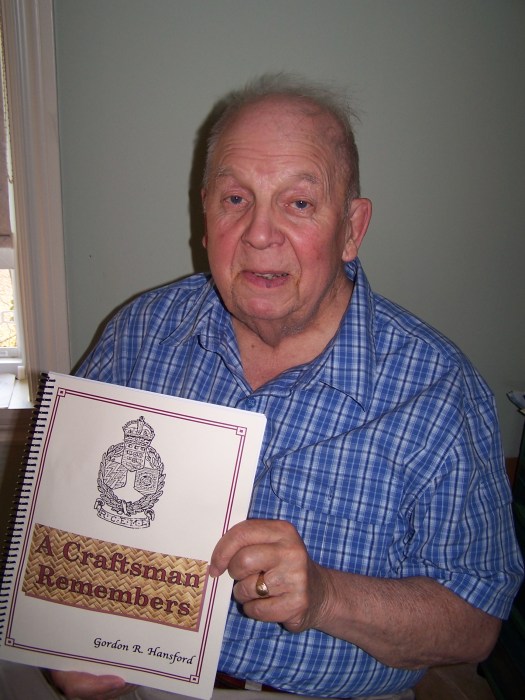
In the forward to his book, A Craftsman Remembers, Gordon Hansford writes that for every front line soldier engaged in combat during WWII, ten served behind the lines in various capacities, the so called “administrative tail of the army.”

Called Craftsmen by the army, these were the soldiers who served as mechanics, electricians and engineers, and when situations called for it, as diggers of latrines and graves. These were the men and women who rarely reached the front line but were never far from it; the soldiers, to paraphrase Winston Churchill’s famous dictum, who also served the war effort by serving behind the lines.

Hansford’s book, which was recently published, is the story of one of those soldiers who served as a Craftsman during the war.  “I choose not to write about the horrors of war,” he said in effect, “but about behind the line soldiers and the many jobs we did that kept the war machine running.”

Hansford does this admirably, creating a wonderful record of what it was like for the ordinary soldier serving behind the lines.  While he writes in the first person about his war years, his story portrays the unknown Canadians soldiers who served, survived and continued on afterwards uncelebrated and for the most part, rarely recognized for their contributions.

Gordon Hansford served overseas during the war for more than three years, taking part in campaigns in Africa, Sicily and Holland.  For those who know Hansford, he’s a genial man with a finely tuned sense of humour and more stories than Google has hits.    He displays this sense of humour and a bit of irony as well, throughout the book.  His being mistaken for a doctor while hospitalized and treating a malingerer is hilarious and is one example of the sort of humour found in his book.

Hansford’s story starts in Wolfville where he became interested in the military at an early age, recalling that at age seven he marched around the streets of Wolfville wearing his father’s World War 1 gear.  In 1941, in his mid-teens, Hansford enlisted in the local unit of the West Nova Scotia Regiment at Aldershot Camp as a bandsman.   That year he decided to join what he called “the real army” and by the spring of 1942 he found himself at the Canadian Army Trade Schools in Halifax.  After additional training with the Royal Canadian Ordnance Corp in Ontario, Hansford was shipped to England, arriving there early in 1943.

This is where Hansford’s war story really starts.  He takes his readers through the major campaigns the Canadian Army participated in, always with a story or two, leaving us with an intimate look at how the war affected everyone involved.  Most of my generation had someone close to us who participated in the war.  Those participants, our fathers, brothers, uncles, cousins and next door neighbours, often refused to talk about their war experiences.  Hansford’s book starkly reveals what he and all those other Canadians caught up in the war went through; he breaks the silence and this makes the work an invaluable record.  The book aptly could have been subtitled, The Canadian Soldier, His War behind the Lines, since this is what it’s all about.

Privately published by Hansford and his wife, Helen, copies of the book are available at the Kings County Museum where they’re being sold as a fundraiser.


Gordon Hansford with his book on WWII

Gordon Hansford, above, with his book on soldiering behind the lines in WWII. (E. Coleman)

ANGLING – EARLY THIS, EARLY THAT (July 23/12)

“Can you believe how quickly fall is coming is?” a friend said, pointing out nearby hardwood trees with a smattering of yellow and orange leaves. Some of the leaves were already down and were littering the marshside track we were walking.

Not only are hardwood leaves tinged with fall colors – usually it’s late August in normal years before this happens – various other plants and trees are way ahead of last year. You’re probably aware that out in farm country, many crops are maturing earlier than average.

The lack of rain until recently may explain the early coloring of the hardwoods, but otherwise nature appears to have changed her schedule somewhat and it’s been a year of early everything. On my favourite brook trout stream, for example, the water on opening day had the appearance and the feel of May. By mid-April, on another local stream, water conditions were much like they usually are in late June.

Again, like the early tingeing of hardwood trees, the advanced condition of these streams might be due to low rainfall. Last fishing season there was too much rain; this season, right from the start, there’s been too little. By mid-June, a friend who pursues sea-run brown trout in the lower Cornwallis was bemoaning the lack of rain and how it reduced angling opportunities. He says he missed the best of the run because everything was so much earlier than usual. This appears to be typical everywhere.

If you fish in salt water for striped bass, or in tidal streams for stripers and trout, low rainfall generally doesn’t affect your angling. Low water on some streams actually is an advantage – in some ways. Low stream levels reveal the trout lies, for example, and you can zero in on areas offering the most potential. This is an advantage if you like to cruise streams with your fly rod, looking for a “hole” where trout could be lurking.

On striped bass, I’ve mentioned before that you should be aware of a possible license for salt water angling. That sometimes reliable grapevine has it that the fisheries people are considering a $20 license.

I heard some hogwash that the license is needed so fisheries can “get a handle” on salt water angling, meaning I suppose so they can count how many people fish for striped bass and flounder; more hogwash is that they require additional money to manage this sport.

I have it from someone in the know – and it’s a reliable source – that if a salt water license becomes a fact, only a tiny portion of the fee would end up in the hands of fisheries. Most of the license fee, $20 or whatever would be eaten up by producing, issuing and monitoring the licensing system and handling the funds collected from salt water anglers.

What’s wrong, by the way, with using the general fishing license to determine how many anglers fish for stripers and flounder. Rather than hit anglers with a totally useless salt water fee, why not make a few changes in the general license?

Or would that be too simple? Isn’t it possible for government departments, whether provincial or federal, to co-operate with one another? Too much to expect, maybe?

Anyway, contact your MLA and tell him or her you’re for or against a salt water angling license. I hope you’re against it. That’s what I plan too tell my MLA.