MANY PEOPLE REMEMBER OLD PEPSI PLANT (March 5/12)

After receiving a couple of e-mail messages, several telephone calls and comments from people I met on the street, I realised Kentville’s old Pepsi-Cola, Morse bottling plant is far from forgotten.  I wrote about the Pepsi plant and Morris beverages in my last column.  While the plant ceased operations over 50 years ago, people still remember it.  Surprisingly, there are families still living here who had close connections with a building that started as a church, became a bottling plant and became a church again.

First, I’d like to mention Sam Milne of Kentville.   He called to tell me his brother Cal was a plant employee for a time.  Sam told me Cal drove the truck that delivered Pepsi (and I assume the Morris brand soda pop) to stores in this area, working under the proprietor, W. E. Morris.  Cal had a humorous adventure or two working under Morris which indicted the latter had a firm hand on the operation.

In a note he sent me, Louis Comeau indicated that when the Pepsi plant was closed in 1949 it remained vacant until 1952, except for a short time when it was occupied by Maritime Roofers Ltd.  From 1953 until 1958 the building was again used as a church, the Church of the Nazarene.  Louis said the building was later moved to Spring Garden Road.

One of the readers who called about the column mentioned the late Bev Conrad’s connection with the Pepsi plant.  This led to a conversation with his widow, Marion Conrad.  She confirmed that she and her husband lived in an apartment that had been added to the building when it was moved to Spring Garden Road.  The building was moved by Irving Oil in 1959 (to make room for a service station) and the Conrads lived in it for 27 years.

Joan Kennedy of Sheffield Mills writes (via e-mail) that she remembers the Pepsi building very well.  “My grandfather, John William Turner was the Methodist minister in that church when he died in 1906,” Kennedy said.  “When he died, he left a wife, three daughters and one son, my father Reginald Turner, who worked so many years at the Kentville Advertiser.”

From information Louis Comeau and readers of this column kindly provided, here’s a brief outline on the old church cum Pepsi Cola and Morris bottling plant:  Used as a Methodist Church until 1923 (the Methodists stopped using the building as a church when they united with the Presbyterians.  Opened as a bottling plant circa 1923, first for Morris soft drinks and later Pepsi Cola.  The plant ceased bottling activities and closed in 1949.  Building vacant from 1949 to 1952 when it was briefly used by a roofing firm.  From 1953 until 1958 the building was used as a church (see above). Irving Oil purchased the building and the lot, moving the old plant to make room for a service station.  The building still stands today on Spring Garden Road and says Marion Conrad, “you can still see the old church steeple.”
A NIGHT OUT WITH RECYCLED RABBIT (March 5/12)

“What’s recycled rabbit?” a friend asked. “I don’t know whether to try it or not.”

“Taste it,” I said. “I guarantee you’ll like it.”

We were at the local wildlife Association’s annual wild game night, an event the group holds every February. The friend had just sampled some smoked rainbow trout and was eyeing a platter of meat labelled “recycled rabbit.” The meat on the platter looked like pieces of cut up pheasant or maybe chicken and I was tempted to tell the friend it was one or the other, just to get him to sample it.

Resisting temptation, I decided to tell the friend what the meat really was. “It’s bobcat,” I said. “Get it? Recycled rabbit.”

The friend made a face but he took a piece of the bobcat off the platter, popped it into his mouth, chewed on it and smiled. “Hey, it is good,” he said. “First time I ever ate a cat.”

The first time I ate recycled rabbit I was reluctant to try it as well, after I asked what it was. The thought of eating cat meat kind of turned me off. However, while the taste of bobcat meat is difficult to describe – partridge and pheasant it ain’t – it really isn’t all that bad. Most people make a face when they hear that recycled rabbit is bobcat meat but the frowns usually turn to smiles after they sample it.

Recycled rabbit was the only strange and unusual fare at the Association’s wild game night this February. Association members generally bring a mixed bag of wild game dishes to the event; smoked salmon, venison hors d’oeuvres, moose meat mince pies and pheasant breast are a few of the dishes I recall sampling at previous wild game nights and this event was no exception.

Besides the recycled rabbit, I had the pleasure of sampling smoked pheasant, smoked salmon with cream cheese and smoked rainbow trout – all dishes fit for a king, if I have to use a cliché. I went back a couple of times to a platter that held brook trout pate and I almost didn’t get a taste of the venison meatballs it went that fast.

Once word got around that recycled rabbit was bobcat meat, it wasn’t devoured as quickly as the other wild game dishes. However, one of my friends, whose name is unmentionable, enjoyed the dish immensely and dipped into the platter holding the cat meat several times. “I never knew cat would taste that good,” he said. Smacking his lips, and with a far away look in his eyes, he said “I wonder if common old housecat would taste as great.”

“Don’t go there,” I said.

KENTVILLE’S PEPSI BOTTLING PLANT (February 21/12)

One of the most popular soft drink beverages in Canada, Pepsi Cola, was once bottled in Kentville, from which point the drink was distributed throughout most of the Valley.

The old bottling plant rarely is remembered today; forgotten as well is the fact that the plant also produced a soft drink that may have been unique to this area.   As well as bottling Pepsi Cola, the Morris Bros. Bottling Co. produced a soft drink under its own label.  The Morris beverages bottle was once a familiar sight in county stores and canteens; and if you’re a senior, you probably recall that it came in several flavours.

Recently Roberts Meister called to ask if I knew anything about Kentville’s old Pepsi bottling plant.  Meister worked at the plant when he was a young man.  His job was to pour “special syrup into the Pepsi bottles.”  He recalls that he was required to put two ounces of syrup into every “10 or 12 ounces bottle of Pepsi.”

Meister placed the plant along west Main Street, on the south side, but he was unsure about its exact location.  However, he remembers names of people associated with the bottling plant.  The plant was owned by the Morris family, “Charlie, and Bill or Clarence,” he said, and one of the drivers was Cal Milne, who as readers may recall, ran a garage in New Minas.

Based on one of my brothers working at the Pepsi plant, I figured it had to be operational at least in the late 1930s and the early 1940s.  I remember as well sampling many a bottle of Morris pop.  However, after digging into my files and checking a few local history books, I came up with absolutely nothing on the Pepsi plant and Morris Bros. beverages.  I was surprised when checking Mabel Nichols Kentville history, The Devil’s Half Acre, that there was no mention of the Pepsi plant or Morris Bros. soft drinks in this book.

As a general rule, when anyone is stumped about some past Kentville event or if anyone needs to know something about an old Kentville business, it’s best to seek out historian and author Louis Comeau.  Comeau’s book, Historic Kentville, is the tip of the iceberg when it comes to what he knows about the town’s history.  As always, Louis came through when I inquired about the Pepsi plant and Morris Bros.  Here’s what he came up with:

The plant (which Louis believes may have opened circa 1923 but he isn’t certain) was located at the corner of Main Street and Masters Avenue.  The plant was housed in what was the former Methodist church building – which the Methodists stopped using, Louis says, when they united with the Presbyterians in 1923.

At the plant they bottled Morris beverages, which came in assorted flavours, the contents indicated on the bottle caps.  Later the plant bottled Pepsi Cola products, which they continued to do until it was closed in 1949.  A few years later the building was again used as a church.  The building was later moved to Masters Park.

Louis also gave me the names of some plant personnel, which he found in the 1948 edition of Mosher’s Directory.  Proprietor:  W. E. Morse; sales manager David Belcher; sales staff, Arnold Tupper, Garnet Sawler; bottler, Francis Lynch; employee, Laurie Keddy.

Readers who may have additional information about the bottling plant are invited to share it with me.  Contact me at edwingcoleman@gmail.com.

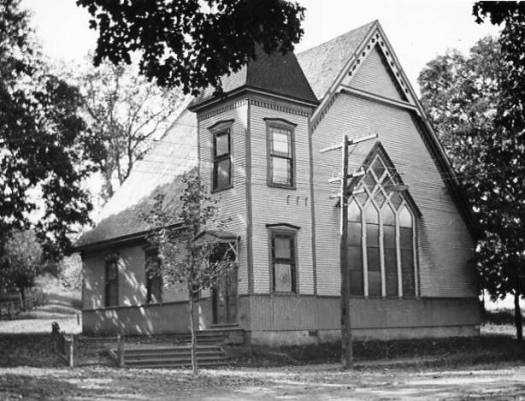
former Methodist church turned Pepsi bottling plant

This former Methodist church was converted to a plant to bottle Pepsi Cola and Morris beverages.

Pepsi Cola and Morris beverage bottles

Pepsi Cola and Morris beverages (above) were once bottled in Kentville. Note the Kentville location stamped on the Morris bottle. (Louis Comeau collection)

FISHING AND HUNTING IN 1774 (February 13/12)

“Shad is the best poor man’s fish of any, for they are fat of themselves, that they need nothing to make them ready for eating.”

Two British farmers touring Nova Scotia in 1774 wrote the above about shad after seeing how plentiful they were in Annapolis Valley tidal rivers. Besides shad, they said, “these rivers abound… with plenty of fish of different kinds.”

After completing that long ago tour the farmers took pen to paper, describing the province and its people in detail, writing a document that eventually was deposited in our public archives. Most interesting of all, for those of us who wonder what hunting was like here over 200 years ago, there’s a description of wildlife and its harvesting. There was little or no sports hunting here in those times and game was taken mainly to supplement the food supply.

But even then, the lengthy excursions into the winter woods to hunt moose must have taken on a holiday atmosphere. Take the description of those winter hunts, for example: “Great numbers of the inhabitants employ much of their time in hunting in the woods, where they will frequently continue for a week, taking a quantity of provisions with them. And at any time when their store is exhausted, they can readily make a fire and dress part of the game they have taken; for which purpose they constantly carry a steel and tinder box, with matches, &c. in their pockets. At night they make large fires, near which they wrap themselves up in blankets and lay down to sleep with as much composure as if they were in their own houses.”

At that time game was abundant, the Britishers report: “They have abundance of game in the woods. The mouse-deer (moose) is also in great plenty…. They also have rein-deer which they call carraboes and numbers of bears, both of which they reckon good eating.”

Bears and wildcats are mentioned, the former “very ravenous and frequently kill sheep, calves and swine wherever they fall in their way. Wildcats, or “lucovie” they call them, are also a “fierce animal (that) frequently does much damage amongst sheep.”

On small game, the report mentions “wild fowl and game in great plenty, such as geese and ducks, of which they have two sorts, and teal.” I find this amusing. Many waterfowl hunters today distinguish between bagging ducks and bagging teal, as if the latter wasn’t a duck. The report indicates the British practiced the same distinction and we’re still doing it over 250 years later!

The report mentioned the various wild birds that were observed, among them “eagles, gleads, hawks, buzzards, ravens and water-crows.” Now, what are gleads and water-crows? Were buzzards resident here in 1774 when today they’re classed as accidental visitors? Readers who have answers to these questions can reach me at via e-mail at edwingcoleman@gmail.com. You can read the entire report by Googling Robinson, Rispin. Thanks to Roger Meister, New Ross, I have a copy of the report, which was printed and released in 1944 by the Public Archives of Nova Scotia.

FISHING AND HUNTING IN 1774 (February 13/12)

“Shad is the best poor man’s fish of any, for they are fat of themselves, that they need nothing to make them ready for eating.”

Two British farmers touring Nova Scotia in 1774 wrote the above about shad after seeing how plentiful they were in Annapolis Valley tidal rivers.  Besides shad, they said, “these rivers abound …. with plenty of fish of different kinds.”

After completing that long ago tour the farmers took pen to paper, describing the province and its people in detail, writing a document that eventually was deposited in our public archives.  Most interesting of all, for those of us who wonder what hunting was like here over 200 years ago, there’s a description of wildlife and its harvesting.  There was little or no sports hunting here in those times and game was taken mainly to supplement the food supply.

But even then, the lengthy excursions into the winter woods to hunt moose must have taken on a holiday atmosphere.  Take the description of those winter hunts, for example: “Great numbers of the inhabitants employ much of their time in hunting in the woods, where they will frequently continue for a week, taking a quantity of provisions with them.  And at any time when their store is exhausted, they can readily make a fire and dress part of the game they have taken; for which purpose they constantly carry a steel and tinder box, with matches, &c. in their pockets.  At night they make large fires, near which they wrap themselves up in blankets and lay down to sleep with as much composure as if they were in their own houses.”

At that time game was abundant, the Britishers report:  “They have abundance of game in the woods.  The mouse-deer (moose) is also in great plenty….  They also have rein-deer which they call carraboes and numbers of bears, both of which they reckon good eating.”

Bears and wildcats are mentioned, the former “very ravenous and frequently kill sheep, calves and swine wherever they fall in their way.  Wildcats, or “lucovie” they call them, are also a “fierce animal (that) frequently does much damage amongst sheep.”

On small game, the report mentions “wild fowl and game in great plenty, such as geese and ducks, of which they have two sorts, and teal.”  I find this amusing.  Many waterfowl hunters today distinguish between bagging ducks and bagging teal, as if the latter wasn’t a duck.  The report indicates the British practiced the same distinction and we’re still doing it over 250 years later!

The report mentioned the various wild birds that were observed, among them “eagles, gleads, hawks, buzzards, ravens and water-crows.”  Now, what are gleads and water-crows?  Were buzzards resident here in 1774 when today they’re classed as accidental visitors?   Readers who have answers to these questions can reach me at via e-mail at edwingcoleman@gmail.com.  You can read the entire report by googling Robinson, Rispin.  Thanks to Roger Meister, New Ross, I have a copy of the report, which was printed and released in 1944 by the Public Archives of Nova Scotia.

1774 TOUR OF PROVINCE OLD NEWS TO SOME (February 6/12)

It was printed almost 70 years ago on inexpensive stock and with its cover frayed and its flimsy pages yellowed by the years, the 1944 report of the Public Archives looked at first glance to be one of those boring government papers.

However, a comment by the gentleman who kindly dropped it off at my house quickly changed that “boring” booklet into an exciting document.  “You might be interested in this account by two English farmers who toured the province in 1774,” Roger Meister said in effect.

That’s exactly what it was.  In 1774 two British farmers, apparently looking to buy farms, toured much of the province, describing in detail what they saw – the land, the people, the early Planter way of life here in the Annapolis Valley.  “Journey through Nova Scotia containing a particular account of the country and its inhabitants,” is the title John Robinson and Thomas Rispin used on the introductory page of their account.

While I’ve read a lot of Nova Scotia history, I must admit the Robinson, Rispin account was new to me.   When I mentioned the account to Kings County Museum curator Bria Stokesbury, however, I soon found out that it was old news for professional historians.  “Google Robinson, Rispin,” Stokesbury said, which I did and I found numerous references to their account on the web.

If you’re interested in what early Planter life was like here in Kings County, you can check out the various entries about the account that are on the web.  Or you can continue reading this column.  Not everyone has access to a computer; and for many of us the Robinson, Rispin account isn’t old news.  For those people without computers here are some of the more interesting highlights of the account.

On Kings County, the general Horton township area:  “Along the side of this river is an extensive marsh called the Gramperre (but by the French the Plain of Minas) all diked in which contains two thousand six hundred acres; here are also other marshes undiked with great quantities of upland …. which seems of a reddish colour and is chiefly sown with rye, Indian corn, pumpkins, potatoes and other roots.”

Robinson and Rispin ventured on into Cornwallis Township, again noting the “large marshes, which are diked in.”  In this township, the English gentlemen write, “they keep good stocks both of beasts and sheep, but not many horses.”  One Mr. Burbridge of Cornwallis “has built a malt kiln, with an intention to set up a common brewhouse so that they expect to have good ale in Nova Scotia.”

On the people of Horton and Cornwallis townships those British chaps have a few unkind words along with high praise.  “They are as bad managers in this town as any we came amongst,” they comment on people of Horton Township.   Yet they later describe the New England settlers of Horton and Cornwallis generously:  “The New Englanders are a stout, tall, well-made people, extremely fluent of speech, and are remarkably courteous to strangers.  Indeed, the inhabitants, in general, poor as well as rich, possess much complacence and good manners.”

On dress we find from the British gentlemen that the men of that time period “wear their hair queu’d and their clothing, except on Sundays, is generally home-made, with checked shirts; and in winter they wear linsey-woolsey shirts, also breeches, stockings and shoes.”

During summer, on every day of the week except Sunday, the men go barefoot.  Except on Sunday, “the women in general wear woolseys both for petticoats and aprons; and instead of stays, they wear a loose jacket ….  The women in summer, in imitation of the men, usually go without stockings or shoes, and many without caps.  They take much pains with their hair, which they tie in their necks and fix it to the crowns of their heads.”

Then there’s a final contrary dig at the general character of the New England settlers:  “Nothing can be said in favour of the inhabitants, as to their management in farming.  They neither discover judgment or industry.  Such of the New Englanders, into whose manners and characters we particularly inspected, appeared to us to be a lazy, indolent people.”

Not a kind assessment.  Robinson and Rispin apparently can’t make up their minds about the character of the Planter people.

HUNTERS, READERS AGREE – SMALL GAME SCARCE (February 1/12)

“In all the years I’ve been hunting, more than forty, I’ve never seen rabbits scarce as they are now.”

An avid hunter who uses a hound told me this recently. He was commenting on rabbit hunting but he could easily have been referring to small game in general. In many coverts ruffed grouse have vanished. In many of the top coverts in the Annapolis Valley, pheasant numbers are the lowest they’ve been in over a decade.

This is what hunters tell me. And this is what I’ve found from being out in the field with my bird dog more than four times a week through October, November and December. Oddly, and I say oddly because it rarely happens, half way through the season waterfowl, especially ducks, suddenly became scarce as well in local haunts.

A couple of letters from readers after I asked for feedback on the small game situation reflects what hunters have been telling me.

Gordon Morse of Greenwich writes that when he was a hunting guide 40 years ago it was easy to bag deer, rabbit, partridge and pheasants. In those days, he says, rabbits were a dime a dozen, there were lots of partridge and pheasants were plentiful.

“I don’t hunt anymore, but game seems to be really scarce” Morse writes. “I can’t remember when I last saw a rabbit track, let alone a wild rabbit. I used t go to the Tatamagouche area and two of us could shoot 20 rabbits in an afternoon. Not anymore. We never used a hound either.”

Along the same line is a letter (via e-mail) from Jan Speelman of Aylesford who believes coyotes are responsible for the scarcity of game.

“For an answer on the pheasant disappearance, I have five acres of grassy swamp where pheasants sleep at night; you hear them going in and coming out. Lately they aren’t there anymore.

“I used to feed 20 to 30 pheasants on the manure pile each winter but they aren’t there anymore either. They are slowly being killed by coyotes who roam the swamp all night. It won’t be long before they kill all the rabbits too.

“Now the pheasants you see less and less. There is no place for pheasants to be safe; that’s why they are wilder and hide in the hedges. Also, there are more skunks that eat (pheasant) eggs in the spring. Wild creatures have taken over!”

My thanks to Mr. Morse and Mr. Speelman for their letters. Readers who have comments can reach me via e-mail at edwingcoleman@gmail.com.

COLLECTING COMMUNITY HISTORIES DIFFICULT (January 23/12)

I collect locally written, locally published history books, in particular those written about Kings County communities.  With a bit of luck and patience I’ve managed to collect most of the local histories that have been published.

A few have eluded me, however.  I’ve had problems finding one in particular.  I know this book is out there and it went into a second edition, but all copies seem to have vanished.

Well, not exactly “vanished,” and not exactly all copies.  Somewhere, probably in attics, on dusty bookshelves, in boxes of discarded books stored in closets and sheds, are numerous copies of this book.  I can even tell you where several copies of the history can be found; but as they say, they “ain’t for sale.”

Recently I was able to add this history to my collection, but only after more than a decade of searching for it.  Grist from the Mills, the Sheffield Mills history, is the book I’m speaking of.  Thanks to an Internet search, and after checking every book dealer website in Canada and the U.S. I found a copy close to home, at a shop on Barrington Street in Halifax.  At this point I remind readers who collect books, new and old, to check the website of ABE Books.  This is the best website on the Internet when it comes to finding out-of-print books in any genre you’re interested in.

But back to Grist From The Mills.  The committee that produced this book, the Sheffield Mills Women’s Institute, did excellent work.  For details and historical interest, this book rates as one the best in community histories. Along with the Port Williams history, The Port Remembers and Greenwich Times, the Greenwich history, this book stands out for research and writing.   The book captures the origin and essence of old time Sheffield Mills.  In the book, for example, is the story of the early mills in the community; this was researched and written by a local historian, the late Ernest Eaton.

It took almost as long to add a few other out-of-print community history books to my collection as it did Grist From The Mills.  A few were difficult to find as well.   If you have a copy of Edythe Quinn‘s history of Greenwich, which I mentioned above, you should treasure it.  While the book has no great monetary value (I purchased a copy for $10) copies are impossible to find and have to be considered as rare.

While there undoubtedly are plenty of copies around somewhere, The Port Remembers is another local history that’s elusive.  The same goes for Anne Hutten’s excellent history of the apple industry, Valley Gold.  This is another book that’s hard to find.  I have two copies in my collection, one purchased for $2 at a yard sale, another for $10 from a book dealer who probably didn’t realise how rare this book is.

Most of the community histories I’ve collected have no great monetary value.  Their real value lies in the records they’ve preserved, for posterity, as they say.  But for the efforts of individual writers and the efforts of community clubs and organizations in writing and compiling these history books, many of these records may have been lost.

THE LEGACY OF DR. LIN COMEAU (January 16/12)

In 1955 Dr. Lin Comeau and his wife Edna purchased the A. A. Thompson house on Wickwire Hill in east end Kentville.

After purchasing the house, writes Kentville historian Louis Comeau, his parents got into serious collecting.  “It had all started with stamps as my mother had been collecting them before she met my father.  After they married in 1941 he too acquired her collecting interests.”

Edna and Lin Comeau decided to fill their Wickwire Hill property with appropriate furnishings to suit the age of their house which was circa 1900, says Louis.  The result was a large collection of antiques, historical documents and photographs. Many of these documents and photographs concerned various Kentville businesses, but more about this later.

Louis Comeau says his father and mother’s collecting “really got out of hand.”  Soon, he says, the “entire house (a two and a half storey Queen Ann revival) and its two adjacent two storey carriage houses became filled with antiques.

“It became quite an eclectic collection indeed; everything from hat-pin holders to a horse drawn surrey (a carriage with a fringe on top) to a complete circa 1920s general store.”

Born in Comeauville, Digby County, in 1904, Dr. Lin Comeau attended College Sainte-Anne, graduating in the late 1920s.  Comeau served at Camp Aldershot as a Sergeant in the Canadian Dental Corp during the 2nd World War.  After the war he entered Universitie de Montreal, graduating in 1948 with a degree in dentistry.  In 1949 Comeau opened a practice on Aberdeen Street in Kentville and it was here that he began collecting in earnest.

Eventually Dr. Comeau amassed a huge amount of Kentville …..  “Included in the collection,” Louis says, “was thousands of old papers and photographs from Kentville.”  The collection provided the base for the book Louis compiled on the town of Kentville – Historic Kentville, published by Nimbus in 2003.

To Dr. Lin Comeau must go credit for amassing a collection that has preserved much of Kentville’s past.  This is his legacy, a work that has been carried on by his son.  Credit must also go to Louis for expanding the Kentville collection. He notes that his father and mother inspired him to “carry on their ideals.”  After his father died in 1975, Louis concentrated on “collecting anything of interest and importance from the town.”  Since 1975 he has specialised in collecting Kentville artefacts; currently he is cataloguing the entire collection.  His book, along with Mabel Nichols work, The Devil’s Half Acre, is the only published history of Kentville.

HISTORY OFA PHEASANT HUNTING RESOLUTION (January 9/12)

At meetings of the local wildlife association and in this column, I’ve mentioned various times I’d like to see one pheasant season for the entire province. As it stands now, the pheasant season opens October 1 outside the Annapolis Valley and on November 1 in the Valley.

The later Valley season originally was set to keep hunters out of farm fields and orchards during the prime harvesting period. There’s no argument here that this was a good idea. A few hunters were giving everyone a bad name by ignoring the right of landowners to control who hunts on their land and when they can hunt.

Let’s fast forward. Eventually hunting regulations were changed to require permission to hunt on cultivated land. This should have been good enough to keep hunters out of orchards and farm fields during the harvesting period. With this change I figured a shorter Valley season shouldn’t have been necessary.

More than a few members of the Kings County Wildlife Association apparently agreed with me. About a year ago the vice-president of the Association introduced a resolution that in effect, requested a pheasant hunting season from October 1 to December 15 throughout the province. This resolution was passed by the membership and was taken to the annual general meeting of the Federation of Anglers and Hunters last March. The resolution was approved there and then was placed with the appropriate government department for consideration.

It is highly unlikely the government will agree to have a province-wide pheasant season opening on October 1. However, while the government was considering the resolution – it still is at this time – the Kings County Wildlife Association had second thoughts. Apparently worried about their image as a conservation group, some of the senior members of the Association decided that passing the resolution wasn’t a good idea. Opening the pheasant season on October 1, ran the reasoning, would cause too many hunter/farmer conflicts at harvesting time, despite regulations requiring permission to hunt on cultivated land.

Even though I’d like to see the same season province-wide for pheasant hunting, I agree with this. Maintaining good farmer/hunter relations is important. We’ve reached a reasonable balance in the Valley and to use a cliché, upsetting the applecart now wouldn’t be a good idea.

Meanwhile, the pheasant resolution sits somewhere on a government desk and the Association ponders what action, if any, it can take to make sure it dies there. I believe it will die there anyway and there’s no need to panic. There’s no sensible reason for opening the pheasant season an additional month in the Valley counties, even though some hunters would like to see it happen. From a conservation point of view, given the current status of the pheasant population, it might make better sense to look at a shorter season in the Valley and elsewhere in the province.

That decision, of course, is up to the Department of Natural Resources wildlife biologists.