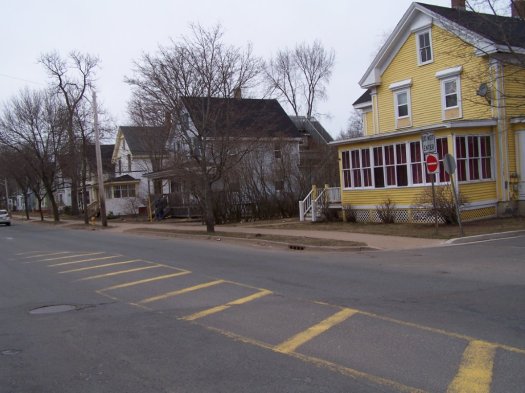
KENTVILLE IN THE PRE-INCORPORATION PERIOD (June 7/11)

In 1932 a member of a pioneer Kentville family decided he would write a series of newspaper articles about the town. Leslie Eugene Dennison’s articles were published in The Advertiser over a period of about a year.

While mainly reminiscent in tone (Dennison said it was “Reminiscences of an ‘Upstreeter’ of the Beautiful Town Embowered in Blossoms) the articles describe Kentville in the late 1870s, the period leading up to incorporation. It was an interesting place at the time. In the downtown core, where banks and business blocks now stand, there were tethering posts and blacksmith shops; it was common for Kentville citizens to keep cows in pastures that are now parking lots.

“Kentville 60 years ago,” writes Dennison, “was a small country village. Its inhabitants were chiefly the descendants of the first settlers, with a few families of railroad officials and workers from the Old Country. Ox teams were common in the streets.”

Describing what eventually would become the town’s business core, Dennison said three blacksmith shops stood on lots now occupied by prominent buildings. “Thomas Cox had a shop on Church Street, near St. James Church. Otho Eaton had one on the south side of Webster Street, opposite the post office, and I do not remember the name of the blacksmith shop on Canaan Road.”

Blacksmith shops were necessary in Kentville’s pre-incorporation days. The automobile was yet to arrive and the horse and ox were the chief means of transportation and labor. Kentville’s blacksmith shops were “great gathering places for men from the nearby farms,” writes Dennison, since here besides shoeing horses and oxen, all sorts of iron work was carried on.

We learn from Dennison musings that Lee Neary was Kentville’s “first uniformed police chief,” that before Gallows Hill earned its grisly name it was called Beech Hill and Wickwire Hill at the town’s eastern edge was once Bishop Hill.

Kentville in pre-incorporation days obviously was much more than the country village Dennison that calls it. Dennison mentions the town had two newspapers, five hotels, five churches, several mills and 26 businesses offering a variety of goods and services. It appears that Kentville, on the verge of incorporation, was a thriving commercial center and at the time was the leading hamlet in the Annapolis Valley.
KENTVILLE IN 1906 – THE TEMPERANCE ACT RAID (May 9/11)

“It can hardly be said that drunkenness has ever been a conspicuous Kings County vice,” Arthur W. H. Eaton wrote in his history of Kings County. “Yet, in the midst of all these efforts at goodness,” Eaton continued, “rum strove hard and often succeeded in holding the reins of power.”

Eaton may have had Kentville in mind when he wrote this observation on black rum. After all, the town was said at one time to be known as the Devil’s Half Acre, due it’s believed to the number of taverns and other liquor outlets located in a wide open town.

If he was referring to Kentville, Eaton may have been right about rum holding the reins of power. A few years before Eaton published his history, Kentville was rocked by an uprising of its “honest, upright citizens” (The Advertiser) who attempted by force to rid the town of demon rum. The Canada Temperance Act (Scott Act) was in force at the time and its so-called local option measure meant in effect that towns and communities could decide for themselves to declare the Act valid in their area. Thus it was possible to have, say, Kentville open to the sale of liquor, Canning closed, Berwick open and so on.

In 1906, Kentville apparently had voted dry and opted to have the Temperance Act enforced in its environs. But this apparently wasn’t entirely clear to some proprietors of hotels and taverns in the town who continued to sell liquor. One of the hotels, the Porter House, was notorious as a place where “spirituous drinks were purveyed freely” (The Advertiser). The proprietor of Porter House, one “Mr. Townsend” as The Advertiser calls him, flaunted the law and openly sold liquor. This aroused the ire of the town’s citizens who decided force was required to rid the town of its rum dens.

At the time the Sons of Temperance had 23 active chapters in Kings County and these had combined to form the Temperance Alliance. Acting through Kentville’s Mayor, W. F. Roscoe, the Alliance obtained a warrant to search the Porter House and seize all liquor found on the premises.

It appears that The Advertiser played a leading role in the raid on the Porter House. On Monday, September 6, a large body of men, along with the county constable, the liquor inspector, several Acadia University professors and various religious leaders met at The Advertiser office. Announcing their intentions, the group proceeded to the Porter House where after being briefly obstructed by Townsend, they seized all the liquor found on the premises.

One account written about the raid on the Porter House (Mabel Nichols in the Kentville history, The Devil’s Half Acre) notes so much liquor was confiscated it filled a boxcar. Townsend was briefly jailed after the raid.

Why a boxcar to hold the confiscated liquor? While the legality of the raid was being determined by the courts, the liquor was shipped to Canning. There it was eventually destroyed, every bottle and keg broken and the liquor dumped into the Habitant River.

Newspaper accounts of the foray into Porter House called it the Townsend Raid.

EATON TALKS ABOUT COUNTY HISTORY IN 1888 (April 25/11)

“There ought to be a general ransacking of the garrets of this County – of Horton, Cornwallis and Aylesford (townships) – for objects of interests …. old books, manuscripts, letters, seals, household furniture, farming implements, bits of wood from old houses, all should be gathered in.”

On an August evening in 1888, Rev. Arthur Wentworth Hamilton Eaton made this appeal at a meeting in Kentville. Many of the prominent citizens of Kings County had gathered together at the time to organize a Kings County historical society and Eaton was the guest speaker.

This was over two decades before Eaton published his greatest work, the history of Kings County. He apparently had already started collecting historical papers, possibly with a county history in mind, and the intent of his talk that August evening in 1888 may have been to stimulate interest in compiling one.

Eaton said, for example, that “of county histories (in Nova Scotia) we have as yet few and none I believe of the highest value. Of this, certainly one of the most interesting counties in the province (Kings), we have no printed history.”

Eaton then referred to a partial work on Kings County that had already been compiled by one Jonathan Hamilton, which “possess much value” but by the author’s admission “needs careful revision.” The original compilation by Hamilton probably sits in a museum or university vault somewhere in New England but Eaton must have incorporated this early research in his county history.

Eaton then refers to his efforts to collect county history: “My own work this summer in gathering facts and through the courtesy of the editors of our local newspapers, presenting them to the public, and so preserving them for future reference, has been the outcome of a profoundly felt interest in the county where I was born and reared.”

Readers must admit this is an interesting insight. Due to a “profoundly felt interest” Eaton was diligently working on compiling a history of Kings County and urging others to take an interest in such a work. As we can see, Eaton worked on this compilation for over two decades before the history was published. But when he spoke before that gathering in Kentville in 1888 he had collected “only a few of the facts that are available for the future histories of the county.”

Actually, when he spoke in Kentville in 1888 about organizing a historical society and preserving county records, Eaton had already been working on genealogical records for at least a decade. “During the past 10 years I have given a great deal of time,” he said, “to genealogical records.” Much of what he had compiled up to that time undoubtedly found its way into his county history.

I’ve taken this report on Eaton’s talk from a newspaper account, The Western Chronicle. The heading on the account read: “Address at the Organization of the Kings County Historical Society in Kentville.” This implies that a historical society was formed. If it was, and I assume it was, I’ve never seen mention of it anywhere in Kings County records. Perhaps it was a short lived organization.

KENTVILLE’S FIRST MAYOR WAS A SCOT (April 18/11)

As the county’s shire town and headquarters of the Dominion Atlantic Railway, Kentville was expanding rapidly. By 1885 the citizens of Kentville decided the town had “attained sufficient importance” and was large enough to ask for incorporation.

On 7 December, 1886, Arthur W. H. Eaton writes in his county history, “articles of incorporation were granted” the town. The following month, on January 21st, the first annual meeting of Kentville’s ratepayers was held, followed in February by the election of town officers.

John Warren King was elected as the first Mayor of Kentville and he would remain in this office until 1888. From King down to the current Mayor David Corkum 30 Kentville citizens would serve as Mayors of the town, several with multiple terms. The longest serving Mayor to date is R. W. Phinney who beginning in 1974 would remain in office for 15 years.

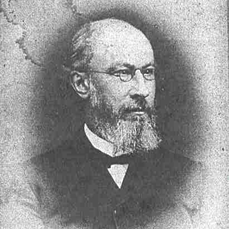
While John Warren King only served for two years (some records show it was three years) he may have been the most interesting of the early Mayors. The photograph of King, which is on display at the Kings County Museum, shows a man of austere visage. Indeed, King was a Scot – he was born in Scotland in 1836 – and a lawyer, the nationality and the occupation lending an inherently serious mien to all men of this nature.

Kings occupation may explain his presence in Kentville. He appears to have been a railway lawyer, residing in Kentville because the DAR was headquartered there. His obituary, published in The Advertiser on his death in 1922, notes that he was a “pioneer in railway work, being legal adviser to P. Innes, general manager of the Windsor and Annapolis Railway, now the Dominion Atlantic Railway.”

In 1889, King succeeded Innes as general manager of the DAR, an undoubtedly demanding position that likely explains his short term as Mayor. The Advertiser obituary portrayed King as a man of “deep intellectuality, of sterling integrity, who by his ability and worth had won the confidence of the entire community and had been placed in the highest positions of honor, Mayor of the Town of Kentville and general manager of the Dominion Atlantic Railway.”

King was saluted in The Advertiser as one of the outstanding citizens of Kentville. “He early identified himself with the interests of the community,” says The Advertiser, “so it was no wonder when Kentville became an incorporated town, his outstanding ability and marked personality made his election as first Mayor by acclamation a natural sequence.”

John Warren King died in Kentville at 85, shortly before his 86th birthday. On display at the Kings County Museum is a desk of ash and birch handcrafted in the “Victorian style” by King. “The Mayor’s Desk,” as it is called, is believed to have been used by King when he served as Mayor.

Kentville’s first Mayor, John W. King

Kentville’s first Mayor, John W. King

Kentville's current Mayor, David Corkum

Kentville’s current Mayor, David Corkum (Kentville town website)

REDDEN ROW – KENTVILLE’S OLDER HOMES (April 12/11)

(Third in a series celebrating Kentville’s 125th year of incorporation. (Column 1, Column 2)

When William Redden died on 4 December, 1894, The Advertiser saluted him as one of Kentville’s prominent citizens. The newspaper named Redden and another longtime resident who passed away at the same time as “landmarks of a former generation (who) have passed away from the view of Kentville citizens.”

What had William Redden achieved to earn this distinction? We have to look to Arthur W. H. Eaton’s Kings County history for the answer to this question. Redden was a builder, trader, real estate developer, farmer and mill operator. As Eaton points out, Redden was “in a marked degree identified for many years with the material growth and prosperity of the town.” Apparently a large part of residential Kentville (up until Eaton published his history in 1910) owed its existence to Redden’s single-handed enterprise. “To his foresight, courage and industry, The Advertiser said, “the large number of buildings he erected are an enduring monument.”

Many of those “enduring monuments” stand today. “He bought much land and built many houses to sell and rent,” writes Eaton. Exactly how many houses and other buildings Redden built in Kentville might be difficult to determine today but some of his handiwork can be identified. As Eaton writes in his county history, “a large number of the houses in that part of Kentville known as ‘the flat’ are the result of his enterprise.”

These houses, eight in all, stand along east Main Street between the ends of Crescent Avenue. All were built immediately before and just after 1886, the year Kentville was incorporated. Once this area was farmland; but Kentville’s rapid growth created a demand for housing and William Redden obliged by building affordable single family homes along the stretch of Main Street some deeds refer to as Redden Row or Redden Road.

As we can see today, Redden constructed his houses close to the street on narrow lots, using a building style that was standard at the time. However, while they may have been average houses for the period, they were once the residences of some of Kentville’s elite business and working class people.

A census taken in the early 1890s reveals that residents of seven of the eight homes along Redden Row ranged from office workers to traditional craftsmen. Included were the general manager of the Windsor and Annapolis Railway, accountants, a cooper, stone mason, a hotel clerk and a customs officer. It is believed that Kentville’s first mayor, John W. King, lived on the Row as well, at 227 Main Street. King served as mayor from 1887 to 1889.

William Redden built these houses on east Main Street around the time Kentville was incorporated

William Redden built these houses on east Main Street around the time Kentville was incorporated. This area is known as “the flat” today. Various old deeds refer to the street as Redden Row and Redden Road. (E. Coleman)

A BRIEF HISTORY OF KENTVILLE NEWSPAPERS (March 22/11)

The town of Kentville can boast that the county’s leading newspapers have been published there since the late 19th century. Here’s a look at he town’s newspaper history, the second in a series of columns marking the town’s 125th anniversary (Column 1, Column 3).

While the honor of pioneering the county’s first newspaper belongs to Canning (The Kings County Gazette was first published there in 1864) Kentville had its own newspaper shortly after. In 1868 a weekly newspaper called the Star moved from Berwick to Kentville, where it was published for five years. This was the beginning of Kentville’s dominance as the publishing site for Kings County’s newspaper, a dominance lasting until recent times.

In 1873 The Star moved its office back to Berwick in 1873, leaving Kentville without its own newspaper. This situation was quickly rectified. Realizing the importance of having a newspaper in the town, a group of young Kentville businessmen formed a publishing company in the spring of 1873, creating a newspaper called The Western Chronicle.

My source for this preamble on Kentville’s newspapers is an article in The Advertiser’s 1979 centennial issue. The Advertiser’s source was a story on journalism in Kings County, by John E. Woodworth, published in 1904 in a Halifax County newspaper called The Suburban. All following quotes are taken from this article, which readers can find in its entirety in Ivan Smiths website, Nova Scotia History Index.

No record exists (that I can find) of who the “young Kentville businessmen” were but they quickly installed Joseph H. Cogswell, “a practical printer,” as manager and editor of The Western Chronicle, which first was a semiweekly and then a weekly. Under Cogswell, (who within five years was sole owner of the paper) and later under G. W. Woodworth, whom Cogswell sold out to in 1879, The Western Chronicle became one of the leading newspapers in the province.

Kentville’s little newspaper, usually never more than eight pages each issue, was recognized around the province for its journalistic content. “Mr. Woodworth’s management of the Western chronicle was fraught with energy,” reads the centennial issue article, meaning I assume running the paper was too much for one person. Thus the “services of Mr. Elihu Woodworth were secured, and under his control the editorial management of the paper was second to none in the province. Notwithstanding the fact that the brother of the proprietor – the late D. B. Woodworth, Esq. – was prominent in political circles at the time, the paper, being the only one in the county, was courteous and fairly independent in the treatment of public question.”

Woodworth began publishing a second newspaper in Kentville, The Farmer’s Manual, but this was short-lived. Around 1885 another newspaper, The New Star, moved to Kentville from Wolfville and an often heated competition began with The Western Chronicle. Both newspapers remained active in the county for some time. I’ve read in some accounts that The Western Chronicle eventually became The Advertiser (now The Kings County Advertiser) but the article in The Suburban claims otherwise.

The Suburban notes that The New Star was sold to Frank H. Eaton in 1892. Eaton changed the name of The New Star to The Advertiser. Eaton ran the paper until 1897; in 1897 he turned the paper over to his brother, R. W. Eaton, who in turn sold The Advertiser to H. G. Harris. When The Suburban published the history of Kings County newspapers in 1904, Harris was still editor and proprietor of The Advertiser. The Baker family eventually took over The Advertiser and it became the sole newspaper serving Kentville and surrounding district.

SKETCHES OF TWO FENIAN RAID VOLUNTEERS (March 15/11)

In a [January] column I listed 15 Kings County natives who served in the local militia during the Fenian scare in the 1860s. The list came from a Nova Scotian born collector of military artifacts and history who now lives in British Columbia.

In the column I asked readers to contact me if anyone in the list of militia volunteers was an ancestor, hoping they could tell me what became of them. Some of the volunteers were awarded medals and given grants of land for their service. In some cases, the grants were for land in other provinces which could mean they may be long forgotten by relatives who still lived here.

However, this isn’t the case with two Fenian volunteers. I’m pleased to report that I have thumbnail sketches of two Kings County natives who served in the militia during the Fenian period and the have family here. I have Randy Rockwell of Waterville to thank for these sketches. Rockwell is writing a history of Waterville. During his research he came across the names of Nathan Best and Foster Parrish of Waterville and he provided the following information on them.

“Nathan Best was the son of Richard Tritten Best who was one of the first families to settle in the Waterville area in the 1820’s. Nathan is listed as a carpenter living on Brooklyn Street in Grafton in the Hutchinson’s directory of 1864-65. He purchased land in Waterville in 1870 and built the house that Carl and Barb Best have lived in for the past 50 years. Nathan was a well known carpenter and sold and installed metal ceilings, like the one in Carl and Barb’s home. Nathan died on January 4th, 1918.

“Nathan Best had a son named Harris R. Best who was for many years one of Kentville’s leading building contractors and chief of the fire department. He built hundreds of homes, businesses, a number of DAR stations and public buildings. Harris was also a member of the Hiawatha Lodge IOOF for 52 years, a mason and a member of the Kentville Baptist Church Choir.

“Foster Parrish’s name can be found on the old Church map of Kings County in South Waterville. Foster’s great grandson and great great grandson still live and farm this parcel of land. When I contacted his great grandson Harold Parrish, he knew nothing about his ancestors’ experience in the militia or a medal.”

MORE EARLY MEMORIES OF CANNING (March 8/11)

People sometimes think of stores such as Walmart and Zellers as relatively new in the retail world. However, many of our seniors can tell you stories of their parents and grandparents shopping in stores much like the Wal-Mart’s and Zellers of today. These old time stores sold everything – clothing, groceries, footwear, drugs, hardware, household supplies horse and buggy days equipment and so on

I was reminded of this when I received another letter from 87-year-old Jean Calkin of Black Rock. Ms. Calkin wrote last December about her early days in Canning (December 21 Kings County Advertiser). In the second letter Calkin expands on her earlier description of H. R. Ells General Stores, which as readers will see from what follows could have been an earlier version of Walmart combined with Sobeys.

“Huge stalks of bananas hung from the ceiling and on the counter were rolls of wrapping paper and a large cone of twine. Peanut butter, dates, salt pork and outer meats were weighed out in bulk. Molasses was in a large wooden keg and run off in customer’s gallon jugs. Kerosene and vinegar were dispensed in the same way.

“There were oil lamps and chimneys of various sizes, together with wicks and burners. One hundred pound bags of flour were in the back of the store. On the shelves were packages of loose black tea. There were fresh eggs, butter, and hard yeast cakes in boxes, tiny red cinnamon ‘berries.’ Available also were pilot biscuits and cheese in large round blocks.

“There were washboards, wash tubs and wash boilers, shaving mugs. Shaving brushes, straight razors and razor strops, gaiters, armbands, ladies’ stockings, buttons, snaps, hooks and eyes, horse blanket pins and safety pins, hair nets, bobby pin and large bone hair pins. There were pen nibs, ink in bottles, fountain pins and dip pens.

“In the home remedy department the stock included Sweep Spirits of Nitre, Dodd’s Kidney Pills, Lydia Pinkham pills, Epsom Salts, Sloan’s and Minard’s liniments, castor oil and Castoria for children, Pinex cough syrup, mustard ointment and Peps cough drops.”

This is a condensed version of Calkin’s letter but readers can see that in the early days it was possible to make one stop and shop for anything needed for the household. Of interest also was Calkin’s mention of the some of money in use – “fifty-cent coins and tiny dollar bills about 5 inches by three inches.”

Calkin also refers to the “brick block in canning, a section of paved sidewalk on the west end of town where the bank and Xerxes store were located. “I also remember,” she writes, “whistle of the ‘Blueberry Special’ as it chugged its way on the tracks from Kingsport to Kentville at 8:00 a.m., Kentville to Kingsport at 12 p.m., Kingsport to Kentville at 1:00 p.m. and returning to Kingsport at 4 p.m.”

AMAZING GRACE – THE COMPOSER’S AMAZING STORY (February 15/11)

At the recent “funeral for farmlands” march in downtown Kentville my grandson and I rendered one of the best loved, best known hymns of all times on our bagpipes. This beloved hymn was Amazing Grace, which according to Adam Hochschild in Bury the Chains may also be one of the most recorded hymns of all times. Hochschild wrote in his book on abolishing the slave trade that Amazing Grace has been recorded nearly 1,200 times and counting.

The melody of Amazing Grace has also become a popular bagpipe tune; I get requests for it all the time, at celebrations of all kinds, at rallies, private parties, at marches, wedding and funerals. To the best of my knowledge, and I stand to be corrected, Amazing Grace was first introduced and popularized as a pipe tune several decades ago by the renowned band of the Scots Guards. However, the hymn is well over 200 years old. John Newton, a British clergyman, composed it in 1772.

There is an amazing tale behind this wonderful hymn and it has to do with its composer, John Newton. Born in London in 1725, Newton went to sea when he was 11 with his sea captain father. At age 17 he was seized by a naval press and spent two years at sea on a British ship. Several years later we find him on a slave trader’s ship. An unruly troublemaker, Newton’s captain got rid of him when the opportunity came to trade him for a sailor from the slave ship.

Eventually Newton became the captain of a slave ship and spent roughly a decade buying and selling human beings. Before he became the master of a slave ship, however, Newton suffered through a near disaster at sea and became convinced that he was saved through the mercy of God. He became deeply religious as a result but still became involved in the slave trade.

In 1774, 10 years after leaving the sea, Newton was ordained as an Anglican clergyman. As curate of a market town near London, Newton’s sermons earned him the reputation as a leading preacher. In the meanwhile, Newton began writing hymns in earnest; one of the most renowned hymn writers in the English language, he composed some 280, many of which are still sung today.

What make Newton’s story amazing is that as a former slave trader turned deeply religious, he lived on the proceeds of his slave trading days until he died and saw nothing wrong with it. Now for a bit more irony. Newton eventually became involved in the successful crusade to abolish slave trading in the British Empire. Long silent on the slave trade as a famous clergyman, he became a devout abolitionist in his sixties. A pamphlet he published (Thoughts Upon the African Slave Trade) was a confession of sorts but it became one of the key tools in abolishing slavery.

KENTVILLE’S 125th – THE TOWN’S LAST BLACKSMITH (February 11/11)

In one of my first history columns for this paper in the 1980s I wrote about early days in Kentville, the period when hitching posts stood in front of every store and blacksmith shops were located downtown. At one time it was common in Kentville to operate blacksmith shops in the main business area alongside clothing, grocery and drug stores.

Blacksmiths were a necessity in early Kentville, of course, and in its heyday the town boasted of having as many as three or four. Hutchinson’s provincial directory listed at least three blacksmith operating in town in 1864, for example. For the record, these blacksmiths were John Cochran, James Dennison, and Otho Eaton. Another business listing in this directory showed a blacksmith shop operating under the name Eaton & Dennison, but this might have been a duplication.

The 1864 Ambrose Church map of Kings County indicated that as well as the above smiths, one Joseph Gould operated a blacksmith shop in Kentville. Gould may not have been in Kentville the same period as Cochran, Dennison and Eaton. While the Church map is dated 1864, it was published much later and the period when Gould was in business may have been in the 1870s.

Around 1879, however, Kentville saw another blacksmith shop open near the retail section. According to Mabel Nichols in her Kentville history, T. W. Cox and John B. Rogers opened a blacksmith shop at the foot of Joe Bell (Gallows) Hill in 1879. This was the only mention of blacksmiths I could find in the Devil’s Half Acre but the name of T. W. Cox came up in research I did recently.

One may think it unusual blacksmith shops once were common on Kentville’s streets; you may also think such downtown shops are a thing of the past. However, not that long ago a blacksmith shop operated in town no more than a whisker away from the main business core. This takes us back to the T. W. Cox mentioned above. This likely is the Thomas Cox whose handmade axes are highly collectable today.

Around 1903 or 1904, T. W. Cox took on five apprentice blacksmiths at his Kentville shop. (At that time blacksmiths usually were required to apprentice for several years before being accepted as masters of the trade). One of the apprentices was John Fitch. Mr. Fitch apprenticed successfully and worked as a blacksmith with Cox until 1915; in that year he purchased the Cox shop and was on his own.

John Fitch operated his blacksmith shop in Kentville for at least 50 years and has the distinction of being the last blacksmith operating in the town. Fitch closed the shop in 1965 or thereabouts. One of his sons, Arthur, believes this is the correct year but he isn’t 100 percent positive. Fitch died in 1977 when he was 86 years old.

Fitch’s blacksmith shop was located on the south bank of the Cornwallis River, not far from where he apprenticed with Cox. The shop occupied the site of the current Kentville library, approximately where the parking lot is today. The shop was located under the basement of the Fitch home with the entrance facing northeast. Arthur Fitch told me the shop originally was at street level and the family lived over it, moving down when the shop went into the basement.

I remember the shop well, by the way. As a boy I visited it often. As I recall, I was always welcome. Fitch always had time to tell me about his ironwork and the tricks of the trade that came in handy when shoeing balky and sometimes vicious horses. Arthur told me he was a hard worker, going at it from 7 a.m. to 7 p.m. six days a week. He chewed tobacco all his life and he always swallowed the juice; which, he used to say, along with staying away from doctors and hospitals contributed to his long life.